
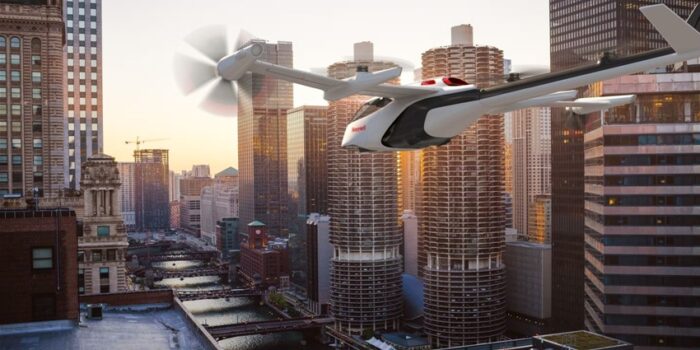
Bypassing congested roads, Urban Air Mobility can significantly reduce traffic jams, saving time and money for commuters and businesses.
By Partha Pratim Ray
The ‘Urban Air Mobility’ (UAM) envisions a network of ‘Electric Vertical Take-off and Landing’ (eVTOL) aircraft, buzzing like metallic bees across the urban sky bypassing the urban chaos like the rhythmic honking of horns, the endless crawl of brake lights and the suffocating air altogether by soaring above the gridlock in sleek, silent flying taxis.
These compact, multi-rotor vehicles which can take off and land vertically, eliminating the need for runways and offering point-to-point transportation on demand is the audacious vision of ‘UAM’, a revolution with unlimited possibilities poised to transform our cities in India.
Redefining Accessibility
‘UAM’ can redefine accessibility by bypassing congested roads thus saving everyone’s time and money as the ‘eVTOLs’ can land on rooftops, in parks, or even in remote villages, connecting far-flung communities. Electric propulsion makes ‘UAM’ a sustainable alternative, reducing air and noise pollution, and contributing to cleaner, healthier cities and boosting India’s economic growth.
In India’s vast and diverse landscape, timely medical access can be a life-or-death gamble. ‘UAM’ holds immense promise to revolutionize medical transport, particularly for emergency response and critical care. This could dramatically improve survival rates for heart attack victims, stroke patients, and those suffering from time-sensitive medical conditions. ‘UAM’ can also provide crucial logistical support, transporting organs for transplants and medical supplies to underserved regions.
‘UAM’ also has the potential to transform India’s tourism landscape. Tourists could access remote landmarks, explore hidden gems from the sky, and enjoy personalized, point-to-point travel within cities thus promoting sustainable tourism practices.
Challenges
‘eVTOL’ technology is still evolving and critical challenges like battery range, safety regulations, and noise control demand research and development. In addition to this, building a network of ‘Vertiports’ i.e. the landing and take-off infrastructure requires significant investments and planning, integrating seamlessly with existing transportation systems. Further to this, concerns about noise, safety, and privacy need to be addressed through public engagement.
A Regulatory Framework for ‘UAM’
Recognizing ‘UAM’s transformative potential, the Ministry of Civil Aviation (MoCA), G.O.I. established the UAM Expert Committee comprising eminent experts from diverse fields, including aviation, technology, urban planning, law, and safety in August 2023.
The ‘UAM’ Expert Committee’s mandate was to develop a regulatory framework that includes drafting regulations for ‘eVTOL’ operations, ‘vertiport’ infrastructure, air traffic management, and safety standards.The Committee has already released a draft policy framework in October 2023, outlining the regulatory framework, licensing procedures, and safety standards for ‘UAM’ operations in India. This framework is open for public feedback and is expected to be finalized soon. The committee is actively engaging with the state governments to identify potential pilot projects and test beds for ‘UAM’ technology.
International UAM Projects and Lessons Learned
Globally,‘EHang’, a company in China completed over 10,000 test flights and partnered with cities like Guangzhou and Shenzhen to establish pilot programs for UAM taxi services. Another example can be of ‘Volocopter’ which made significant progress with its ‘VoloCity’‘ eVTOL’ aircraft by conducting public test flights in Dubai and Singapore with a target of launching commercially in 2024. Similarly, Joby Aviation’s eVTOL aircraft, the Joby S4 have secured major funding from Toyota and are partnering with Uber to develop an aerial ride-sharing network.
These promising developments globally, show us that the UAM projects need to address public concerns about noise, safety, and privacy to gain widespread acceptance. At the same time, clear and comprehensive regulations are needed to ensure the safe and responsible operation of UAM vehicles.
Fostering the Ecosystem
The Government of India is actively fostering this ecosystem, providing grants, collaborating on research projects, and creating test beds for ‘eVTOL’ development. Additionally, private investments are pouring in, with companies like ‘Mahindra Aerospace’ and ‘SpiceJet’ partnering with international players like ‘The Boeing Company’, an American multinational corporation that designs, manufactures, and sells aeroplanes, rotorcraft, etc.) and ‘Airbus’, a global leader in aeronautics, space and related services to develop ‘UAM’ solutions for the Indian market.
Indian startups like ‘ePlane’, ‘Vaayu’, and ‘AlphaZero’ are developing ‘eVTOLs’ tailored to India’s unique needs. ‘ePlane’ focuses on short-haul urban transportation, while ‘Vaayu’ designs ‘eVTOLs’ for medical emergencies and disaster relief, showcasing the versatility of the technology.
The Road Ahead
The ‘UAM’ Expert Committee plays a pivotal role in shaping the future of ‘UAM’ in India. By working closely with stakeholders, addressing challenges, and fostering innovation, the committee can ensure that India becomes a leader in this emerging field. The success of ‘UAM’ in India will not only revolutionize urban transportation but also create new jobs, boost economic growth, and improve the quality of life for millions of citizens.
(The writer is a senior Journalist and a research fellow for leading environmental organizations. He manages contents and brands with 19 years of hands-on experience. views expressed are personal.)