
Almaty,16th March 2026:
Air Astana JSC, the airline group of Central Asia and the Caucasus regions had announced its results for the fourth quarter and full year ended 31 December 2025. On this occasion, the CEO of the Airline group Peter Foster shared his views on the various aspects of the airlines growth strategy:
On 2025 Performance
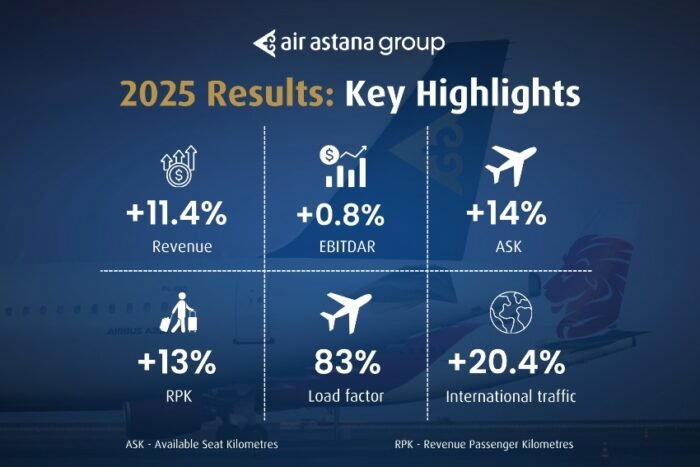
2025 marks Air Astana Group’s second year as a public company and my 20th year as CEO. Amid industry-wide challenges, the Group has shown resilience with revenue growth of 11.4 per cent [1] to USD1,453.9 million and EBITDAR stability at USD321.2m (+0.8 per cent* increase). Through our continued commitment to dynamically managing capacity allocation, ASKs are up 14.0 per cent to 22.0bn, from 19.3bn in FY24. In Q4 specifically, the Group has seen strong demand with total revenue growth of 15.8 per cent.”
Overall Journey
More broadly, the Group has made significant progress in a number of areas, as we position both of our brands for long-term success. This includes investment in our fleet (including the largest aircraft order in our history), expansion of our route network (25 new routes), improvements in customer experience and enhanced operational efficiency – a central aspect being advancing our digital capabilities. Our Aviation Technical Centre serves as a primary asset in the resilience of the business, with the in-house MRO expertise being margin protective in the context of our ongoing management of the Pratt & Whitney issue.”
Pratt & Whitney prompted Unscheduled Engine Removals are an industry-wide issue. UERs have impacted profitability by limiting our growth opportunities and thereby increasing unit costs, driven primarily by lost capacity, compressing the margin between RASK and CASK across the year. Our mitigation actions, however, have placed us in a strong position to minimise the forward-looking impact. We see the impact from UERs as diminishing over time. We have addressed the RASK challenge with improvements towards the end of Q3 and a particularly visible recovery in Q4 with an increase of 9.8 per cent. That gives us further confidence in our business with focus on CASK. As we start growing and spreading costs over a bigger capacity, we will achieve the margins we aspire to.
While concluding his comment, Peter Foster said, ” With this being my final set of results, I would like to end by expressing the huge confidence I have in Air Astana and its leadership. We have a strong, diverse and motivated management team, many of whom I have worked with for my entire tenure. Others have joined very recently and will bring an external perspective to our strategy, such as Gonçalo Pires as our new CFO and Johan Eidhagen as the new FlyArystan President. From April, they will be led by Ibrahim Canliel who is uniquely positioned to drive Air Astana’s next phase of development. Ibrahim was a commercial leader within the group for 15 years before becoming CFO. In his roles he has been integral to much of the success we have enjoyed and as CFO also took responsibility for the entire IPO process. It has been my pleasure to work with him for over two decades and I leave the airline in very effective hands.
We are due to take delivery of three new Boeing 787-9 aircraft in the next 15 months with other aircraft deliveries scheduled. We carried almost 10 million passengers, despite external challenges, with international network expansion a key factor in our success. I am enormously proud of what we have achieved together and I look forward to remaining involved in the company as a senior advisor to the Board.”
FY 2025 Highlight:
Solid revenue and capacity growth with stable EBITDAR performance despite margin pressure.
• Total revenue and other income increased 11.4 per cent to USD 1,453.9 million (FY 2024: USD 1,304.9 million).
• EBITDAR increased 0.8 per cent to USD 321.2 million (FY 2024: USD 318.7 million). EBITDAR margin 2.3 pp lower to 22.1 per cent (FY 2024: 24.4 per cent).
• PAT decreased USD 35.9m to USD 13.6 million (FY 2024: USD 49.4 million).
• ASK up 14.0 per cent to 22.0 billion (FY 2024: 19.3 billion).
• RPK increased 13.0 per cent to 18.2 billion (FY 2024: 16.1 billion).
• RASK-CASK differential reflected margin decrease in a challenging operating environment partially mitigated through dynamic capacity management, fares adjustment and operational efficiency.
o RASK decreased 2.3 per cent to USD 6.60¢ (FY 2024: 6.75¢).
o CASK increased 1.6 per cent to USD 6.20¢ (FY 2024: 6.10¢).
• Group passengers carried increased 7.9 per cent to 9.7 million (FY 2024: 9.0 million) with a stable average load factor of 82.7 per cent (FY 2024: 83.5 per cent).
• Group fleet expanded to 62 aircraft.
Q4 Highlights
Revenue and traffic growth, with earnings impacted by Pratt & Whitney Unscheduled Engine Removals (UER) but RASK growth turning positive in the fourth quarter.
• Total revenue and other income increased 15.8 per cent to USD 357.0 million (Q4 2024: USD 308.4 million).
• EBITDAR decreased 9.7 per cent to USD 59.1 million (Q4 2024: USD 65.4 million). EBITDAR margin 4.7pp lower to 16.5 per cent (Q4 2024: 21.2 per cent).
• PAT decreased USD 15.3m to USD -17.7 million (Q4 2024: USD -2.4 million).
• ASK up 5.5 per cent to 5.0 billion (Q4 2024: 4.7 billion).
• RPK increased 5.4 per cent to 4.1 billion (Q4 2024: 3.9 billion).
• RASK-CASK differential impacted by Pratt & Whitney UERs, curtailing capacity growth and grounding more of the fleet than planned during Q4.
o RASK increased 9.8 per cent to USD 7.18¢ (Q4 2024: 6.54¢) due to the allocation of capacity to higher margin international routes and fare adjustments initiated earlier this year with the full financial effect reflected in Q4.
o CASK increased 17.3 per cent to USD 7.23¢ (Q4 2024: 6.16¢) due to lost capacity caused by UERs, with resources geared for peak season and higher engine maintenance costs.
• Group passengers carried remain stable at 2.2 million (Q4 2024: 2.2 million) with average load factor of 81.7 per cent (Q4 2024: 81.7 per cent).
Outlook
The engine-related constraints that impacted Q3 persisted into Q4, continuing to affect operational performance and as a result the Group’s FY 2025 CASK growth is ahead of RASK growth. Notwithstanding this differential, the Group remains on course to deliver growth in 2026, in line with its medium-term guidance:
• Realign capacity to ensure highest margin delivery and mitigate inflationary cost pressures, while retaining a load factor in the low-to-mid 80s.
• Total fleet to expand to 86 aircraft by the end of 2030.
• Medium-term expectation of mid-to-high 20s EBITDAR margin with liquidity ratio above 25% and leverage below 3.0x Net Debt/EBITDAR.
( This news is based on the PR issued on behalf of Air Astana Group by Euro Asia Communications, Singapore)