

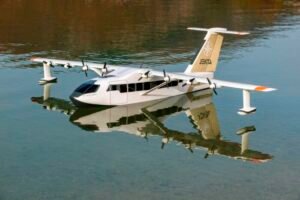
JEKTA, the manufacturer of the zero-emissions Passenger Hydro Aircraft – Zero Emissions 100 (PHA-ZE 100) amphibious aircraft, has already received more than $1.35 bn of forward commitments from operators for LoI signed for 139 aircraft in the Middle East, India, and Asia, with Gayo Aviation, MEHAIR (in India), Solyu, Seaplane Asia, among others demonstrating commitment. Recently, at the Dubai Airshow, George Alafinov, CEO and Co-Founder of JEKTA in an exclusive interview with Vishal Kashyap, Managing Editor, Aviation World, shared insight on all aspects of the aircraft and his vision towards launching a new era of affordable, sustainable regional air mobility, where they see themselves as the global leader in the amphibious aircraft sector. Excerpts…
Q: What does JEKTA do and could you share more details about the products?
A: JEKTA is based in Switzerland and is specialised in developing and building amphibious aircraft. When we’re talking about amphibious aircraft, we are not talking about an aircraft with floats, but we specifically mean a flying boat design that can operate as easily from prepared or unprepared runways and water without any requirement for additional hardware like floaters or anything else.
Flying boats have superior technical capabilities compared to float planes because they’re originally designed for what nature has given us – water and land. When 80 per cent of the world is covered by water, that means that 80 per cent of the world is our potential runway. We can create a regional transportation network with minimal investment into airports, with no time needed to build an airport and reduced ecological impact.
Since building an airport irreversibly impacts on nature, we’re using nature’s gift, which is water. Today, most of the population of the world lives near water, whether it’s lakes, rivers, the sea, or the ocean, and this opens up an opportunity for the creation of transportation for these communities by using that water where they live.
We believe that using amphibian aviation is sustainable, easy, and low cost. With minimal barriers of entry it creates the possibility of providing services to communities, within record time and with reduced financial investment.
Q: What factors drive you foresee for the potential for sea plane operations?
A: We’re talking about half a billion people living on thousands of islands where there is not only a desire to have amphibian aviation but an absolute need of amphibian aviation. As in the case of India, we see huge development and growth in the middle class. As the growth continues, the middle class wants to travel more and even sometimes simply to travel to international airports to fly to their relatives in other parts of India or abroad, or to visit island nations like the Maldives, or to visit global tourist attractions.
Today it’s very challenging for Indian travelers, and it’s even more challenging for island nations, for example, the Indonesians, because they have to invariably take a boat to access other locations. Amphibious aviation provides a tool for quick, comfortable, sustainable, and affordable transportation to the international hubs.
Q: How do you see the market for JEKTA across the world and especially India?
A: Currently, we have Letter of Intent (LoI) for 109 aircraft, of which 50 are in India. India is going to be one of the biggest markets in the world for amphibious aviation, and the reason for that is not only the geographical and topographical conditions of India, but also the absolute willingness of the government of India to open rivers and lakes.
As you might know about five or six years ago the Govt. of India had already integrated regulations for the opening of lakes and rivers of India for aviation. They see it as an incredible opportunity to develop transportation without huge investment in regional airports that would inadvertently destroy India’s nature. We commend this decision by the Indian government, and we respect it very much because it aligns with our global vision for the development of amphibian aviation. We have an Indian customer who has signed an LoI for 50 aircraft, and we believe the Indian market is so large that it requires up to 400 aircraft to support intra-region and inter-region aviation.
Q:How about other markets where you see the potential?
A: The other very interesting market for us is the Middle East which comprises of countries like the UAE, Saudi Arabia, Qatar, Bahrain and Oman. The Middle East has an extensive coastline, yet it doesn’t incorporate regional ground transportation. Railroads and highways connecting key destinations are quite limited. So, the opportunity mirrors that of India. We see the option of developing a transportation network using existing infrastructure such as international airports in combination with water. It is an opportunity that the Middle East cannot pass up. Our discussions with local stakeholders demonstrate that they understand amphibious aviation presents a huge opportunity for the provision of new affordable, sustainable air transport services through operators and through the state, for its local communities.
Probably the biggest potential market for regional operations for us is in Southeast Asia, which includes Indonesia, the Philippines, and Malaysia.
Q: In regard to India, what is the tentative timeline for the delivery of the aircraft?
A: Our tentative schedule to enter the market is 2031. The usual cycle for development of aircraft of such a class is about 10 years, including certification.
Q: You must be aware that in India a few seaplane operations were planned but could not take off. How do you prepare yourself to address such situations?
A: Yes, I am well aware of that. They could not make it due to various reasons, out of which two are important to put here:
The first main reason is the limited availability of aircraft that can successfully support seaplane operations on the Indian shores. The second reason relates to the extremely expensive maintenance and high fuel consumption, which make flight operations unviable.
JEKTA has designed its aircraft to have vastly superior technical capabilities through its flying boat design and to have much lower maintenance operating costs through the integration of electric aviation. Though it’s light, it is a very large, comfortable aircraft that is made of composite materials, which in itself removes concerns around rust and corrosion and therefore decreases maintenance needs. Operating costs are also reduced as the aircraft can fly almost every day, even in harsh conditions in comfort, which is important for operators.
Q: What will be cabin configuration of the aircraft? Also, if you can highlight the operating range?
A: The PHA-ZE 100 aircraft is designed to seat up to 19 passengers with one crew and two pilots. It can also accommodate two crew, but this depends on the operator’s requirements and local DGCA guidelines. It also has options for the integration of in-flight entertainment and a lavatory. Added value services like in-flight catering are up to the operator but it is only designed to prepare light snacks as operational time between the sectors will be low.
The aircraft is designed to operate with a range of 500 km plus reserve. To make the operations viable, it depends upon the operator at what price point they sell the seats. The other factors that will support operators are that our aircraft is IFR capable, so it can operate day and night non-stop, even in wind and waves.
The reduction in operating costs through lower maintenance costs and the 19-seat capacity will allow operators to push prices down. Whether they’re going to do it or not is not something we influence. But the way we see it is that even a small reduction in prices will greatly increase the passenger flow because of the economies of scale and the sheer size of the population in India.A reduction in 5-10 dollars per seat can potentially increase 30-40 percent of your passenger flow.
Q: What will be the provisions for the baggage area?
A: We designed the aircraft with baggage storage in the back of the aircraft based on bags of up to around 15kg to 20kg per person. The aircraft is made of fiber-glass composite, therefore it’s very light in comparison with metal. It’s a good size and through using modern technologies and materials we’re able to increase the payload in comparison with existing airframes.
Q:How about the regulatory approvals?
A: The advantage for our niche or for our class of aircraft is that the regulations for the design of amphibious aircraft have already existed for around 100 years. The certification process starts at the level of the design, and we follow the guideline book issued by the EASA. That decreases the certification process because we’re already in compliance at the design level with the existing regulations.
Q: Is there any other company also joining hands to be part of this ambitious project?
A: Chances are yes! Currently, we do not disclose our suppliers, but we are holding several negotiations with possible Indian suppliers for this aircraft.