
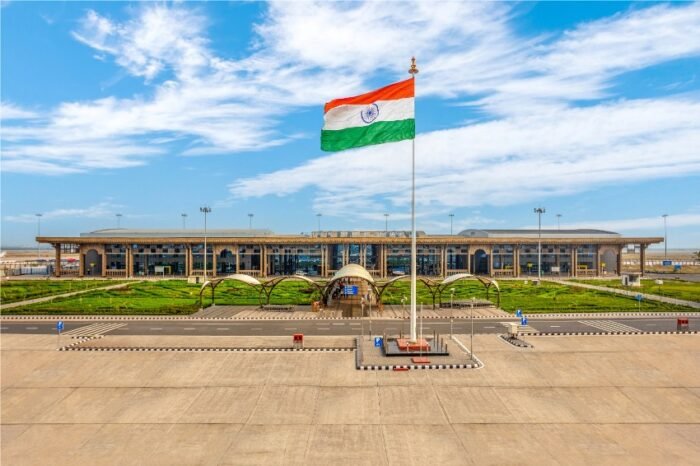
Since 2014, Indian aviation has undergone a decisive transformation. Connectivity has expanded rapidly, infrastructure has scaled up beyond metropolitan hubs, and airports have evolved into world-class, experience-driven spaces. And in this defining moment, Rajiv Srivastava stands alone in documenting India’s aviation renaissance with unmatched depth, patience, and sensitivity. Working at the intersection of aviation, architecture, landscape, and visual storytelling, Rajiv’s photography captures more than aircraft and terminals. His images reveal how aviation infrastructure mirrors a nation in motion, its aspirations, cultural identity, and relationship with landscape.
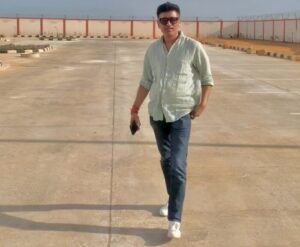
Rajiv’s journey into photography did not begin in a conventional classroom. He started his professional life as a cricketer before discovering his calling behind the camera. Over the last two decades, his work has spanned street photography, fashion, sports, landscapes, and documentary film-making. Early in his career, he assisted renowned fashion photographer Tarun Vishwa, where he developed technical discipline and a refined understanding of light and composition. Yet, even during his years in fashion, his instinct leaned toward expansive spaces and environments that tell larger stories. That instinct found its strongest expression in aviation photography.
The roots of this passion trace back to Rajiv’s childhood in Arunachal Pradesh, where aviation was not an abstraction but a lifeline. Surrounded by mountains, rivers, dense forests, and remote airstrips, he grew up witnessing how air connectivity shaped everyday life. A formative helicopter ride with father during his school years proved pivotal. Seeing runways, valleys, and waterfalls from the air left an enduring imprint, one that would later define his professional path. Encouraged by his mother to observe the world closely, Rajiv developed a way of seeing that remains central to his work.
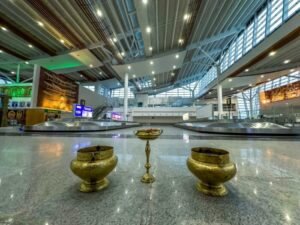
What distinguishes Rajiv’s aviation photography is his perspective. He does not merely document aircraft or terminal façades; he studies airports as living spaces. For him, an airport is the first narrative of a region, a gateway into its culture, geography, and ambition. His photographs highlight architectural rhythm, natural and artificial light, spatial flow, public art, and human movement. Bamboo-inspired columns, soaring glass façades, regional motifs, and quiet transitional moments find equal place in his frames.
Photographing airports, however, is rarely straightforward. Security protocols, complex lighting conditions, and uninterrupted operations leave little room for error. Often, Rajiv has just a single day to capture an entire terminal. Years of experience allow him to anticipate light, angles, and fleeting moments, resulting in images that feel both precise and alive.
His background in landscape photography plays a critical role here. Rajiv is particularly drawn to airports set within dramatic natural contexts, whether in the Himalayas, along coastlines, or across open plains. By situating terminals within their surrounding terrain, he creates a visual dialogue between infrastructure and nature. This sensibility has also led to over 20 solo and group landscape photography exhibitions across India, where he has shared platforms with eminent photographers such as Raghu Rai and Samar Jodha, firmly establishing his reputation beyond aviation circles.
Rajiv’s work has received national recognition. His photographs feature in landmark coffee table books such as 100 Airports for New India, released by the Honourable Prime Minister in 2018, and Kala Sankalan, released by the Honourable Minister of Civil Aviation. These publications celebrate India’s aviation growth through design, culture, and visual narrative rather than numbers alone.
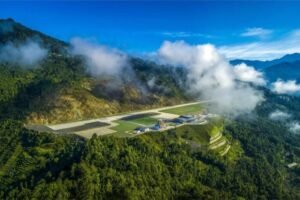
One defining moment came at Pakyong Airport in Sikkim. Battling dense fog, rain, and visibility windows as short as 10–20 minutes, Rajiv persisted. His images, dramatically framing the airport against the Himalayan landscape, went viral internationally even before inauguration, appearing in CNN, BBC, Vogue, and Condé Nast Traveller. The moment became historic when the Honourable Prime Minister referenced those very images during the airport’s inauguration.
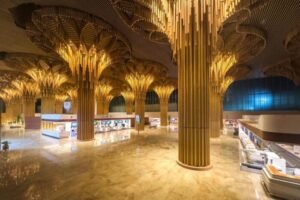
Today, with over nine years dedicated specifically to aviation photography and filmmaking, Rajiv continues to document India’s evolving skies. From UDAN-activated regional airstrips to architecturally ambitious terminals like the new Guwahati Airport, inspired by Assam’s natural and cultural heritage, his work captures a sector redefining itself.
Beyond aviation, Rajiv is currently working on a coffee table book on Varanasi, his hometown, exploring its ghats, rituals, architecture, and everyday life. Whether photographing an ancient city or a modern terminal, his lens remains committed to preserving stories of place, progress, and identity.
Through Rajiv Srivastava’s photography, India’s airports are no longer just transit points. They are narratives of ambition, culture, and connection etched in light, steel, landscape, and sky.
( Pix Courtesy: Rajiv Srivastava)