
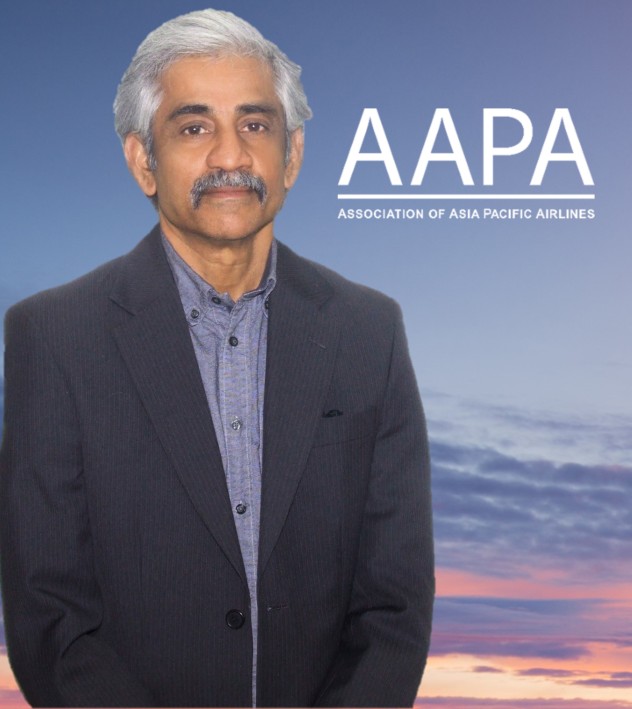
At the Singapore Airshow, in a candid interview with Vishal Kashyap, Managing Editor, Aviation World, Director General of Association of Asia Pacific Airlines(AAPA), Mr. Subhas Menon shares insight on various key aspects of the growing Aviation sector in Southeast Asian region with special views on India. Excerpts…
Q: How you see the evolving Indian Aviation ecosystem?
A: The situation of India and the Indian authorities is huge. India wants to build an aviation ecosystem that meets the ambitions of Indians. They should be able to go to anywhere in the world and for their families who are overseas to come to India from anywhere in the world seamlessly and comfortably. At the moment, anywhere the Indians want to go to, they have to go through other hubs. The ambition of the Indian authorities is to have all the hubs in India itself.
The domestic Indian traffic has been building up over the years and growing naturally. The international Indian traffic is still very low as it’s the third largest aviation market in the world after the US and China.
The Indian carriers have made huge aircraft orders and when these orders were placed, the supply chain crisis has already happened because it occurred during the pandemic. They may not be able to get all the aircraft that they have ordered in time as there will be disruptions.
On safety side, it’s not only specific to India as we have seen aircraft incidents becoming very common. The regulators need to make the system more stringent so that such incidents should be discouraged or minimised. Still, air transport continues to be the safest mode of transport.
Q: What’s your opinion on the future airspace movements in India?
A: Airspace will be packed but India is starting from a low base. I think, there is still a lot of room to grow in terms of airspace as it will take 5 to 10 years to get all the aircrafts that both IndiGo and Air India have ordered which is slightly over 1000 aircrafts.
If the manufacturers are business savvy, they will try to supply the aircraft as quickly as possible to the Indian operators. It needs to be speed up as nobody else is really ordering that many aircrafts. India is really growing very fast and has the potential to grow further by leaps and bounds.
Q: Could you specify on the countries which have significant growth in this region?
A: If you look at the potential, it is basically India and Southeast Asia. They all have young population and a growing middle class. In the Asia-Pacific region, we are not contiguous or compact as people need to travel by air and it share some of same demographies.
China now is actually going into an ageing population. Though their middle class can still grow, but they are facing some economic constraints at the moment. So, they might not be a growth market and we are trying to get to see whether it will go back to the levels of travel generation that they had before the pandemic. Outbound travel in China was driving growth for many years but post pandemic they have certain level of economic problems.
Q: How you see Vietnam and Indonesia growing an aviation hub in the region?
A: The Vietnamese government managed to get one of the lowest tariffs in the US. There was a parallel economy to China developing in Vietnam for manufacturing goods in the last five years and its continuing. Vietnam also has a very young population, so workforce-wise, a lot of centralisation is taking place within the country.
The potential for Vietnam is huge, both inbound and outbound as it’s a very beautiful country. They have a tourism plan which encourages and attracts people to visit Vietnam from a historical, cultural, as well as leisure perspective. Vietnam Airlines is going as an international hub carrier and they also have a low-cost carrier there.
For Indonesia, it’s always been huge and they have a strong national carrier. They also have budget carriers, both who are members of AAPA (Association of Asia Pacific Airlines). There is inbound as well as outbound potential but at the moment, Indonesia is struggling a little bit because they had a change of government further adding to change of policies and regulations. It’s a matter of time before they stabilise and go back to growth as the Indonesian government is very keen to bring a lot of tourists to Indonesia.
Q: The Indian Govt. had recently issued NOC to three new airlines to break the existing duopoly. But in ground they are facing challenges to procure an aircraft. How you see such situations?
A: Generally, we support competition as its good to have the same. But it is not good if airlines start and then they don’t fulfil their mission and they go bust and not able to survive. The best advice to the potential startups’ airlines would be to ensure enough funds to last long.
It should be minimum for five years before one can really stabilise their operations. If they don’t have that, it’s a big risk to start an airline. In the last few years, there have been a few startups in the region and most of them didn’t make it.
Q: What are the key factors that OEMs basically see before giving an aircraft to a startup airline?
A: It’s the financial capability to sustain for a long term is one thing that OEMs look at. If they once survive the startup stage, then at least you have a future.
Number two, they are in the process of trying to fulfil outstanding orders, so, why would they give new aircraft to new startups when they haven’t fulfilled their outstanding orders. That doesn’t make any sense as they have a relationship with existing operators who are still waiting for their orders to be fulfilled.I think it’s a reasonable thing to do to make sure that existing clients get their orders first. The potential startups should take that into consideration as well.
Third point is the supply chain impact which is everywhere. Its not only aircraft and engines, even things like seats, taps for your toilets, all these things are being held up. That is one of the serious concerns that these operators definitely must consider before planning or investing even a single penny into this kind of sector.
Q: Indian aviation sector is placed at number three rank globally. How you see the growth transition between number 3 to 1?
A: It’s difficult to say what the timeline is, but I think it will take some time.The gap between number two and number one is really huge and I don’t think it will be achieved in a very short span of time. It might take up to 5-10 years also to achieve this number. It’s not like the other market which is going to be stand still for example, China will continue to grow, however US may be stand still.
Q: India is developing around 100 airports in the next ten years. How do you see such initiatives contributing towards the growth of aviation sector?
A: India is a huge if you compare it with other countries and the airport growth here is fantastic because they want to develop a good chain of airports.
China went through this process may be 20 years ago as they built around 200-300 airports all over China. They completed the job much before and now they are enjoying the fruits of their efforts.
In India, the authorities are not only building airports and terminals but they are building hubs. Due to the size of the country, they want to have three to four hubs because in some places, there is not enough traffic for direct flights. Ideally, there is need of regional hubs like southern hub, northern hub, eastern hub and western hub. The authorities have got a game plan and they are doing the right thing.
Q: Airport privitisation has become the new format of airport operations in India. Is this the same practice in other regions as well?
A: I think in large countries, this is quite common. Many countries have started with the airport authorities being part of the government regulators, so they don’t really have that sort of a history. But over time, the private investment in airports has grown and it has been privatised. For ex, Australia has also privatised all the airports.
Q: What reasons you see for the IndiGo fiasco last year? Is it due to their huge fleet size that they could not asses the alarming situation or is it something else?
A: I don’t think they have become too big and that’s the case. They were growing and they probably knew what they were doing, but may be they underestimated the complexities. If they fix it and put it right, then it helps them. They have a blueprint to manage their expansion but certainly it’s a wake-up call.
Q: How you see Indian Aviation at large?
A: I would say that the potential of India is huge and it’s time that India had two large carriers, and focused on expanding and meeting the ambitions of the government as well as the Indian people.