


In a significant endorsement of India’s rapidly expanding aviation and MRO ecosystem, UK based Jewers Doors has established its wholly owned subsidiary in India. This strategic investment aligns with the vision of “Make in India” and “Atmanirbhar Bharat”, underscoring Jewers Doors’ long-term commitment to localisation, skill development, and sustained engagement across India’s civil and defence aviation sectors.In a conversation with Aviation World, Chris Jewers, Managing Director of Jewers Doors highlighted his thoughts on the growing Indian Aviation sector and how Jewers Doors is inclined to contribute into developing top class aircraft hangar doors in India. He is joined by Anirrban Batacharrya, Country Director, Jewers Doors who speaks upon Jewers Doors’ plans for India.Excerpts…
Q: How do you see the entry of Jewers Doors into the India?
A: Jewers Doors is a family owned British engineering company designing and delivering aircraft hangar doors around the world for more than four decades. We’ve been, and for quite some time now watching the rapid growth of the aviation and MRO sector in India with real interest. The market has been evolving quickly, and it’s clear there’s a long-term need for world-class infrastructure.
A key milestone for us was securing the contract to supply and install hangar doors for the VVIP squadron’s B777-300ER AIR INDIA ONE fleet in New Delhi, operated by Indian Air Force. That project really confirmed for us that India is not just an opportunity, it’s a market where we can make a meaningful contribution over the long term.
Q: How the India project is progressing?
A: The project is progressing well, and in many ways it strengthened our conviction that India and the surrounding region represents an exceptionally exciting market for us.
Last year, we joined a trade delegation organised by the British High Commission, visiting Bangalore, Ahmedabad, Delhi and Hyderabad. We met with a wide range of organisations across both government and private sectors. What struck me most was the scale of ambition and the pace of development in aviation infrastructure.
I’ve been on many trade missions over the years, but this was one of the few where I came away genuinely energised by the opportunity. That experience played a major role in our decision to formally establish our Indian subsidiary.
Q: With the Indian Govt. planning to develop more than 100 airports in the next 10 years, how do you see the market for the Jewers Door?
A: The potential is clearly there. The pace of development will depend on many factors that are outside our control, but the long-term direction is unmistakable. Aviation infrastructure is expanding, fleets are growing, and maintenance capability needs to keep up. That’s precisely why we’re here – to be part of that growth as it unfolds.
Q: What are the priorities in terms of type and size of aircraft hangar doors you have planned to develop in India?
A: We cover the full spectrum from very large wide-body aircraft hangars through to facilities for narrow-body aircraft.
There are two core strengths we bring to any project. The first is engineering expertise, built over decades of designing and manufacturing highly specialised door systems. The second and equally important is execution.
Large hangar door projects demand rigorous project management, coordination of multiple suppliers and subcontractors, and precise on-site execution. Ensuring everything comes together seamlessly is something we take enormous pride in.
Q: How you plan to execute the projects in India? Are you also taking onboard some Indian companies to fulfil your existing commitments?
A: Absolutely. Local collaboration is fundamental to how we operate here.
While we now have an incorporated presence in India, a significant proportion of the components used in aircraft hangar doors shall be sourced locally. Structural steel, many mechanical components, and various construction elements shall be manufactured within the country. Certain specialist elements may still be supplied from the UK, but they represent only a small portion of the overall system.
A hangar door is essentially a complex integration project. It involves multiple materials, specialised panels, mechanical systems, and locally sourced construction elements. Our role is to bring all of these together into a single, precisely engineered and fully functional installation. That integration and the project management behind it is where much of the expertise lies.
Q: Are you looking forward to contribute towards Make in India initiatives?
A: Oh! Absolutely yes! Much of what I’ve described will be under “Make in India” as the Indian Prime Minister says that.
Local manufacturing and sourcing are central to our approach. While certain specialist components may be imported, the majority of the structure and many supporting elements are produced locally. That aligns naturally with the broader objective of building domestic capability and strengthening the supply chain within India.
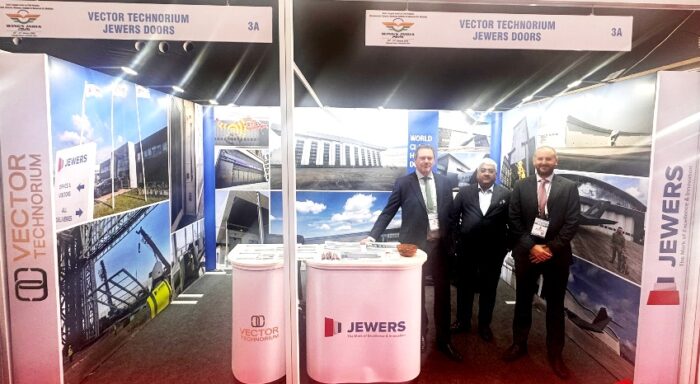
In addition to the above conversation, Anirrban Batacharrya, Country Director, Jewers Doors added on how he sees Jewers Doors’ progressing into India?
He emphasised that the Jewers name has always been associated with engineering excellence, product quality and, above all, reliability which is absolutely critical when it comes to hangar doors. Quite simply, the door must open & close when you need it to do so. That level of dependability has been built steadily over more than four decades, shaped by the values of a family-driven organisation.
For him, ethics and trust sit at the very heart of the company’s growth in India. His own relationship with the Jewers family spans more than ten years and has been grounded in complete transparency from the very beginning. Their association first began when he was working as a project management consultant supporting a low-cost airline establishing an MRO facility, the starting point of what has now evolved into the creation of a fully owned subsidiary in India.
He noted that this progress has only been possible because trust was established early and strengthened over time. The company’s presence in India is not about pursuing isolated projects, but about building a sustained, long-term commitment to the market. While they are currently executing what is likely the largest hangar door project in the country, commercial airline projects are expected to follow soon. Beyond that, the company is actively exploring a broad range of future opportunities as the aviation ecosystem continues to expand.