
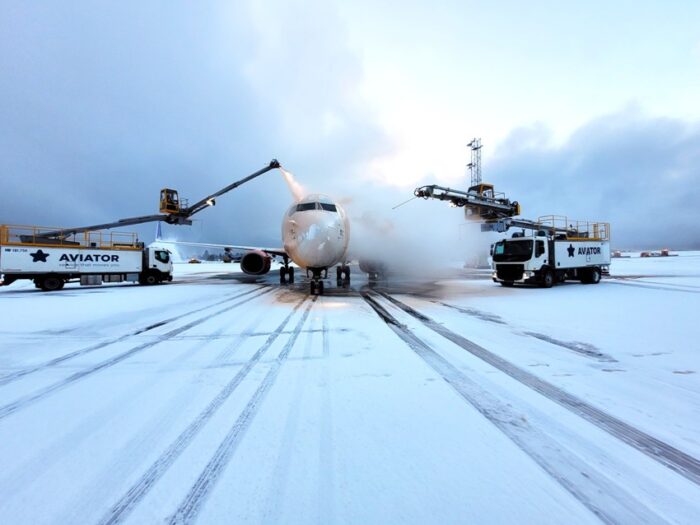
De-/anti-icing of an aircraft is a critical pre-flight procedure that ground handling teams around the world undertake ahead of take-off and is mandatory if ice, frost, or snow has accumulated on major surfaces including an aircraft’s wings or fuselage.
Effective de-/anti-icing training is crucial for ensuring flight safety and enables safe and timely aircraft operations during winter weather conditions. Aviator Airport Alliance, a full-range provider of aviation services at 15 airports across the Nordics and a family member of Avia Solutions Group, delivers insights on how the importance of equipping their team with comprehensive de-icing training is critical for successful operations across Northern Europe, spanning the Baltics, Nordics, and Scandinavia.
Anders Søreide, Head of De-Icing & Safety Advisor at Aviator, outlines the structure of the training program that operates within his team, “Our training program is based upon SAE (Society of Automotive Engineers) aerospace industry standards. The main objective is to train our staff to perform de-/anti-icing operations according to the SAE standards to ensure flight safety.”
Theoretical and Practical Integration
Training includes both theoretical and practical training and is renewed through annual recurrent training before each season. Theory in the classroom provides the foundations but potential candidates are often curious to understand how the practical training is delivered.
Anders commented, “Practical de-/anti-icing training consists of both simulated scenarios and actual operations performed under supervision. Simulated exercises may vary between stations, but a typical simulated exercise would include a vehicle driving through an ‘obstacle course’ to develop driving patterns.”
Operational Excellence and Safety
As well as ensuring safe movement around high value aircraft, teams must also know how to correctly spray de-icing fluid onto key areas of the aircraft. Anders continued, “Spraying exercises on a suitable surface, communication with other vehicles, drivers, and flight crews are essential. Operators also need to understand the emergency procedures and visual interpretation of contamination (where ice, frost, or snow accumulates) in order to safely prepare the aircraft for departure.”
During simulated exercises, the focus is on operator confidence as there are many tasks to be mastered simultaneously. The exercises are repeated and are accommodated for individual learning processes as some staff require more practice than others. The simulated exercises are extremely important to ensure familiarity with the necessary equipment and procedures and for teams to be able to focus on the contamination at hand. For live operations, all staff perform at least the minimum SAE requirements for operations under supervision.
Continuous Learning and Improvement
In the aviation safety industry, it’s extremely important to optimize operations continuously, which is why Aviator performs annual reviews of their training materials. This review is primarily based upon new revisions in the SAE standards, as well as feedback from instructors and reported incidents. Aviator also attends live SAE meetings each year.
“Reviews, monitoring, and revisions of the training material are performed by the Aviator de-/anti-icing working group which meets pre-season, mid-season, and post season. Additionally, Aviator performs several internal inspections to assess training at their stations, in addition to being audited by the DAQCP (De-icing/Anti-icing Quality Control Program). Aviator emphasizes transparency and trust-based relationship with our customers, and since flight safety is a collaborative effort, feedback and/or reports from our airline customers are valuable sources for potential improvements,” commented Søreide.
One of the biggest challenges for training operators is the sometimes lack of actual de-/anti-icing events, especially at smaller stations. Initial training at a large busy station may be performed in a matter of weeks but operators typically perform de-/anti-icing operations together with more experienced staff for a longer period. At smaller stations, training can last over several seasons as the practical training requires actual de-/anti-icing operations to be performed.
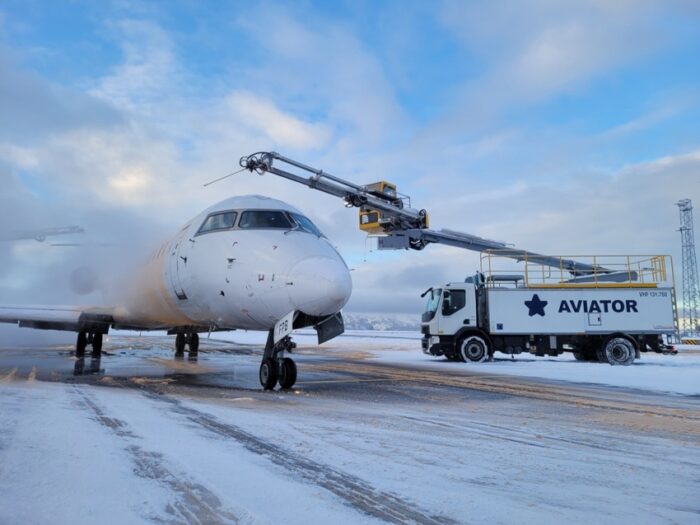 At Aviator, Anders’ team have frequently used their stations at Bardufoss and Tromsø in northern Norway as support stations for de-/anti-icing training, as they offer frequent winter weather and highly competent staff and instructors. This ensures trainees have the necessary guidance and experience before being certified to undertake live operations back at their home stations.
De-/anti-icing is a service that is critical for flight safety and operators are the last line of defence ahead of a flight. This means that the selection process must be rigorous. “Typical requirements at Aviator for our initial operators are for ramp agents with some years’ experience, and who have completed all the required courses. Their driver’s license must be applicable to our vehicles and local regulations, while they also must have completed applicable de-/anti-icing training program. Being able to communicate proficiently in English is also a prerequisite for the role.”
However, the most important requirement for Anders is personal suitability for a flight safety critical service. “Our operators must be able to handle and operate several tasks simultaneously, being able to manage a stressful environment, with safety being their number one priority at all times,” commented Søreide.
(Content & Image Courtesy: Aviator-Avia Solutions Group Company)
(Views Expressed are personal.)