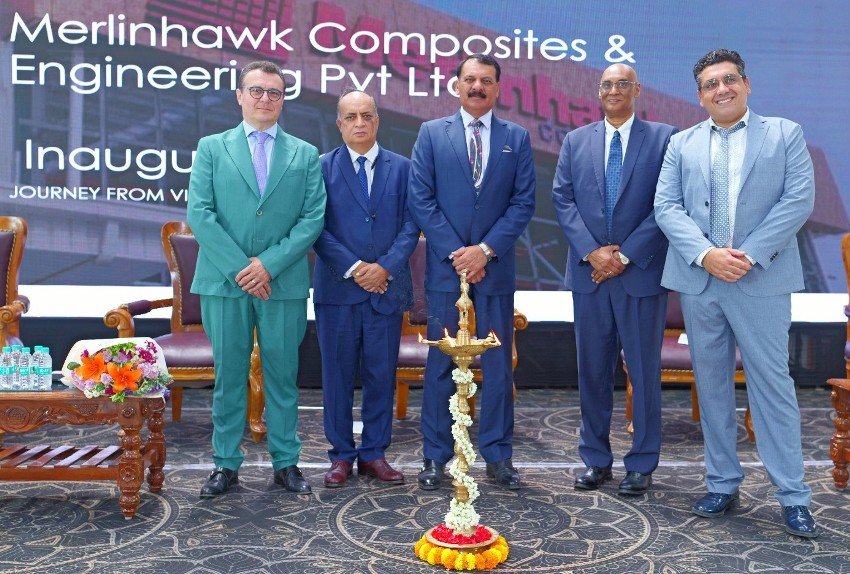
Shoolagiri,Tamil Nadu, 30th June , 2026: Merlinhawk Aerospace in partnership with Italy-based Vega Composites has inaugurated its advanced composites manufacturing facility – Merlinhawk Composites & Engineering at Shoolagiri in the Tamil Nadu Defence Industrial Corridor, marking a significant step in India’s evolution as a globally competitive aerospace manufacturing hub. The facility was inaugurated by Admiral Dinesh K Tripathi, PVSM, AVSM, NM, Former Chief of Navy Staff (CNS), in the presence of senior industry leaders, global partners, and key stakeholders from India’s defence and manufacturing ecosystem. This milestone formalises a strategic India–Italy collaboration, bringing together global expertise in advanced materials and manufacturing technologies with India’s growing engineering and industrial capabilities. Speaking on the occasion, Admiral Dinesh K Tripathi, PVSM, AVSM, NM, Former CNS said, “It is heartening to note that Merlinhawk Aerospace, for the last four decades, has been at the forefront in developing indigenous solutions for high end avionics technology and has indigenised large number of components in line with the nation’s vision of Atmanirbhar Bharat. It is also noteworthy that the firm has moved into advance composite material technology with Vega Composites, Italy towards ensuring that the Indian Defence industry absorbs advanced technology into the ecosystem. I’m sure that this facility is going to be of immense importance to our nation in design and manufacturing of advance composite components for defence and aerospace industry.” A Strategic Leap in Aerospace Manufacturing: The Shoolagiri facility is designed to manufacture advanced composite aero structures and high-performance materials that are critical to next-generation aerospace and defence platforms, including aircraft and unmanned systems, radar, and electronic warfare structures & high-performance defence applications. With integrated capabilities spanning cleanroom layup, precision cutting, autoclave curing, and five-axis CNC machining, the facility enables end-to-end composite manufacturing from design to delivery within India. It also reflects a deeper shift in India’s defence ecosystem – from build-to-print manufacturing to design-led, high-value engineering capabilities. Ramachandra Rao, Founder & Managing Director, Merlinhawk Aerospace Pvt. Ltd., said: “This facility marks a defining step in Merlinhawk’s journey from systems engineering to advanced aerospace manufacturing. As global aerospace platforms increasingly rely on high-performance composite materials, it is critical for India to build integrated capabilities in design, materials, and manufacturing. Through our partnership with Vega Composites, we are bringing together global technology expertise and Indian engineering to create a manufacturing ecosystem that not only supports domestic programmes but also positions India as a credible player in global aerospace supply chains.” Global Technology, Indian Manufacturing The facility integrates globally aligned manufacturing technologies and processes, with key equipment and systems sourced from leading European partners, reinforcing its positioning as a globally compliant aerospace manufacturing centre. This collaboration enables technology transfer from Europe, strengthens capabilities in advanced materials, and supports integration into global aerospace supply chains. Commodore (Retd.) Bharat Bhushan Nagpal, CEO, Merlinhawk Composites & Engineering Pvt. Ltd., said, “Advanced composites are at the core of modern aerospace and defence systems. This facility has been built with a clear focus on precision, quality, and compliance with global aerospace standards. Beyond manufacturing, our focus is on building long-term capability – developing skilled talent, strengthening process excellence, and creating an ecosystem that supports sustained growth in India’s high-technology manufacturing sector.” Roberto Lapini, CEO, Vega Composites (Italy), said,“This joint venture reflects a strong and forward-looking industrial partnership between Italy and India. We see India as a strategic manufacturing base for advanced composites, with the potential to serve both domestic and global markets. Through this collaboration, we are enabling technology transfer, co-development, and the creation of globally competitive capabilities that integrate Italian expertise with India’s dynamic industrial ecosystem.”