
Cargo

Cargo

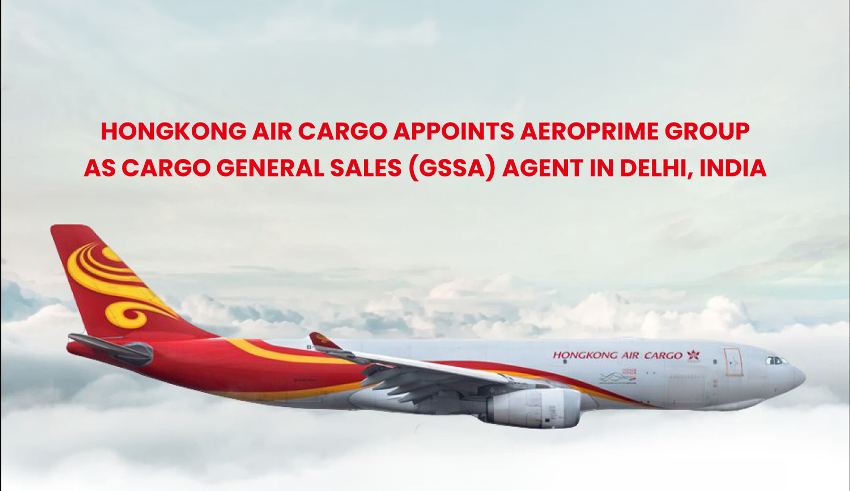
Hong Kong Air Cargo appoints Aeroprime Group as Cargo GSSA Agent for Delhi

New Delhi, 18th June 2026 : Hong Kong Air Cargo has appointed Aeroprime Group as its Cargo General Sales and Services Agent (GSSA) for Delhi, reinforcing the airline’s commitment to expanding its cargo presence in the Indian market and strengthening trade connectivity between India, Hong Kong, and key international destinations. Under the agreement, Aeroprime will be responsible for cargo sales, marketing, customer engagement, and business development activities for Hong Kong Air Cargo’s operations in Delhi. The partnership aims to capitalize on the growing demand for air cargo services between India and East Asia, while providing customers with enhanced access to Hong Kong Air Cargo’s extensive network and cargo capacity. As one of Asia’s leading aviation and logistics hubs, Hong Kong continues to play a pivotal role in facilitating global trade flows. The strategic appointment of Aeroprime Group is expected to further support Indian exporters and freight forwarders by offering efficient and reliable cargo solutions through Hong Kong, one of the world’s busiest international cargo gateways. Commenting on the appointment, Raymond Chen, Vice President, Commercial said: “India remains a strategically important market for Hong Kong Air Cargo. Delhi, in particular, serves as a major gateway for high-value and time-sensitive shipments. We are pleased to partner with Aeroprime, whose deep market understanding, strong industry relationships, and proven cargo expertise will help us strengthen our presence and better serve customers in the region.” Speaking on the partnership,  Abhishek Goyal, Executive Director & CEO, Aeroprime Group, said: “We are delighted to represent Hong Kong Air Cargo in Delhi. Hong Kong remains one of the most important air cargo hubs globally, offering seamless access to major manufacturing, trading, and consumption markets. This partnership reflects our continued commitment to delivering value-driven cargo solutions to the logistics community while supporting Hong Kong Air Cargo’s growth ambitions in India.” The collaboration comes at a time when trade between India and East Asia continues to witness robust growth.

Cargo, Features

The Horizon Is On Fire: West Asia’s Fuel Surge and What Indian Logistics Must Do Next

A frank assessment of where the industry stands and the structural moves that can no longer wait. By  Rajkiran Kanagala, President & Chief Business Officer, TCI When you move roughly 2% of India’s GDP annually, energy shocks are part of regular business transactions, we have to face it,help customers navigate the same, face the reality that’s the bottom line. The Strait of Hormuz crisis has produced what the World Bank calls the largest global energy price surge since 2022, oil up 45%, immediate impact on diesel, petrol and high speed diesel.The road network carrying 65% of India’s goods remains deeply fossil-fuel dependent, and there is no short-term fix for that structural reality. India has brought logistics costs to 7.97% of GDP (as per the DPIIT–NCAER Assessment of Logistics Cost in India*, 2024) down from the long-cited 13–14% through GST, FASTag, and PM Gati Shakti.*One geopolitical event now threatens to reverse years of that progress. The industry’s response cannot be limited to surcharge revisions and cost-cutting. This moment demands structural decisions ones that reduce our dependence on fossil fuels and build resilience into the supply chain architecture itself. Below are the eight priorities the Indian logistics industry must act on. Some are well underway. None can afford to wait. 1.Multimodal Integration – Coastal Shipping as the Strategic Backbone India’s 7,500 km coastline remains one of the most underutilized assets in our logistics network. Coastal shipping costs significantly less per tonne-km than road and is structurally insulated from diesel price movements. The shift to multimodal coordinating road,coastal, and inland water legs as a single integrated flow must move from a stated ambition to an operating model. This is the theme that should define the industry’s strategic direction in the years ahead. 2.Containerization and Rail: Capturing the 31-Tonne Advantage The increase to 31-tonne axle loading per container on Indian Railways is a meaningful structural efficiency, more freight per move on the same energy. Containerization also enables genuine multimodal integration: one box, moving by road, rail, and coastal vessel without repacking. The industry must design supply chains to capture this advantage. The economics are compelling; the constraint is intent and execution. 3.Dedicated Freight Corridors: Deploying Infrastructure Already Built The Eastern and Western Dedicated Freight Corridors represent a generational investment in logistics infrastructure, freight trains running at twice the speed of the shared network, with significantly lower fuel cost per tonne-km. The DFC changes the competitive position of rail as a primary freight mode. The industry must now align logistics park development, warehouse location strategy, and freight flows to maximize corridor utilization. The infrastructure is ready. The urgency to use it is greater than ever. 4.Fleet Electrification: Breaking the Diesel Dependency A logistics sector built entirely on diesel; means as a sector aways victim to fuel price fluctuation and every fuel price revision reinforces that reality. Hence adoption of alternate fuels, especially electric vehicles is an imperative change. Fleet electrification changes this equation fundamentally. Electric trucks eliminate fuel cost volatility on the corridors where they operate, reduce lifecycle operating costs significantly, and position operators well ahead of the carbon pricing that will inevitably follow today’s crisis. The barrier has never been the technology or the long-term economics, both of which are well established. It has been the upfront capital required to transition a fleet, which has kept most operators anchored to diesel by financial inertia rather than commercial logic. This is precisely the gap that risk-sharing financing mechanisms are designed to close, and it is where TCI is taking a concrete position. Through the ZPPP project, a structured risk-sharing facility that distributes the capital burden of EV fleet adoption across stakeholders, TCI is working to make electrification commercially viable at scale for Indian logistics operators. It is the kind of structural enabler that turns a widely acknowledged imperative into an actionable transition. 5.Return Haulage: Closing the Utilization Gap An estimated 30–40% of India’s trucks travel empty on return legs. The entire ecosystem is paying for that inefficiency, invisibly, in every freight rate. The solution real-time digital freight matching across carriers and corridors is technically available. The gap is adoption. Improving vehicle utilization by even a few percentage points delivers a direct reduction in effective fuel cost per tone km across the network. This is one of the highest-return operational priorities in the sector right now. 6.ULIP: Treating Visibility as a Margin Strategy The Unified Logistics Interface Platform integrates data across Indian Railways, NHAI, customs and ports, the digital infrastructure that makes multimodal logistics operationally efficient. Invisible inefficiencies – border delays, documentation errors, port dwell time are estimated to add 3–5% to logistics costs. In a margin-compressed environment, that is not an acceptable waste. ULIP adoption must be treated as a margin recovery priority, not a regulatory obligation. 7.Biofuels: Raising Ambition beyond the Blending Target Brazil’s RenovaBio policy has produced freight corridors running on near-100% biofuels structurally decoupling logistics costs from global crude cycles through feedstock development, blending mandates, and carbon pricing. India is moving faster than most expected. The E20 target was achieved by July 2025, five years ahead of schedule. And on 6 June 2026, India launched E85 an 85% ethanol blend at the pump, with flex-fuel vehicles from Hero MotoCorp and Maruti Suzuki already in the market to receive it. E100 now has formal regulatory recognition. The feedstock diversity is real: sugarcane, broken grains, agricultural waste, bamboo, seaweed, India is not dependent on a single crop. The ambition must now move from the fuel pump to the freight corridor. 100% biofuel capability on specific routes particularly agricultural freight corridors where feedstock is locally available is achievable within this decade. The economics are already visible: E85 is priced approximately ₹20 per litre below petrol. Operators who build feedstock partnerships and infrastructure now will carry a structural cost advantage not a marginal one into the next fuel shock. 8.Truck Payload Reform: A Structural Lever the Industry Must Champion Brazil’s freight sector operates at significantly higher average truck payloads than India producing lower cost per

Cargo

Globe Air Cargo France strengthens All Nippon Airways and Nippon Cargo Airlines’ joint cargo presence in France

France, 27th May 2026: ECS Group’s Globe Air Cargo (GAC) France is working closely with All Nippon Airways (ANA) and Nippon Cargo Airlines (NCA), to promote and strengthen NCA’s position in the French market. As the two airlines join their networks together, GAC France acts as a single point of sale out of France, ensuring optimum load factors and digitally enhanced commercial processes. “GAC France is at the forefront of this historic cargo integration and will actively contribute towards optimising NCA’s capacity and network usage. Its objectives for the next 6–12 months are clear: strengthen NCA’s market position and share by increasing its visibility; and expanding and consolidating key accounts, focusing both on existing partners and targeting potential customers,” says Jean Ceccaldi, Chief Executive Officer of ECS Group. “What makes the partnership particularly interesting, is the group’s combination of freighters and passenger flights serving France. This integration of services means a broader offer for customers in terms of products, capacity, and destinations – and all from a single team interface.” “We are proud to support NCA in strengthening its presence in France. By combining GAC France’s local market expertise with NCA’s strong network and product offering, we can create new opportunities for our customers while delivering greater visibility, efficiency and added value across key verticals,” adds Franck Tordjman, Managing Director of Globe Air Cargo France. GAC France already has an established, centralised ANA Cargo team that proactively coordinates all operations and customer follow-ups. It places a dedicated focus on key accounts and specific verticals (such as aerospace, pharma, automotive, and high-tech). Through the integration of NCA’s customer segments, those verticals will also include oversize cargo, CAO and other high-value or specialised commodities. NCA’s Boeing 747-8F fleet operates 5 weekly flights from Paris – Charles de Gaulle (CDG) airport, via Amsterdam or Frankfurt to Japan (NRT/HND/OKA/KIX/NGO/FUK). Daily flights are available to Hong Kong (HKG) and Shanghai (PVG). Bangkok (BKK) is served three times per week, and flights to Singapore (SIN) and Taipei (TPE) are operated twice per week. “The larger the network and greater the product scope, the more important it is to ensure maximum process efficiency,” Jean Ceccaldi. “And that can only be achieved through digitalisation which is standard throughout ECS Group. From real-time capacity access though the booking platform, to immediate quote-to-booking functions, to optimum capacity usage thanks to SkyPallet, NCA will benefit from GAC France’s experience in combining innovation with in-depth market knowledge.”

Cargo

Transport Corporation of India (TCI) Announces Strong Growth in Q4 FY2026 Financial Results

Gurugram, May 26, 2026: Transport Corporation of India Ltd. (TCI), India’s leading integrated multimodal logistics and supply chain solutions provider, today announced its financial results for the fourth quarter and year ended March 31, 2026. Financial Highlights for Q4/FY2026: – Revenue: TCI reported a consolidated revenue of Rs.1336 Cr, marking a growth of 11.6% compared to ₹ 1197 Cr in the same period last year. – EBITDA: The Company’s Earnings before Interest, Taxes, Depreciation and Amortization (EBITDA) stood at Rs.174 Cr, a 7.4 % increase from Rs. 162 Cr in Q4/FY2025. – Profit after Tax (PAT): PAT rose by 8.7% to Rs. 125 Cr, compared to Rs. 115 Cr in the corresponding quarter of the previous year.                                                                                                                          Consolidated                                                                                                                             Standalone                                                                                                                             Management Commentary Vineet Agarwal, Managing Director, Transport Corporation of India Ltd. commented, “Q4 FY2026 reflected TCI’s steady execution and disciplined operations in a dynamic business environment. Our diversified portfolio, integrated multimodal capabilities and customer-led approach continued to strengthen our market position. TCI saw healthy traction across warehousing, multimodal movement and sector-specific logistics solutions, with our 3PL, cold chain and warehousing offerings serving customers across FMCG, consumer durables, renewables, e-commerce and quick commerce. Momentum across rail, road and coastal shipping, supported by continued investments in warehouses, hubs, trucks and rail car carriers, is strengthening our long-term capabilities, alongside our exploration of EV trucks to advance greener logistics. Looking ahead, we remain focused on leveraging our investments in technology, multimodal infrastructure, green logistics and strategic partnerships to create enduring value for our customers, communities and shareholders.

Cargo

Lufthansa Cargo receives comprehensive IATA CEIV Pharma certifications

22nd May 2026: The International Air Transport Association (IATA) has comprehensively certified Lufthansa Cargo according to the CEIV Pharma standard. CEIV stands for “Center of Excellence for Independent Validators” and confirms the highest quality standards for the transportation of time- and temperature-sensitive healthcare products. In addition to airline processes, the certification for the first time also includes IATA’s corporate approach, under which a carrier’s quality management and processes are assessed holistically across a dedicated portion of the network. The corporate certificate was presented during this year’s World Cargo Symposium in Lima by Brendan Sullivan, IATA Global Head of Cargo, to Oliver von Götz, Vice President Global Fulfillment Management at Lufthansa Cargo. “Lufthansa Cargo’s renewed certification demonstrates in an impressive way how holistic quality assurance can be implemented in the global air cargo industry,” says Sullivan. “The company proves that standardized processes, centralized governance and local execution go hand in hand across the entire network, setting new benchmarks for the safe transportation of pharmaceutical products.” “The certification highlights the pharmaceutical expertise we have continuously built up in one of our strategic focus industries,” says von Götz. “Through close collaboration with our customers and the consistent further development of processes, training and infrastructure, we work every day to ensure a reliable and consistent level of quality throughout the entire transportation chain.” Corporate Approach strengthens global quality management The corporate approach was specifically developed for globally operating aviation stakeholders and evaluates quality management centrally and across the network rather than limiting assessments to individual stations. Quality requirements such as processes, training and infrastructure are centrally defined, monitored and implemented locally. In addition to the central pharma hubs in Frankfurt, Munich and Chicago, the certification also includes selected own stations such as Atlanta, Washington, D.C., Mexico City and New York. Numerous independently certified stations operated by ground handling agents (GHAs) complement the network, giving Lufthansa Cargo access to one of the world’s largest pharma networks. The audits took place between November 2025 and March 2026. Strong foundation for global pharma logistics Lufthansa Cargo is now looking back on ten consecutive years of CEIV Pharma-certified expertise. Since the initial certification in 2016, quality standards have been continuously enhanced and the global pharma network has been systematically expanded. Today, Lufthansa Cargo operates a network of more than 350 stations worldwide, including around 230 stations offering “Passive Temp Support” and around 120 stations providing “Active Temp Control.” Standardized processes, specially trained employees and continuous quality monitoring along the transportation chain form the foundation for the safe transport of temperature-sensitive and time-critical pharmaceutical shipments. The current CEIV Pharma certification is valid through April 2029.

2026, Cargo

AISATS and SAMSUNG SDS Sign MoU to Fast-Track Cargo Shipments from MMC Hub at NIA

Mumbai, 04th May 2026: Air India SATS Airport Services (AISATS) has entered into a Memorandum of Understanding (MoU) with Samsung Data Systems India for seamless cargo movement of Samsung products manufactured at its Noida facility through the AISATS Multi Modal Cargo Hub at Noida International Airport. The MMCH, spread across 87 acres, has an annual handling capacity of approx. 255,000 metric tonnes of cargo in phase 1 at its Integrated Cargo Terminal. The strategic proximity to Samsung’s manufacturing unit will enable faster cargo throughput, reduced transit time, and improved access to export markets driving profitability. As Noida stands as one of the world’s largest mobile manufacturing clusters producing smartphones, tablets, laptops, and other devices, this partnership will significantly enhance cargo efficiency. It provides a streamlined export pathway for high-value electronics shipments, further strengthening India’s position as a leading electronics exporter with Samsung SDS playing a pivotal role in logistics digital transformation. India’s electronics exports have increased to an all-time high, reaching approximately USD 47 billion in calendar year 2025, with a growth of nearly 37% over the previous year. Electronics goods are the third-largest export category in the country, driven largely by mobile phone shipments, which crossed USD 15 billion in FY24. With India’s electronics produce projected to reach USD 240 billion by 2030, such partnerships will play an important role in enabling scale, speed, and global competitiveness. The partnership further aligns with AISATS’ vision of building world class cargo infrastructure that supports India’s growing manufacturing and export industry. The Multi Modal Cargo Hub at Noida International Airport has been designed as an integrated logistics zone, combining air cargo operations with multimodal connectivity to ensure faster and more reliable cargo movement. Sharing his thoughts about the collaboration,Ramanathan Rajamani, CEO, AISATS, said, “India’s role as a global manufacturing hub, particularly in electronics, requires logistics infrastructure that is agile, reliable, and at par with international standards. Our partnership with SAMSUNG SDS is a significant step in enabling high-value, time-sensitive cargo to move seamlessly through a globally benchmarked cargo ecosystem. The multi-modal cargo hub combines advanced infrastructure with digital features to support faster turnaround, improved visibility, and superior supply chain efficiency. This collaboration reflects our commitment to strengthening India’s export competitiveness by creating logistics solutions that are both scalable and future-ready.” Namjin Moon, Vice President, SAMSUNG SDS MEIA said, “Our association with AISATS will enhance the speed and efficiency of our export supply chain. As India transforms into a global manufacturing hub, Samsung SDS is strategically positioned to bridge the nation’s key production centers with the global market through our advanced logistics expertise. With the new Multi Modal Cargo Hub, the streamlined and systematic movement of cargo ensures greater reliability and agility. It’s a significant win for our global customers and a major leap forward for India’s export ambitions. This collaboration reflects our commitment to strengthening India’s leadership in exports through logistics excellence.” The Multi Modal Cargo Hub at Noida International Airport has been designed as an integrated logistics platform, with a 30-acre Integrated Cargo Terminal (ICT) and a 57-acre Integrated Warehousing and Logistics Zone (IWLZ). The facility caters to various sectors including pharmaceuticals, electronics, engineering goods, and e-commerce, and works with leading freight forwarders as well as major domestic and international airlines. XXX

Cargo

Tap Air Portugal appoints Aeroprime Group as exclusive Cargo GSSA Pan-India

New Delhi, 06 March 2026: TAP Air Portugal has appointed Aeroprime Group as its Exclusive Cargo General Sales & Service Agent (GSSA) Pan-India, marking a significant step in strengthening the airline’s cargo footprint across the Indian market, effective March 2026. The appointment reflects TAP Air Portugal’s strategic focus on expanding cargo capacity utilisation and deepening engagement with India’s fast-growing trade and logistics ecosystem. Under this mandate, Aeroprime Group will manage TAP’s cargo sales, marketing, customer engagement, and operational coordination across India, leveraging its strong regional presence, technology-driven processes, and established relationships with freight forwarders and logistics partners. TAP Air Portugal, the national airline of Portugal, connects with key destinations across Europe, Africa, and the Americas. India is a rapidly growing cargo market and TAP Air Portugal look forward to play an important role in strengthening global trade corridors. Strategically positioned as a gateway between Europe and the Americas, Portugal continues to gain importance in global air cargo flows. With rising demand from India to Europe and the Americas, including several key destinations exclusively served by TAP Air Portugal, this partnership aims to enhance connectivity and facilitate seamless trade movements across the airline’s extensive international network. Commenting on the appointment, Bruno Aires, Global Cargo Senior Director, TAP Air Portugal said, “India represents a high-potential market for our cargo business. Partnering with Aeroprime Group as our Exclusive Cargo GSSA Pan-India strengthens our local presence and enables us to better serve the evolving needs of the Indian cargo community while expanding our reach across key global markets.” “We are delighted to be appointed as the Exclusive Cargo GSSA for TAP Air Portugal in India,” said Abhishek Goyal, Executive Director & CEO, Aeroprime Group. “This partnership allows us to bring a focused, data-driven approach to cargo market development. With our strong pan-India cargo sales network and commitment to service excellence, we look forward to strengthening TAP Air Portugal’s cargo presence and unlocking new opportunities for trade between India and its global destinations.”

Cargo

Emirates SkyCargo deploys two additional freighters to India

Mumbai,26th February, 2026: Emirates SkyCargo eyes further growth in India, with the deployment of two additional weekly freighters, one to Mumbai and one to Ahmedabad. The cargo arm of the world’s largest international airline continues to strengthen trade lanes and connect businesses in India with their partners, suppliers and customers all over the world, with an average uplift of 3,000 tonnes weekly. Emirates currently serves India with three weekly freighters – one to Mumbai and two to Ahmedabad – as well as bellyhold capacity in 167 passenger services to nine gateways. The new freighter service to Mumbai will launch on 4 March 2026, and connect Dubai, Singapore and India, while the Ahmedabad service will be a direct and dedicated freighter, and also launch in March. The airline expects to carry key commodities such as pharmaceuticals, fresh fruits, vegetables and other perishables as well as personal electronic devices on both freighters. In addition to the freighters to India, Emirates SkyCargo will also deploy a dedicated weekly freighter to Dhaka, Bangladesh, from April 2026. This further expands the airline’s freighter network, reaffirming the burgeoning demand and Emirates SkyCargo’s longstanding commitment to the region. “Our new freighter frequencies to India reflects both the strength of India’s trade corridors, and our long-term commitment to supporting them,” said Badr Abbas, Divisional Senior Vice President, Emirates SkyCargo. “India is a powerhouse of manufacturing, pharmaceuticals, perishables and eCommerce and the demand for reliable and stable capacity continues to grow. These additional freighters bolster our existing operations, by offering more connectivity and capacity to ensure we continue to serve our customers in India and across the globe.” As the third anniversary of the UAE-India Comprehensive Economic Partnership Agreement (CEPA) nears, bilateral trade is booming, with India’s exports to the UAE growing faster than its overall export growth.

Cargo

FedEx to develop fully automated air cargo hub at Navi Mumbai Airport

Navi Mumbai, 19 February 2026: FedEx and Navi Mumbai International Airport (NMIA) broke ground on FedEx’s fully automated air cargo hub, advancing capacity in India’s largest international trade corridor and strengthening its role as an integrated logistics and trade gateway for Western India. The Rs.2,500 crore long-term investment by FedEx will support the proposed 300,000 sq. ft. facility, designed as a regional consolidation and redistribution hub and developed in partnership with Adani Airport Holdings Ltd. (AAHL). The hub leverages NMIA’s multimodal infrastructure to strengthen Western India’s international trade corridor. Once operational, the hub is expected to create more than 6,000 direct and indirect employment opportunities across logistics, warehousing, transportation and allied services. The ceremony was held in the presence of the Honourable Chief Minister of Maharashtra, Devendra Fadnavis,Raj Subramaniam, President and CEO, FedEx,Richard Smith, CEO, Airline and COO, International, FedEx, Kami Viswanathan, President, FedEx Middle East, Indian Subcontinent and Africa (MEISA)and Jeet Adani, Director, AAHL. Jeet Adani, Director, AAHL, said: “This development reflects NMIA’s long-term vision of building integrated infrastructure that strengthens India’s trade competitiveness. With its proximity to Jawaharlal Nehru Port, industrial corridors and multimodal transport networks, NMIA is uniquely positioned to support high-growth export sectors and enhance Maharashtra’s role as a global logistics gateway.” Kami Viswanathan, President, FedEx MEISA, said: “India’s competitiveness in global trade will increasingly depend on the reliability and speed of its logistics infrastructure. Establishing this hub at NMIA allows us to integrate global network strength with India’s fastest-growing trade corridor, providing greater certainty, speed and efficiency to customers.” The development will support trade flows across Southeast Asia, West Asia, Europe and the United States, embedding global network connectivity directly within India’s primary trade corridor. Equipped with advanced automated sorting systems, dimensional scanning, high-speed screening technology and dedicated aircraft parking bays, it will enable simultaneous processing of inbound and outbound shipments and enhance routing flexibility and transit time predictability, particularly for high-value and time-sensitive sectors such as electronics, engineering goods, pharmaceuticals and perishables. The improved reliability is also expected to strengthen export-import capabilities for micro, small and medium enterprises (MSMEs) while contributing to lower logistics costs and faster turnaround times. NMIA’s cargo infrastructure is planned to commence with an initial handling capacity of approximately 0.5 million metric tonnes (MMT) annually, scaling in phases to around 3.25 MMT in its final development stage. This calibrated capacity expansion supports the airport’s long-term strategy of positioning the Mumbai Metropolitan Region (MMR) as one of India’s most advanced air freight and logistics gateways. Building on nearly three decades of operations in India, the hub expands FedEx’s dedicated presence while supporting NMIA’s role as an integrated aviation and multimodal trade platform in global supply chains.

Cargo, Recent News

TCI and FLYING WHALES announces strategic collaboration

Delhi,17th February 2026: Transport Corporation of India Limited (“TCI”),India’s leading integrated logistics and supply chain solutions provider and a publicly listed company on the National Stock Exchange (NSE) and Bombay Stock Exchange (BSE), today announced that it is working together with FLYING WHALES and FLYING WHALES SERVICES its operation subsidiary, a French group that is developing, the LCA60T aeronautical program, a rigid cargo airship with a large payload capacity of 60 tons. The LCA60T has the unique ability to load and deliver its cargo in stationary flight. It will decarbonize transportion of goods, including heavy or bulky loads, and explore new and develop existing logistics, infrastructure and supply chain solutions in India, with a specific focus on enabling high-value and mission-critical programs. This announcement was made on the occasion of the official summit between the President of the French Republic, Emmanuel Macron, and Prime Minister Narendra Modi. The strategic collaboration is intended to strengthen integrated logistics solutions in India. The MOU was signed in the presence of Vineet Agarwal, Managing Director, and Rajkiran Kanagala, Chief Business Officer, Transport Corporation of India and Mr. Sébastien Bougon, President of FLYING WHALES and President of FLYING WHALES SERVICES, FLYING WHALES’ operation subsidiary.

FOREWORD

Dear Reader’s,


The current edition of Aviation World has covered many areas of Aerospace & Defence based on the latest development in the sector. The front cover highlights three different images, first for the Union Civil Aviation Minister ….. who is leading from the front to steer Indian Civil Aviation sector to witness one of the most interesting phases. He is also facing most tumultuous timing due to the ongoing financial stress in the Aviation sector due to ATF rising cost and long airspace restrictions resulting in mounting losses for Indian carriers. Despite of all the ground level challenges,the minister is addressing new things on regular basis which keeps the sector motivated. We have featured many such developmental works in this edition done under his guidance which will be interesting to read.

Our lead story on “ The West War” is another important feature which covers the ground level reality of the challenges faced by the Aviation sector. Its though time ahead and we believe it will pass soon .

There are features on Regional connectivity and MoCA revised rules on the UDAN 2.0 and how its going to transform the flying experience within India.

In this edition, we have covered topics on MRO,Various Policy changes,Sea Plane Operations by SkyHop Aviation, TATA-Airbus joint project on C295 military aircraft under Make In India which is expected to roll out soon and many other interesting contents which will be good to read.

We are covering Farnborough International Airshow 2026 from 20-24July 2026 in London and our next edition will be based on the same event.For features, you may contact our team on priority basis.


Happy Reading!

NEWSLETTER

Aviation World Magazine is India’s premier aviation magazine and has been actively supporting the development of the Indian and global civil aviation sector. We started our journey in year 2015 and its been 12 years now and the response and acceptance is really encouraging. Thanks to all our associates and writers who remained with us in our progressive journey.

We have started 2026 on a very positive note and we look forward to increase our footprints to more locations and induct many more new companies in our campaign.. Do write to us at : editor@aviationworld.in

Disclaimer

The contents published in this website are news covering Aviation, Aerospace and Defence sector. The objective is to provide news in informative form to keep our readers updated of the latest development. We also publish content featured in our print publication Aviation World.We try our best to avoid any factual errors or image displayed here but we ensure immediate corrections to any such thing brought to our notice that might have been published inadvertently. All images and contents are sourced from the relevant organisations media team.

Copyright ©2014 – 2026. AVIATION WORLD. All rights reserved.

Scroll to Top