
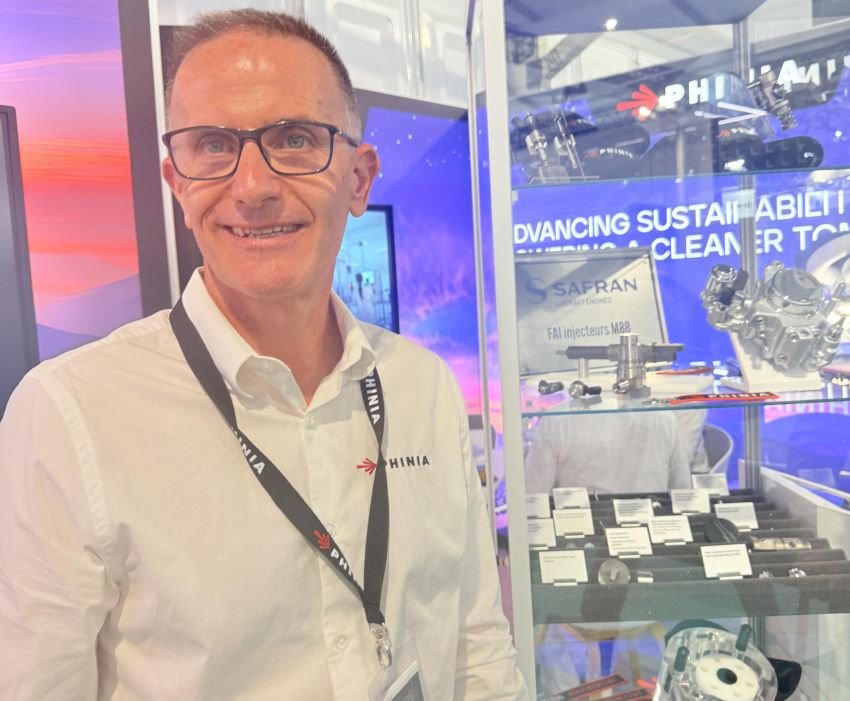
With decades of expertise in precision machining and pressure-and-flow control, PHINIA is expanding from automotive into high-precision aerospace. By partnering with Safran to supply critical components for the Rafale fighter jet’s M88 engine, it is applying automotive-grade scalability and quality control to solve pressing supply chain bottlenecks in defense and commercial aviation. In this interview with Aviation World, Emmanuel Simon, PHINIA’s Program Manager and Aerospace Leader, outlines the company’s global footprint, expanding certifications across Europe and Asia, and its vision for the aerospace sector. Excerpts…
AW: Tell us about the products and vertical that PHINIA deals into?
A: PHINIA is a diversified industrial company operating into different sectors. The range is from heavy-duty trucks tolight commercial vehicleswhere we supply components for them; marines, off-highway vehicles, like agricultural equipment or construction equipment. We also supply equipment for industrial, like power generation sets and automotive industry.
Recently, as a diversified industrial company, we have started our production with Safran in the aerospace sector. Our skill set is precision machining, pressure and flow control and we have decades of expertise in this particular segment. This includes work for hydro-mechanical components, for diesel and gasoline equipment, injector, pump for piston engine or rotary engine. As we can use off-the-shelf product coming from PHINIA so this is why we believe we can give an added value to this sector.
We have been diversified to supply components for turbine engine that require precision machining, high knowledge and skill in pressure and flow control. Due to this capabilities, Safran has selected us for the first production that has started this year.
AW:Where is PHINIA’s HQ located? How about your APAC presence?
A: PHINIA is a US-based company and has presence in more than 40 locations in above 20+ countries. We have approx. 13,000 people working and our annual revenue last year was 3.5 billion US dollars. Our first site in France is located in Loire which is certified for aerospace production. We have not yet our presence in Asia-Pacific but we have sites in China and India. This is why we have certified, and we are certifying this year another site in UK, our Stonehouse site. It will be certified EN-9100 before the end of 2026.
AW:From India, what services you provide?
A: In India, we are providing and manufacturing hydro-mechanical components, and we have also services for software systems.
AW:What area of work does you have with Safran?
A: With Safran, I cannot share all because we have NDA. We have started our first production this year for one product that equips the M88 engine, which is fitted on the Rafale fighter jet, which has been sold to India. There is a plan to sell 114 Rafale fighters to the Indian government and this should be tied up and signed before the end of the 2026. We have started the production in March.
We are SOP another product for the same engine and within next year, we will SOP for another product for this engine. So, this is about Safran industrialization, but also we are collaborating with Safran for advanced development project, where here it’s military and civil.
AW:How do you see your presence at the Farnborough Airshow?
A: Here, we highlighted the fact that we are convinced that PHINIA with his decade of expertise can bring an added value to the aerospace sector, because we are coming from the automotive industry. Currently, as I said, we are diversified across multi-sector of the industry and we can bring added value to perform fast track development. This is our DNA from the automotive industry and we have a vertical integration.
We have a strong quality approach which is now standardized also at the aerospace. This quality approach is giving us a guideline to make sure that we are developing products to answer the right requirements according to the right process.
This is a strength that PHINIA has and we have also the scalability. Currently, the supply chain in the aerospace manufacturers are struggling with the supply chain because many suppliers are small and they struggle to deliver and to answer the increased demand due to the growth of this sector.
( This interview is also published in the Aviation World Sept-Oct 2026 Print Edition)