
2nd India SAF Conclave brings together 500+ delegates and 200+ companies from 25+ countries; 5% blending targeted by 2030
New Delhi, September 28, 2026:
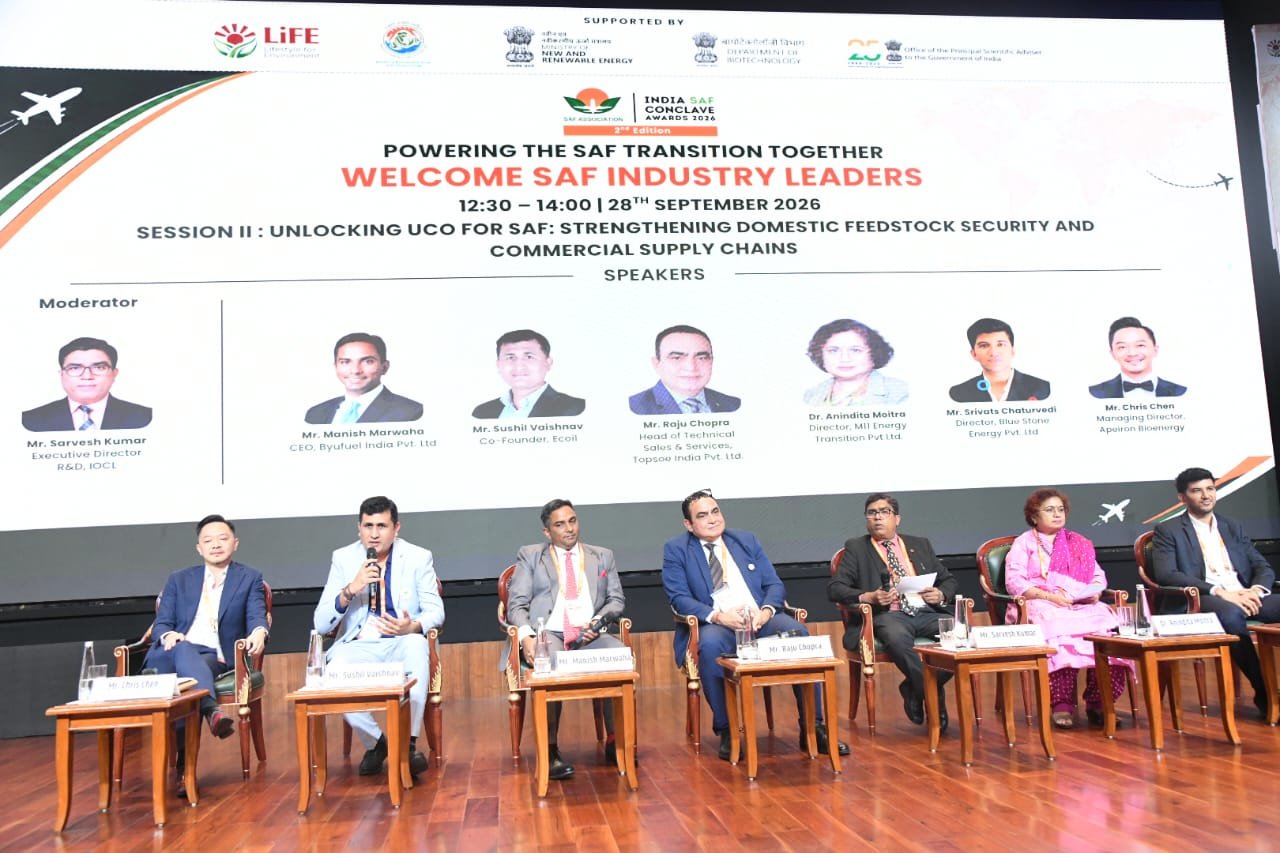
India’s Sustainable Aviation Fuel industry will rest on two foundations: fair income for the farmers who supply feedstock, and a verifiable carbon economy that earns the trust of airlines and international markets. That was the central message at the 2nd India SAF Conclave & Awards 2026, organised by the SAF Association at Bharat Mandapam on September 28-29.
H.E. Issa Saleh Abdullah Saleh Al Shibani, Ambassador of Oman to India, highlighted the scope for partnership. “India’s SAF transition presents significant opportunities for collaboration across energy, technology and investment,” he said. “Strong India-Oman partnerships can help develop sustainable aviation solutions and strengthen the clean-energy ecosystem. International cooperation will be critical to accelerating SAF adoption and building a sustainable aviation future.”
H.E. Benedikt Höskuldsson, Ambassador of Iceland to India, pointed to next-generation possibilities. “Green technologies and Power-to-X pathways can play an important role in shaping the next generation of sustainable aviation,” he said. “Innovation must be connected with investment, technology deployment and practical implementation. International platforms such as the India SAF Conclave can help accelerate collaboration and the global SAF transition.”The conclave has drawn over 500 delegates, 200 companies and 100 industry leaders from more than 25 countries.”SAFA is committed to bringing the entire SAF value chain together through industry-led collaboration and global partnerships,” said Rohit Kumar, Secretary General, SAF Association & CMAI. “Our focus is to connect policymakers, investors, technology providers, feedstock players and buyers to create practical opportunities. Through SAFA Matchmaking and structured dialogue, we aim to turn collaboration into projects, investment and commercial-scale SAF production.”
Harvest beyond the harvest
Conclave material estimates that feedstock opportunities could add around US$160-300 (₹15,000-₹29,000) per hectare to farmer income. SAFA estimates India could produce about 40 million tonnes of SAF a year by 2050, roughly 10% of global potential.
Sugarcane ethanol supply of around 1.5 billion litres gives Alcohol-to-Jet production a head start, while annual edible oil consumption of 29-30 million tonnes could yield 1.8-2.6 million tonnes of used cooking oil, though only a small share reaches authorised collection channels.
Dr. Alok Sharma, Vice President, SAF Association and former Director, R&D, IOCL, said scale depends on supply. “Scaling SAF will require reliable feedstocks, technology readiness, financing, certification, infrastructure and long-term offtake commitments.”
Proving every tonne
SAF can deliver up to 80% lifecycle CO₂ savings, and India’s emerging carbon economy will depend on proving them. The S&P Global Energy-SAFA report, India’s Strategy for SAF Leadership: From Policy to Implementation, stresses traceability, verification and certification.India already has four ISCC-CORSIA certified co-processing facilities with combined capacity of 106,500 tonnes. The next step is extending that rigour to the farm gate and the kitchen, so the carbon economy stays credible and suppliers are fairly rewarded.
The road to 5%
The indicative blending pathway for international flights is 1% in 2027, 2% in 2028 and 5% by 2030, with demand rising from about 46,000 tonnes to roughly 250,000 tonnes. Existing capacity should cover 2027 and 2028, but if HEFA and ATJ projects due between 2028 and 2030 do not come online, the 2030 target will be missed. Those projects need steady feedstock, putting farmers and collection networks at the heart of delivery. Blending mandates alone, the report notes, will not build a viable industry.

Building the ecosystem: SAFA and CMAI
SAFA, working with CMAI, has brought policymakers, investors, technology providers, feedstock players and airlines onto a common platform. Through SAFA Matchmaking, structured dialogue and global partnerships, it is turning conversations into projects and investment. Its joint report with S&P Global Energy offers a data-backed roadmap.
SAF YouTube channel launched
The conclave today also saw the launch of the SAF YouTube channel, Alongside the SAFA Knowledge Hub, the channel extends SAFA’s knowledge initiatives to a wider audience, bringing the SAF conversation to industry, policymakers and the public.
Growing market
S&P Global Energy estimates India’s jet fuel demand could rise from about 192,000 barrels per day in 2024 to 277,000 by 2031. The two-day conclave includes B2B and B2G meetings, MoU signings, technical workshops and CORSIA and SAF-Bioeconomy roundtables. The report concludes that the 2027 and 2028 milestones will lay the foundation for the 5% target in 2030.