
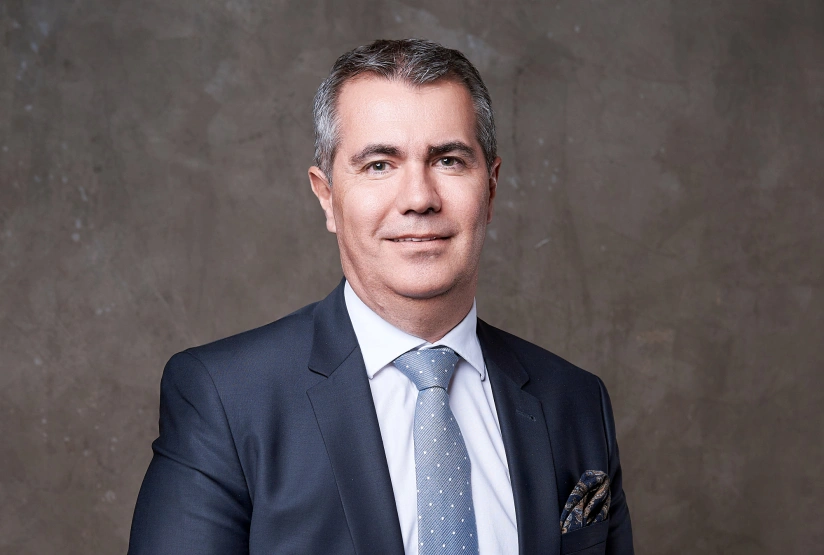
During a recent visit to Air Astana’s headquarters in Almaty, Vishal Kashyap, Managing Editor of Aviation World sat down with the airline’s Chief Executive Officer, Mr. Ibrahim Canliel. Having previously served across marketing, commercial planning, revenue management, and most recently as CFO through the company’s IPO, he brings a unique, 360-degree perspective to leading Central Asia’s premier aviation group. In a wide-ranging conversation, he shared key insights on the airline’s strategic pivot toward high-demand markets like India, navigating operational detours around closed airspaces, scaling domestic training and MRO infrastructure, and expanding the group’s fleet to 86 aircraft by 2030. Excerpts…
AW: You’ve been with Air Astana for a long time across various roles. How do you see your personal role in shaping the company’s core vision, particularly when it comes to corporate culture and operational strategy?
A: I’ve had the unique benefit of moving through the company almost like a nomad. I worked across Marketing, Sales, Commercial Planning, and Revenue Management before taking over as head of the commercial team. At that point, I felt I had exhausted my challenges—until our CEO at the time, Peter, invited me to step into the CFO role, specifically to lead us through our IPO process. It’s been an incredible journey with a steep learning curve that keeps me deeply driven.
Regarding our culture, when Air Astana was founded 24 years ago, our shareholders established three core principles that still define us today:
- Best International Standards: Operating with the highest global benchmarks for safety and service excellence.
- Strong Corporate Governance: A commitment to transparency, equal opportunity, and a strict meritocracy.
- Financial Independence: Operating without government subsidies or shareholder handouts—even during COVID-19, when we didn’t take a single penny. Being financially self-sufficient allows us to make purely commercial decisions that best serve our company, employees, and shareholders.
Ultimately, our biggest competitive advantage is our people. Competitors can buy the exact same aircraft or seats, but they cannot replicate our human touch. That signature customer experience is why Skytrax has named us the best airline in the region for 15 consecutive years and recognized our staff service for 10 straight years. We are constantly improving our product and training to ensure that competitive gap only continues to widen.
AW: How you’re targeting to enhance the airlines network with direct long haul routes further into Europe and Asia?
A: In Asia, we’re very clear and very ambitious, and we’re already executing on that strategy. As soon as the Gulf stabilises, we’ll start right back up where we left off six or seven months ago, when we were growing very strongly across the UAE, Saudi Arabia, Oman, and Qatar. We also have our eyes on a few more destinations there and want to increase our frequencies.
For Europe, our business case has been impacted by the longer flight times due to the Russia-Ukraine conflict. Because we don’t fly over or via Russia, our flights into Europe are about an hour and a half to two hours longer than what the great circle route would suggest.
Of course, that makes things a bit more difficult, but certainly not impossible. We’re still growing—this past year, we grew our existing destinations in Frankfurt and London, and we also added Larnaca, Cyprus to our network. We’re currently looking at multiple destinations along the European Mediterranean coast, as well as other points in Central, Eastern, and Western Europe. Naturally, if the Russia-Ukraine situation eases in the future and flight times are shortened, that would significantly accelerate our expansion plans into Europe.
AW: How about the status of fleet expense and plans? And are they well on as per your schedule?
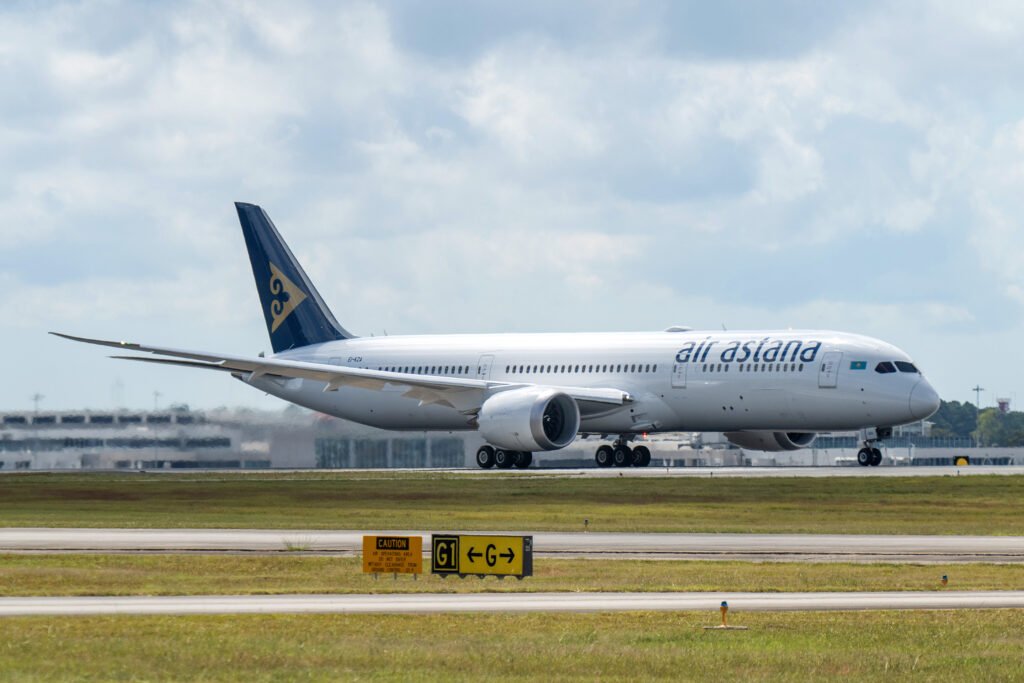
A: We are on track. This year, we’re currently operating at 63 aircraft, and we plan to close the year with 66. Looking ahead, our goal is to grow the fleet to 86 aircraft by 2030.
At the end of last year, we placed the largest order in our company’s history—as well as for the country and the entire region—for up to 65 aircraft. That includes up to 50 A320-family aircraft and up to 15 Boeing 787-9s.
Moving forward, we’ll continue to review our trajectory in line with our ambitions, adjusting our plans as we get closer to those key dates.
AW: Given recent geopolitical tensions, jet fuel prices have been highly volatile. How has this fluctuation impacted your flight operations ? And as a follow-up, have you had to pass those costs on to passengers through higher airfares or added fuel surcharges?
A: I’ll divide the question into two parts. First, we source 80 per cent of our fuel domestically in Kazakhstan, which is an oil-producing country. The government generally maintains a specific fuel price policy, and as a result, our domestic fuel prices—including jet fuel—have remained broadly stable throughout the entire year.
Second, for our international flights, when we uplift fuel outside of Kazakhstan on the way back, those prices are roughly double what they were at the beginning of the year. Naturally, that has had an impact, and we’ve had to increase fuel surcharges on our international network.
But relatively speaking, our exposure is much smaller than our competitors’, who have to import or buy 100 per cent of their fuel at market prices. In our case, at least 50 per cent of an international round trip operates on domestic fuel, so we only see price increases on the inbound leg.
That has put us in a very strong relative position. Being backed by domestic fuel availability is definitely a huge relief, especially at a time when most other airlines are having a very tough time.
AW: You operate two destinations into India right now. So is there any plan to add on more stations and seek increase in bilateral limits?
A: We would love to add more. Unfortunately, the bilateral agreement is quite restrictive at the moment. We would love to see both more cities and higher frequencies, as we see great scope for developing air connections between India and Kazakhstan.
Our President was in India just a few weeks ago, and he also highlighted the importance of strengthening business and cultural ties between our countries. India is a market where we see strong travel demand from both sides—from Kazakhstan as well as from India.
We have a lot of Kazakh travelers who would like to visit more cities in India, but currently, they’re unable to do so. At the same time, we’ve seen a very strong trend of travel from India to Kazakhstan. We are only three and a half hours away, and Kazakhstan is visa-free, so it’s very open to tourism from India.
While we see very strong demand, unfortunately, the supply is falling short. We would very much welcome an expansion in both the number of cities and the frequency of flights. We are fully committed that as soon as that happens, we will expand our geographical coverage to new cities as well as increase our overall flights into India.
AW: On the MRO front, are you looking to expand your maintenance services to other airlines across Central Asia?
A: We do. We currently own one hangar in Astana and lease a hangar in Almaty. Our plan is to invest in two more hangars in Astana—where we already have the land—and to build one big hangar in Almaty.
That will provide us with the capacity needed for our own ambitious growth plans going forward, while also giving us a certain amount of capacity for third-party services.
We already provide line maintenance to more than 40 airlines, but with these new hangars, we could provide full aircraft maintenance services in Kazakhstan as well. I wouldn’t limit the target market for that just to Central Asia and the Caucasus. As you know, aircraft maintenance can be provided on a much broader scale, so we would be looking to offer our services to airlines across Asia, the Middle East, and Europe.
AW: Are there any discussions currently underway regarding a demerger between Air Astana and FlyArystan?
A: No. FlyArystan is a 100 per cent owned investment of the Air Astana Group. We run the two to the very core of their respective business models. Air Astana is a full-service airline that targets network development, while FlyArystan is a low-cost carrier operating strictly by the core principles of an LCC.
We see great complementary characteristics between the two. It was a conscious decision not to go for a hybrid model, as that would mean competing for market share while diluting a very- very strong product that our loyal customers were extremely happy with. We would have been upsetting them, and the price point still wouldn’t have been right to drive the type of market stimulation we wanted.
That’s why we established FlyArystan. Air Astana already has one of the most competitive unit costs in the world, and FlyArystan is another 30 per cent lower than that. So,in markets that need to be stimulated, FlyArystan is a great asset to have, and we would not want to lose it. The two airlines complement each other exceptionally well in terms of market segmentation and network coverage, as well as from a strategic perspective. So, we have no plans to dispose of it.
AW: What is your current training capacity for pilots and cabin crew, and are you planning to expand your training facilities or programs?
A: We’ve actually just added a second simulator at Air Astana this year. We were running on just one simulator, and that single unit was operating around the clock at over 95 per cent utilization.
With the ambitious growth plans we have, along with the ungrounding of some of our Pratt & Whitney aircraft, we knew we were going to grow rapidly. So, we invested in a second simulator for our flight crew.
The same goes for our cabin crew—in the past, we used to send our crew abroad for training. Now, we can handle all mandatory training in-house, which saves us a lot of time and money.
Currently, the capacity of both facilities is more than sufficient to fully cater to our own needs. But as we continue to grow moving forward, we will certainly keep investing.