
Insect season: an overlooked threat to aircraft efficiency

Aircraft performance during insect season faces a costly challenge that many airlines underestimate. Research shows that insect accumulation on an aircraft’s laminar flow area and increase fuel consumption by 1.1% to 4.4%, with contamination levels as low as 400 insects creating measurable drag penalties. In other words, insect season can cost airlines millions annually.

The hidden costs of contamination

During insect season, bug residue tends to build up quickly on the nose, wings, and forward sections of aircraft. Without proper aircraft exterior cleaning, the drag they produce counteracts the force of thrust generated by engines and the lift generated by wings. This increases fuel consumption, creating additional operational expenses for airlines.

According to a detailed study by the German Aerospace Center (DLR), insect accumulation on natural laminar flow (NLF) wings can cause significant fuel penalties. The study showed that contamination levels of about 400 insects can increase fuel consumption by roughly 1.1% for shorter flights (~750 km) and up to 4.4% for longer missions.

“Given that fuel typically accounts for 25-30% of an airline’s total operating expenses, even a 1-4% increase in fuel burn due to insect contamination can cost airlines millions of dollars, especially for fleets with many daily flights,” says Veronika Andrianovaite, Chief Commercial Officer of Nordic Dino Robotics.

The insect problem

The threat of insect contamination is typically limited to operational phases close to the ground. Even during critical phases of flight, the aircraft speed is high enough to cause a rupture of the insect body.

“It is estimated that 50-60 % of the insects are collected during the ground run and thebalance at low altitude during climb out, final approach and landing,” Nordic Dino expert explains. “Depending on insect size, impact angle and impact speed, insect residue can account for up to a fourth of an aircraft’s overall contamination.”

Insect activity for air travel has distinct regional and seasonal patterns. According to Andrianovaite, it reaches its peak during warmer months:

“In Europe, for instance, it’s spring and summer. In many parts of Asia, it is linked to the monsoon season, which typically brings increased rainfall and humidity and can last until October.”

A solution that works

Given the cost impact of insect contamination, frequent aircraft cleaning becomes critical during peak insect activity periods. With airlines currently in high season across many regions, efficient cleaning solutions are essential for maintaining operational performance.

Robotic aircraft cleaning equipment offers a fast and safe solution to remove contaminants, including dead bugs – especially crucial during high-frequency, warm-weather operations when insect buildup accelerates, says Andrianovaite:

“Using modern aircraft washing robots, such as the Nordic Dino, can help to reduce aircraft exterior cleaning times by up to 80%,” “For wide-body airliners like the Airbus A330 and the Boeing 777, the time spent on exterior cleaning can be shortened from 8 to 4 hours, and for narrow-body jets like the Boeing 737, the required aircraft-on-ground (AOG) time is reduced from 3 to 1 hour.”

Aircraft washing robots eliminate long hours of manual labor-intensive washing procedures. In an industry that requires the highest levels of efficiency, these solutions bring serious long-term benefits – making sure tiny insects don’t create big problems for performance and profitability.

( Article provided by Nordic Dino,producer of self-contained robots for automatic aircraft washing and aircraft cleaning services)Views expressed are personal)

FOREWORD

Dear Readers,


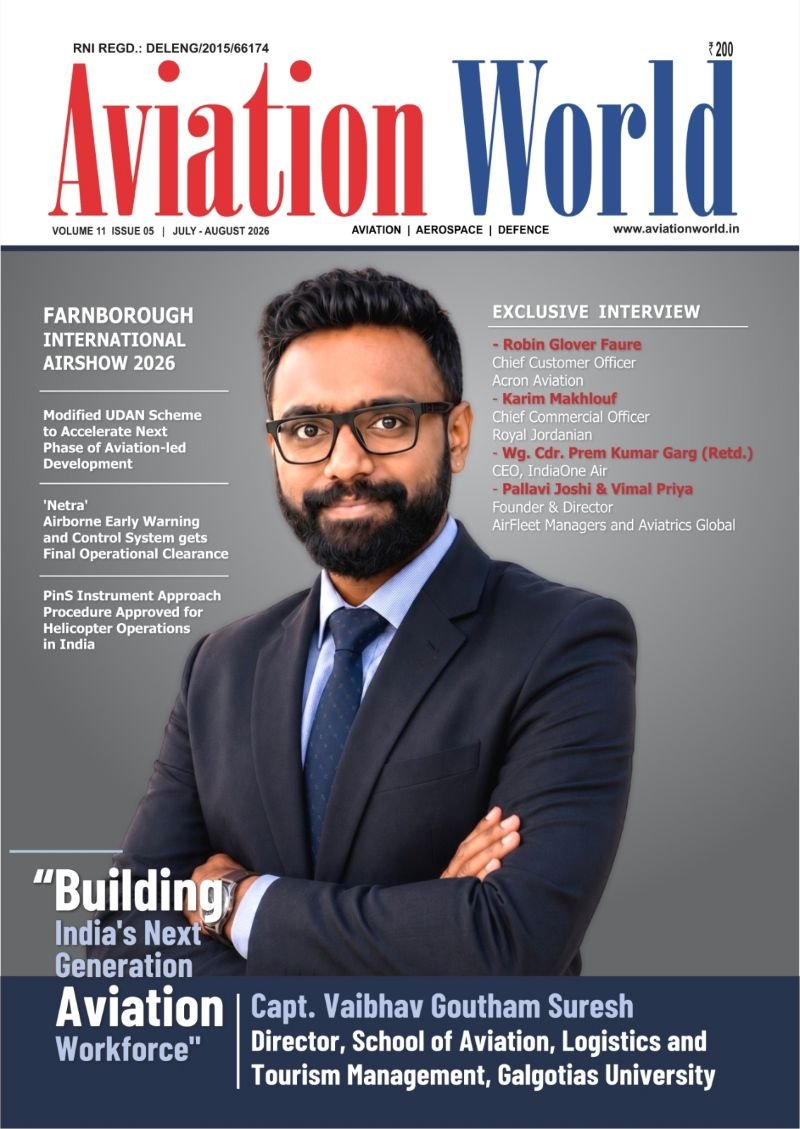
Welcome to the latest edition of Aviation World. This is an incredibly significant issue for us, perfectly timed to align with several prominent aviation events unfolding across the globe.


Chief among them is the Farnborough International Airshow, taking place from July 20th to 24th, 2026, in Hampshire, United Kingdom. Ranked as one of the world’s premier events for aviation, aerospace, and defense, this year’s airshow arrives at a crucial moment. Against a backdrop of geopolitical turbulence, Farnborough provides an invaluable platform to engage with global leaders and gain firsthand perspectives on the future of the industry. Inside, you will find our comprehensive curtain-raiser report focusing on the show’s core themes, as well as the highly anticipated static and aerobatic aircraft displays.


On our front cover, we are proud to feature Capt. Vaibhav Goutham Suresh, Director of the School of Aviation, Logistics and Tourism Management (SALTM) at Galgotias University. In an exclusive interview, Capt. Suresh highlights how SALTM bridges the gap between academia and the runway, delivering a comprehensive curriculum that ensures graduates are industry-ready from day one. Complementing this, our special feature on SALTM dives deeper into how the institution maintains world-class academic standards and a cutting-edge learning environment.


We are also privileged to bring you exclusive insights from a stellar lineup of industry trailblazers in this edition, including:

  • Robin Glover-Faure, Chief Customer Officer of Acron Aviation
  • Karim Makhlouf, CCO of Royal Jordanian Airlines
  • Pallavi Joshi & Vimal Priya, the leadership powerhouse behind AirFleet Managers &Aviatrics Global
  • Wg. Cdr. Prem Kumar Garg (Retd.), CEO of IndiaOne Air

Each shares a detailed perspective on driving innovation, navigating current market dynamics, and establishing progressive frontiers within their respective sectors.


Beyond these highlights, this issue is packed with curated features and analytical pieces designed to keep you informed and inspired.


Finally, we extend our heartfelt gratitude to our esteemed advertisers and partners. Your unwavering support empowers us in our ongoing endeavor to make Aviation World a truly world-class publication with global reach and recognition.


Happy Reading!


The Editorial Team


Aviation World

NEWSLETTER

Aviation World Magazine is India’s premier aviation magazine and has been actively supporting the development of the Indian and global civil aviation sector. We started our journey in year 2015 and its been 12 years now and the response and acceptance is really encouraging. Thanks to all our associates and writers who remained with us in our progressive journey.

We have started 2026 on a very positive note and we look forward to increase our footprints to more locations and induct many more new companies in our campaign.. Do write to us at : editor@aviationworld.in

Disclaimer

The contents published in this website are news covering Aviation, Aerospace and Defence sector. The objective is to provide news in informative form to keep our readers updated of the latest development. We also publish content featured in our print publication Aviation World.We try our best to avoid any factual errors or image displayed here but we ensure immediate corrections to any such thing brought to our notice that might have been published inadvertently. All images and contents are sourced from the relevant organisations media team.

Copyright ©2014 – 2026. AVIATION WORLD. All rights reserved.

Scroll to Top