

Jet Blast Deflectors contribute to overall airport efficiency by allowing for more compact and flexible airport designs…
With the growing number of airports and airlines, it is important to take some decisive steps towards efficient operations and maintain standard safety zones which is directly impacted by the Jet Blast. To understand more about the Jet Blast impact and how it can be curtailed,Vishal Kashyap, Managing Editor, Aviation World speaks with Mr. Sameer Khale, Director, Sheetala Infrastructure Consultancy Pvt. Ltd which has successfully installed JBDs at prominent Indian Airports. Excerpts…
Q: What are International regulatory norms for installation of Jet Blast Deflector (JBD) at airports?
A: While there are no specific international regulatory norms governing the installation of JBDs at airports, various aviation authorities and regulatory bodies worldwide may have guidelines or recommendations regarding their use.
Organizations like the International Civil Aviation Organization (ICAO) provide general standards and best practices for airport operations, which may include considerations for mitigating jet blast effects. However, the specifics of JBD installation may vary by country or region. In many cases, the installation of JBDs at airports is mandated by national or local aviation authorities or regulatory officials.
These authorities may require airports to install JBDs based on factors such as airport layout, proximity to sensitive areas, aircraft types operating at the airport, and safety considerations.
While regulations often dictate the need for JBDs, it is typically the responsibility of airport operators to ensure compliance with these requirements.
In conclusion, while there may not be specific international regulatory norms for JBD installation, the decision to install Jet Blast Deflectors at airports is often influenced by a combination of regulatory requirements, safety considerations, and operational needs.
Q: Is it the choice of airport operators or mandated by the respective governments or regulatory officials to install this system?
A: The decision to install JBDs is often influenced by a combination of regulatory requirements, safety considerations, operational needs, and financial feasibility.
Airport operators may work closely with regulatory authorities, aviation consultants, and engineering firms to assess the need for JBDs, plan their installation, and ensure that they meet regulatory standards. They may also consider factors such as airport layout, traffic patterns, aircraft types, and safety assessments when deciding to install JBDs. The presence of a JBD allows airports to design their layout more efficiently.
Without a JBD, airports would need to maintain greater distances between runways, taxiways and other infrastructure to account for the safety concerns associated with jet blasts. The redirection of the exhaust by the JBD means that these safety zones can be reduced, optimizing the use of available space.
This efficient layout design is particularly crucial at busy airports where maximizing the number of runways and taxiways is essential for accommodating the high volume of air traffic. In summary, Jet Blast Deflectors contribute to overall airport efficiency by allowing for more compact and flexible airport designs while ensuring the safety of surrounding areas.
Q: How does the system works in terms of deflating the impact of jet blast?
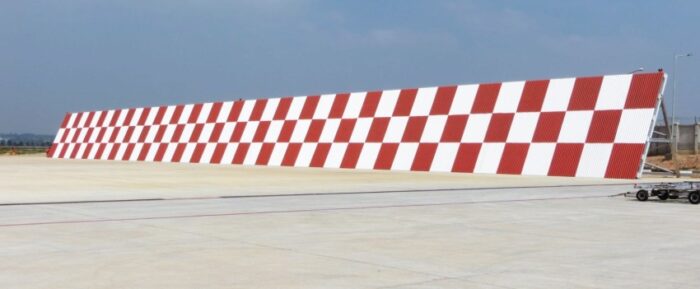
A: A JBD is an inclined steel structure which fully diverts the high energy jet blast upwards thus protecting the area behind. The angle of the JBD has to be such that the entire blast is diverted upwards but no turbulence is formed due to the negative pressure which may have been generated by the jet blast.
JBDs are required in 2 places; at airports and by MROs. It is mandatory for all engine MROs to have a JBD. The jet blast can reach speeds of upto 240 kmph which can be extremely dangerous for personal present at the airports, for equipment as well as nearby structures. Also, any wind speed above 56kmph is considered dangerous and should be mitigated appropriately. The use of a JBD increases the efficiency of the airport by allowing more flexible use of the available space.
Q: In terms of percentage, how impactful this process is in terms of minimizing the jet blast impact?
A: The impact is 100%. The JBD fully diverts the jet blast upwards, making the area behind, completely safe, for personnel and equipment.
Q: As mentioned in your report, already few airports in India have taken this service. Any data you may share in terms of pre-post impact at these airports?
A: Generally JBDs are planned in advance when the airport is being constructed or going for expansion For Eg: Navi Mumbai is going for 3 JBDs during construction stage itself; Cochin airport has 2 JBDs and now they want 2 more for their T3 expansion.
Q: How big this segment is when you see the growing number of airports in India and overseas?
A: Demand is just picking up and with the kind of exponential growth in the Indian aviation sector,I anticipate that 100 to 120 JBDs will be needed in the next 7 to 8 years in India alone. A similar number will be needed for Asia-Pacific and Africa.
Q: What are the future projects in terms of number of airports you will target globally?
A: Our product is at par with the Market leader with a much lower cost. We are considered as among the top 5 JBD manufacturers in the world by various market research websites. We are targeting the Indian, asia pacific and African region.
Q;How does the production works? Is it based on the demand and what’s about the capacity?
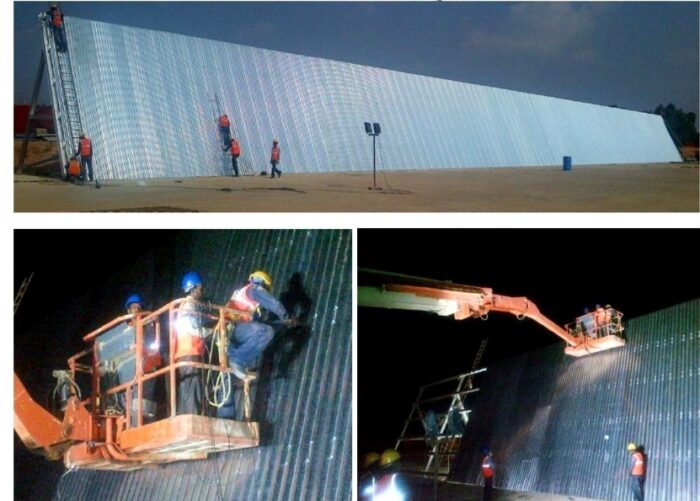
A: We design all JBDs as per the specific requirement and situation of that particular airport. All our JBDs are totally bolted structures. Sheetala Infrastructure specializes in completely bolted custom designed Jet Blast Deflector systems. Welding is not used at all thus greatly reducing the power consumption and eliminating the gases that would have been generated during welding.
The reduced energy consumption during manufacturing, ease of disassembly for recycling, and flexibility for modifications make bolted steel structures a more environmentally friendly option compared to welded structures.We have enough capacity to carry out production of several JBDs simultaneously.