
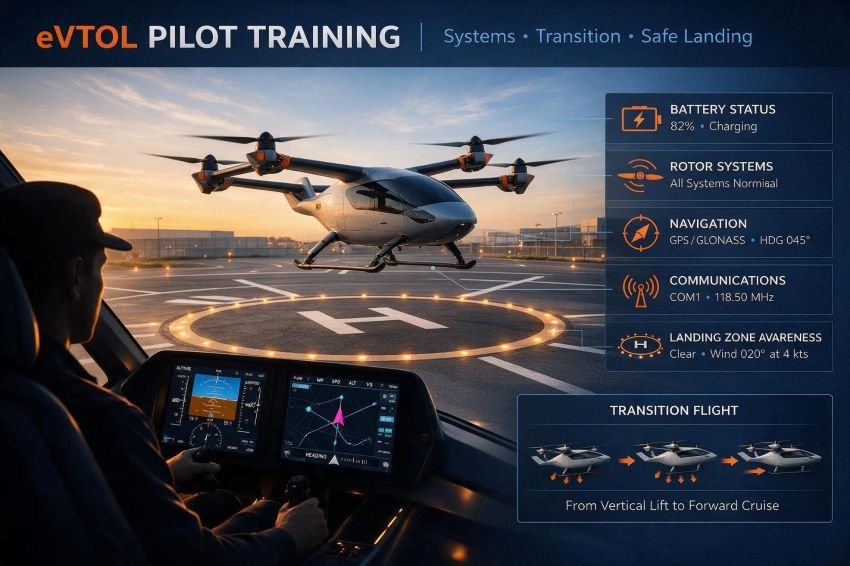

Pilot training for eVTOL aircraft should combine helicopter, airplane, and powered-lift competencies.
- By Amit Mittal
1: Regulatory qualification
Training must begin with the applicable licensing framework:
- A commercial pilot qualification and instrument privileges will generally be important for passenger-carrying operations.
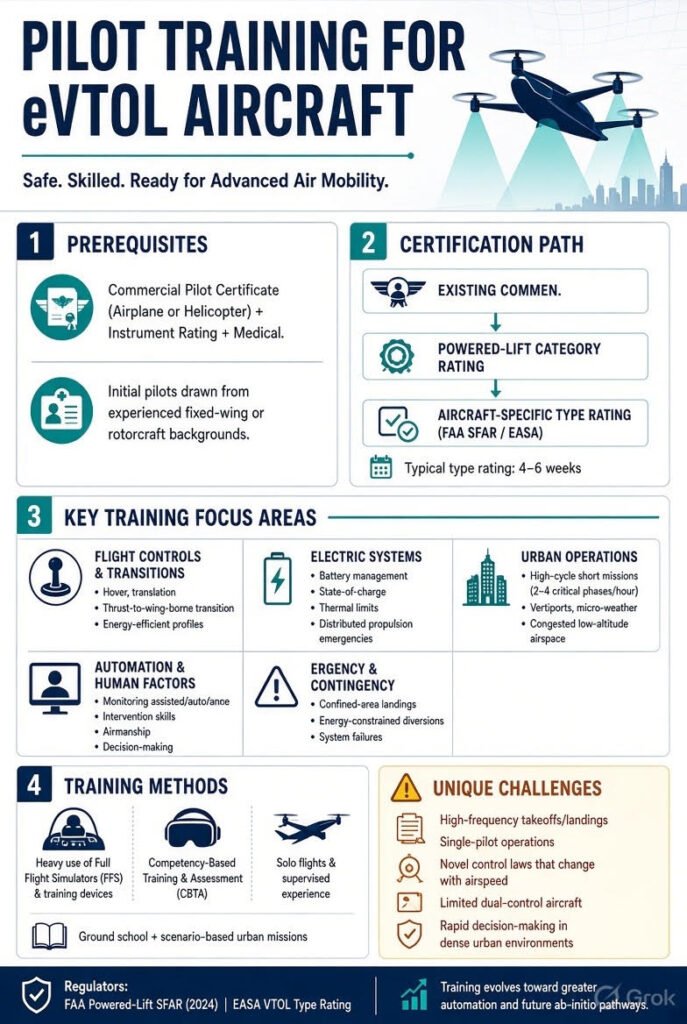
- FAA treats powered-lift as a distinct category and provides guidance for adding a powered-lift category rating and an aircraft-specific type rating under SFAR 120.
- EASA expects manned VTOL aircraft to require a type rating. Its guidance allows the syllabus to draw from airplane, helicopter, and powered-lift training, with a customized training-needs analysis for each aircraft type.
- Pilots should be trained and checked on the specific aircraft model, not merely on a generic “eVTOL” category, because flight-control logic, transition behavior, propulsion architecture, and emergency procedures vary widely.
- SAE standards (e.g., AS7062) support curriculum development for on-board and remote pilots, including simulation use.
- Training duration for type ratings is often around 4–6 weeks for experienced pilots (ground school + simulator + limited aircraft time).
- Aircraft systems knowledge
The ground-school portion should cover:
- High-voltage electrical systems and electrical safety.
- Batteries or other energy-storage systems, including state of charge, state of function, degradation, thermal limits, and power availability.
- Distributed electric propulsion, lift/thrust units, inverters, motors, cooling systems, and associated monitoring.
- Flight-control computers, fly-by-wire logic, envelope protection, automation modes, and reversionary control.
- Navigation, communications, datalink, health-monitoring, and maintenance-alert systems.
- Weight, balance, center-of-gravity limits, and how passenger or battery loading changes performance.
Energy management deserves special attention. Unlike conventional aircraft, eVTOL performance can depend strongly on battery aging, state of charge, cooling or heating, and the power demand profile during a flight. EASA specifically identifies these factors as relevant to performance assessment.
- Vertical flight and transition handling
The central new skill is managing the aircraft across different flight regimes:
- Vertical takeoff and landing.
- Hover and low-speed maneuvering.
- Acceleration from hover into wing-borne or mixed flight.
- Deceleration and conversion back to vertical flight.
- Conventional airplane-like cruise, if the aircraft has that capability.
- Wind, turbulence, crosswind, and gust management during hover and transition.
- Recognition of unsafe or incomplete transitions.
- Use of aircraft-specific limits for tilt angle, airspeed, motor speed, power, and altitude.
Pilots must understand not only the normal control technique but also how the aircraft behaves when the transition is delayed, interrupted, automated incorrectly, or affected by a failed propulsion unit.
- Automation and human factors
Many eVTOLs will rely heavily on automation, so training should include:
- Automation mode awareness.
- Mode changes during takeoff, transition, approach, and landing.
- Manual flying with reduced automation.
- Detecting misleading or contradictory indications.
- Managing automation surprises and unexpected reversion.
- Workload management in a single-pilot cockpit.
- Crew resource management where two pilots, remote support, or ground personnel are involved.
- Passenger, vertiport, and air-traffic communications while monitoring complex systems.
- Decision-making when the aircraft’s software, energy reserves, weather, or landing-site availability changes.
A pilot who can operate the automation but cannot safely take over manually is not adequately trained.
- Emergency and abnormal procedures
This is likely to be one of the most important parts of the syllabus. Training should cover both immediate aircraft control and subsequent decision-making for:
- Loss of one or more lift/thrust units.
- Partial or total loss of electric power.
- Battery fire, thermal runaway warning, smoke, or overheating.
- Propulsion-control or inverter failures.
- Flight-control-computer failures.
- Sensor disagreement or unreliable airspeed/altitude data.
- Loss of communications or navigation.
- Landing-site unavailability.
- Low-energy or unexpected energy-consumption scenarios.
- Controlled emergency landing or autorotation-like procedures, where applicable.
- Forced landing in urban or congested environments.
- Windshear, turbulence, icing, heavy rain, and degraded visibility.
- Aborted takeoff, rejected landing, and go-around during transition.
Training should include failures at the most safety-critical points: shortly after liftoff, during conversion, during final approach, and with minimum practical energy reserves. EASA’s VTOL compliance material highlights the need to consider critical failures for performance and the effects of wind, altitude, temperature, configuration, and energy-storage condition.
6: Simulator-based training
High-fidelity simulation should be central rather than supplementary. It should reproduce:
- The cockpit displays and control laws.
- Vertical, transition, and cruise modes.
- Realistic battery and propulsion behavior.
- Wind, weather, traffic, and vertiport environments.
- Normal and abnormal automation behavior.
- Failures that are too dangerous or impractical to rehearse in the aircraft.
- Different passenger, payload, temperature, and state-of-charge conditions.
- Night and instrument operations, if authorized.
A strong program should use scenario-based and competency-based training rather than relying only on memorized procedures. Pilots should demonstrate that they can maintain aircraft control, diagnose the problem, select a safe landing option, communicate effectively, and manage energy under pressure.
- Performance and operational planning
Pilots need deeper performance-planning skills than a simple battery percentage check. Training should address:
- Takeoff and landing performance.
- Hover ceiling and out-of-ground-effect performance.
- Density altitude and temperature effects.
- Wind direction and strength.
- Weight and center-of-gravity effects.
- Energy required for each flight segment.
- Reserve policy and diversion planning.
- Battery degradation and uncertainty in predicted range.
- Vertiport limitations and alternate landing sites.
- Obstacle clearance and downwash considerations.
- Noise-sensitive areas and urban operating constraints.
Performance planning should use approved aircraft data and operational limitations, not generalized range estimates.
- Instrument, weather, and airspace operations
For commercial air-taxi or shuttle operations, training should include:
- Instrument procedures and approach profiles.
- Operations in controlled and uncontrolled airspace.
- Traffic avoidance and conflict management.
- Integration with helicopters, airplanes, drones, and conventional air-traffic systems.
- Vertiport arrival, departure, and surface procedures.
- Low-visibility and night operations.
- Weather avoidance and changing micro-weather around buildings.
- Contingency routing when a vertiport is closed or unavailable.
- Communication with air traffic control and operations-control centers.
Urban operations require particular discipline because the pilot may have limited options for a conventional runway or open-area forced landing.
- Practical aircraft experience
Simulator training cannot replace all aircraft experience. Practical training should progressively include:
- Aircraft familiarization and cockpit procedures.
- Instructor-led hover, takeoff, landing, and transition flights.
- Demonstration of normal and abnormal procedures.
- Supervised solo or line-oriented flight, where regulations permit.
- Operations with representative passenger loads and environmental conditions.
- Supervised operating experience with an appropriately qualified pilot.
- A formal skill test and aircraft-specific proficiency check.
The balance between simulator and aircraft time should be based on the aircraft’s design and validated training needs, rather than a fixed number copied from helicopter or airplane training. EASA guidance specifically calls for a type-specific training-needs analysis covering cockpit environment, flight-control logic, handling qualities, maneuvers, limitations, and failure conditions.
- Recurrent training and safety culture
Initial qualification is only the beginning. Recurrent training should regularly assess:
- Manual handling and transition skills.
- Low-energy and propulsion-failure scenarios.
- Battery and thermal-management emergencies.
- Automation failures and mode awareness.
- Instrument and low-visibility operations.
- Urban landing-site contingencies.
- Crew resource management and threat-and-error management.
- Recent changes to software, procedures, or operating limitations.
- Flight-data and safety-reporting lessons.
A useful eVTOL training program should also promote conservative energy management, disciplined go/no-go decisions, effective use of checklists, and rapid reporting of software, battery, propulsion, and human-factors issues.
Challenges and Longer-Term Outlook
Challenges include lack of operational data, varying aircraft designs/controls across OEMs, limited dual-control aircraft for instruction, pilot supply (initial reliance on existing commercial/military pilots), and integrating into dense low-altitude airspace.
Longer-term, as fleets scale and automation increases (toward remote/autonomous operations), pathways may expand for ab initio training focused on eVTOL-specific skills, with reduced traditional hour requirements enabled by simplified vehicle design. Remote pilot training will emphasize decision-making and intervention skills.
Overall, effective programs prioritize safety through rigorous type-specific training, simulation, energy/system awareness, and urban operational competencies while leveraging automation to focus pilots on higher-level airmanship. Requirements continue to evolve with regulatory refinements and operational experience.
( Amit Mittal, Director of AeroIntellect Aviation is an aviation expert with extensive experience of over 21 years in the industry. He is associated since a long time internationally with eVTOL , UAM, Electric Aircraft, AAM as Advisor and Subject Matter Expert.)
E: amitmittal@aerointellect.net