
 By Sudip Sharma,Director, Safe Fly Aviation
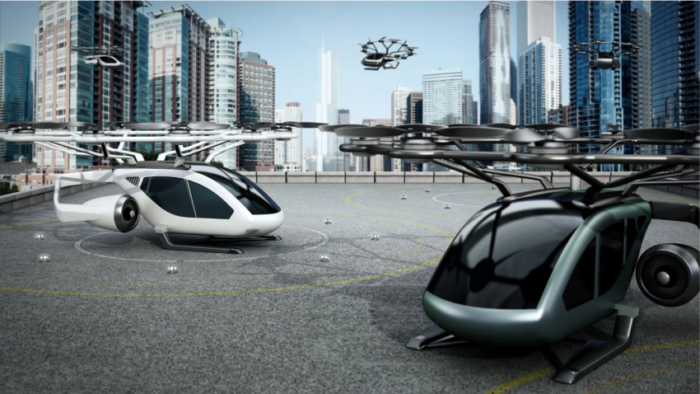
The skies above our cities are quietly changing — and faster than most people realise. What was once the domain of helicopters and the occasional news or medical flight is now being joined by delivery drones, surveillance platforms and a new generation of electric air taxis known as eVTOLs (electric vertical take-off and landing aircraft). Below 3,000 feet, urban airspace is becoming one of the most active and complex transportation environments in the world.
This transformation brings enormous opportunity. Urban air mobility promises quicker journeys, reduced pressure on congested roads, and cleaner, quieter aircraft. But it also presents a serious challenge: how do thousands of aircraft safely share the same narrow band of sky over busy cities?
Without smart management, this airspace could become as crowded as the roads below — undermining safety, reliability and public confidence.
That is why the future of urban aviation depends not just on new aircraft, but on new ways of managing the sky.
WHY TRADITIONAL AIR TRAFFIC CONTROL ISN’T ENOUGH
Conventional air traffic control was designed for large aircraft flying at high altitudes between major airports. It works exceptionally well for commercial jets, but it was never built to handle thousands of low-level flights operating autonomously, on demand, and often within dense urban environments.
To solve this, aviation authorities and technology providers are building a new digital layer of airspace management called Unmanned Traffic Management, or UTM.
UTM platforms act like an intelligent traffic system for the sky. They coordinate aircraft in real time, assign flight corridors, automatically detect conflicts, and reroute traffic when weather, emergencies or congestion arise. Unlike traditional ATC, much of this process is automated, allowing vast numbers of drones, helicopters, and eVTOLs to operate safely simultaneously.
A GLOBAL SHIFT IS ALREADY UNDERWAY
This is no longer theoretical. Regulators around the world are actively rolling out frameworks to integrate UTM with existing air traffic systems.
In the United States, the FAA is developing nationwide rules for remote identification, digital flight authorisation and drone-to-ATC coordination. In Europe, EASA is implementing the U-Space framework, which allows drones and air taxis to fly safely even near major airports and busy cities.
Live trials in places such as Los Angeles, Paris, Singapore and Dubai have already demonstrated mixed operations — where cargo drones, helicopters and passenger air taxis operate side-by-side using AI-driven flight planning, weather integration and automated safety systems.
The goal is simple: increase airspace capacity without increasing risk.
WHAT THIS MEANS FOR SAFE FLY AVIATION
For an operator like Safe Fly Aviation – with expertise spanning private jet charter, helicopter services and advanced air mobility — this evolution is not just important, it is essential.
Our clients depend on speed, reliability and safety.
As urban airspace becomes more dynamic, we are actively preparing for a future in which helicopters, drones, and eVTOL aircraft operate together seamlessly. Smarter airspace means fewer delays, better routing, lower emissions and more predictable operations — whether it is a VIP helicopter transfer today or an electric air taxi tomorrow.
FROM CONGESTION TO CONNECTIVITY
The future of low-altitude airspace is not about competition between aircraft types. It is about coexistence.
With the right technology, regulations, and collaboration among regulators, operators, and innovators, our skies can become an extension of our transport networks — connecting people, businesses, and cities faster and more sustainably than ever before.
At Safe Fly Aviation, we are committed to being part of that future, ensuring that every flight — whether piloted, autonomous or electric — is guided by the same principles that have always defined aviation excellence: safety, precision and trust. The sky is no longer the limit. It is the next frontier of connected mobility.
(Views expressed are personal. Banner image is used for representation purpose only)