


September 21, 2026

Interview

We are the only firm in India representing both fixed-wing and rotary-wing OEMs in India

In an exclusive conversation with Aviation World, Sudhir S. Rajeshirke, President – Aerospace at Jubilant Enpro Pvt. Ltd. shares insight on aircraft management reform, regional turboprops and the coming HEMS market. Excerpts… AW: Help us understand the role of Jubilant in representing two global OEMs in a market like India, and how has that role evolved? A: Jubilant’s aerospace business has represented OEMs since 1995 and now we represent top aerospace brands such as Bell Flight and Textron Aviation in India. As far as I am aware, we are the only firm in India representing both fixed-wing and rotary-wing OEMs in India. We front-end customer relationships right from the time they first engage with us on assessing the right aircraft for them through the entire life cycle of the product. Our key role is to develop market and ecosystem for an eventual sale of aircraft in India.  When a customer is ready to take delivery, we ensure that the pilots, maintenance infrastructure, training, spares and other support systems are available for a seamless induction and operation of Textron and Bell aircraft in India. In addition, by taking active role in leading industry bodies, we work in development of aviation policies that are conducive to the growth of business aviation in India. AW: The Ministry of Civil Aviation and DGCA have been working on enabling provisions for aircraft management, and eventually for shared ownership. You have argued for this for the better part of a decade. What would be likely impact when the changes come through?  A: Today, a huge hassle for any aircraft customer, typically the companies, State Governments, large institutions, is they have to  start and operate an aviation company which is outside their core domain expertise. They have to hire flight crew, engage maintenance agency and carry out quality, procurement, regulatory activities. This is a huge deterrent as large liabilities are involved. Further, due to complex structuring, customers don’t receive depreciation benefits.  That’s a huge financial loss for an expensive asset. Under an aircraft management model, a professional entity spreads crew, quality systems and administrative capability across a fleet. This model separates the ownership and operation between two parties.  The customer gets ownership and depreciation benefits, the aircraft management company provides professional aviation services, which is it’s core expertise.  Both win. Secondly, the regulator’s job gets easier. Today the DGCA has to oversee a very large number of small operators, many holding one or two aircraft, each with its own systems. That is an enormous supervisory burden on an organization that is already stretched. If a professional aircraft management service provider holds operational and compliance responsibility for several aircraft, the regulator monitors one competent entity instead of many uneven ones. That is better for safety oversight. Thirdly, aircraft management regulations will lay the foundation for aircraft fractional ownership. It is better that these are bought sequentially and not simultaneously as you cannot attempt the second without having proved the first. AW: Turning to regional connectivity, how do the Cessna Caravan and SkyCourier fit India’s requirement? A: The Ministry of Civil Aviation’s UDAN’s Regional Connectivity Scheme succeeded in upgrading tier-2 and tier-3 airport infrastructure and in making air travel affordable on routes that were never served before.  However, two major challenges still exist.  Firstly, airlines need to offer a price that’s affordable at even subsidized levels.  Secondly, planes, need to fly at least half full for profitable operations. These challenges have impacted airlines to serve profitably on aircraft that have more than 70 plus seats but need to serve short-thin routes.   The economics don’t work. The Grand Caravan EX is built precisely for that. It carries up to ten passengers and an airline is able to fill the aircraft on almost all routes. The cost of acquisition and operation helps airlines using Caravan become profitable on RCS routes.  India One Air has been an exemplary example. They built a business model on short-thin routes in North East region and opened up access to locations that were previously unserved in the region.  Another new operator Megamax Aviation will be launching services next year with Grand Caravan aircraft thus making it an obvious choice for RCS operators. The SkyCourier operates a notch above. It is a twin-engine turboprop that carries between 15 and 19 passengers, including cargo combination versions.  For India, e-commerce and pharmaceutical logistics are pushing volume into tier-2 and tier-3 cities faster than the feeder air-cargo network has developed. A twin-engine aircraft with containerized loading and low operating cost is a very sensible answer to that. AW: You have also spoken about HEMS and search and rescue (SAR). Where is that market today? A: India is, to my knowledge, the only major economy still substantially under-served by air medical and search and rescue services. The Ministry of Civil Aviation has made a start: The Sanjeevani pilot, with a helicopter stationed at AIIMS Rishikesh was an important proof of concept. But pilot projects need scale. For HEMS to become a genuine industry in India, three  things need to be resolved. The first is the funding model. Somebody has to pay for the helicopter acquisition and missions. In mature markets that is a combination of insurance reimbursement, state health budgets and subscription schemes. In India, the funding model is not yet developed.  So we need to enable hospital chains to pay for acquisition and have management companies to operate HEMS missions. The second is infrastructure and air congestion within cities for HEMS operations. The third is regulatory and airspace clarity  specific to the mission. HEMS and SAR operate under time pressure and need to occur at a moment’s notice and not wait for any approvals. Initiating search and rescue (SAR) missions need inter-ministerial coordination framework to carry out widespread SAR missions that save lives in times of emergencies such as floods, earthquakes and other natural calamities. AW: How does Bell position itself in that segment? A: Bell has been at the forefront in championing the cause of HEMS and SAR
Defence

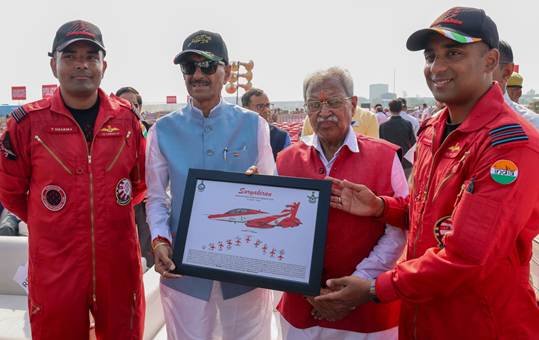
Suryakiran Aerobatic Team takes to Meerut skies for the first time

Meerut, 21 September 2026: The Suryakiran Aerobatic Team of the Indian Air Force took to the skies of Meerut for the first time on September 19 and 20, 2026, captivating spectators with a breathtaking display. Over 1 lakh people, including students, National Cadet Corps cadets and National Service Scheme volunteers turned up over two days to witness the display. Notably, three members of the SKAT team, including two pilots who performed aerobatics, are from Meerut. On September 20, 2026, the show was witnessed by Raksha Rajya Mantri Shri Sanjay Seth. Posting on X, Shri Sanjay Seth described the event as a remarkable blend of discipline, precision, teamwork, and professionalism, and a testament to the Indian Air Force’s glorious capabilities. He commended the courage and dedication of SKAT which has performed in over 800 airshows, both in India and abroad, in its 30-year journey, so far. Posting on X on the first day of the display, Chief Minister of Uttar Pradesh praised the precision and courage of SKAT pilots who painted the sky in the colours of the Tricolour, showcasing breathtaking precision and courage. He called it a proud and inspiring moment for the state and a nation as a whole. Other dignitaries who witnessed the show include Rajya Sabha MP Dr Laxmikant Bajpai, UP Minister of State Shri Somendra Tomar, and Members of the Legislative Council Shri Ashwini Tyagi and Shri Dharmendra Bhardwaj.

Civil Aviation

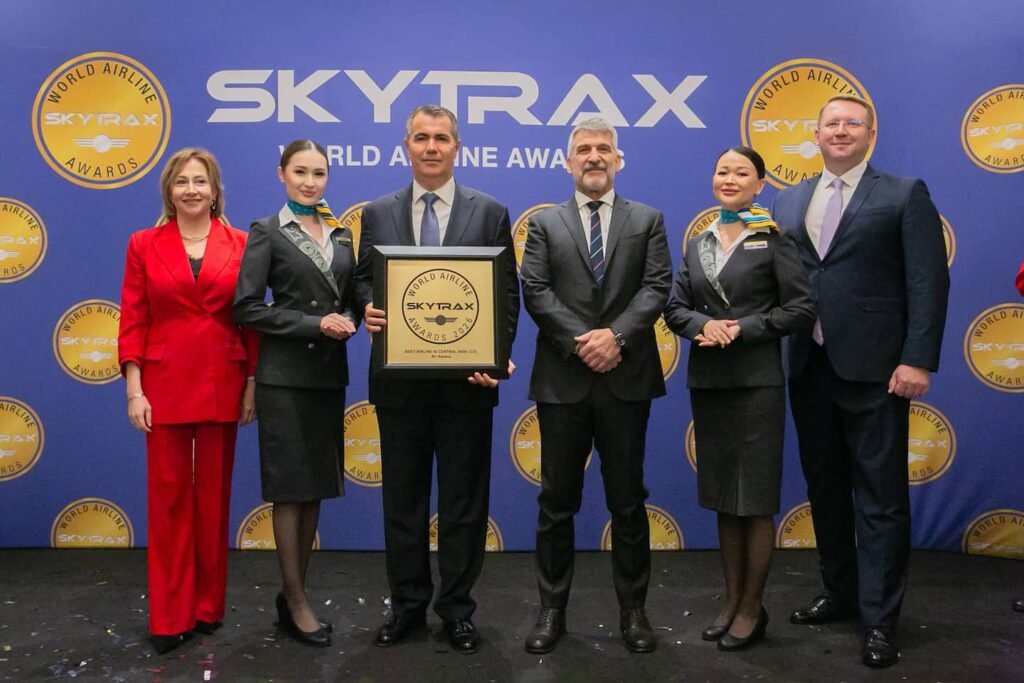
Air Astana Group Wins Several Top Awards at the 2026 Skytrax Airline Awards

Singapore, 21 September 2026: Air Astana received two major accolades, being named Best Airline in Central Asia & CIS for the 15th consecutive year and Best Airline Staff Service in Central Asia & CIS for the tenth time at the prestigious 2026 World Airline Awards, held on 18 September 2026 at the iconic Langham Hotel in London. The awards are organised by Skytrax, the international air transport rating organisation. Air Astana continues to lead the region in quality and service delivery, with 2026 marking another year of double-award success at the World Airline Awards. This continued recognition reinforces its position as the top-rated carrier in Central Asia & CIS and reflects strong customer appreciation of the airline’s consistently high standards and quality of staff service. FlyArystan, the Group’s low-cost carrier, also confirmed its regional leadership by receiving the Best Low-Cost Airline in Central Asia & CIS award for the fourth consecutive year. Edward Plaisted, CEO of Skytrax, said: “Air Astana’s success at this year’s World Airline Awards serves to highlight the high standards of their front line service and product standards. Customers show a strong appreciation of their service, and this success in 2026 demonstrates Air Astana’s dedication to providing an excellent quality of onboard experience, and consistent service delivery.” Ibrahim Canliel, CEO of Air Astana Group, said: “We are honoured to receive these prestigious Skytrax awards for both Air Astana and FlyArystan. This recognition is particularly meaningful because it reflects the views of our passengers and demonstrates the strength of both airlines across their respective market segments. I would like to thank our customers for their continued trust and loyalty, and our entire team for their dedication and commitment to delivering the highest standards of safety and service. We will continue to invest in our people, our fleet and our customer experience as Air Astana Group enters the next stage of its growth.”

FOREWORD

Dear Readers,


Welcome to the latest edition of Aviation World. This is an incredibly significant issue for us, perfectly timed to align with several prominent aviation events unfolding across the globe.


Chief among them is the Farnborough International Airshow, taking place from July 20th to 24th, 2026, in Hampshire, United Kingdom. Ranked as one of the world’s premier events for aviation, aerospace, and defense, this year’s airshow arrives at a crucial moment. Against a backdrop of geopolitical turbulence, Farnborough provides an invaluable platform to engage with global leaders and gain firsthand perspectives on the future of the industry. Inside, you will find our comprehensive curtain-raiser report focusing on the show’s core themes, as well as the highly anticipated static and aerobatic aircraft displays.


On our front cover, we are proud to feature Capt. Vaibhav Goutham Suresh, Director of the School of Aviation, Logistics and Tourism Management (SALTM) at Galgotias University. In an exclusive interview, Capt. Suresh highlights how SALTM bridges the gap between academia and the runway, delivering a comprehensive curriculum that ensures graduates are industry-ready from day one. Complementing this, our special feature on SALTM dives deeper into how the institution maintains world-class academic standards and a cutting-edge learning environment.


We are also privileged to bring you exclusive insights from a stellar lineup of industry trailblazers in this edition, including:

  • Robin Glover-Faure, Chief Customer Officer of Acron Aviation
  • Karim Makhlouf, CCO of Royal Jordanian Airlines
  • Pallavi Joshi & Vimal Priya, the leadership powerhouse behind AirFleet Managers &Aviatrics Global
  • Wg. Cdr. Prem Kumar Garg (Retd.), CEO of IndiaOne Air

Each shares a detailed perspective on driving innovation, navigating current market dynamics, and establishing progressive frontiers within their respective sectors.


Beyond these highlights, this issue is packed with curated features and analytical pieces designed to keep you informed and inspired.


Finally, we extend our heartfelt gratitude to our esteemed advertisers and partners. Your unwavering support empowers us in our ongoing endeavor to make Aviation World a truly world-class publication with global reach and recognition.


Happy Reading!


The Editorial Team


Aviation World

NEWSLETTER

Aviation World Magazine is India’s premier aviation magazine and has been actively supporting the development of the Indian and global civil aviation sector. We started our journey in year 2015 and its been 12 years now and the response and acceptance is really encouraging. Thanks to all our associates and writers who remained with us in our progressive journey.

We have started 2026 on a very positive note and we look forward to increase our footprints to more locations and induct many more new companies in our campaign.. Do write to us at : editor@aviationworld.in

Disclaimer

The contents published in this website are news covering Aviation, Aerospace and Defence sector. The objective is to provide news in informative form to keep our readers updated of the latest development. We also publish content featured in our print publication Aviation World.We try our best to avoid any factual errors or image displayed here but we ensure immediate corrections to any such thing brought to our notice that might have been published inadvertently. All images and contents are sourced from the relevant organisations media team.

Copyright ©2014 – 2026. AVIATION WORLD. All rights reserved.

Scroll to Top