
Study finds 27% of India–UAE air travel demand could go unmet over the next decade

Hyderabad,23rd January, 2026:

A new study finds that existing limits on flight and seat capacity between India and the United Arab Emirates may not keep pace with rising travel demand, potentially reducing the economic benefits that stronger air connectivity can support.

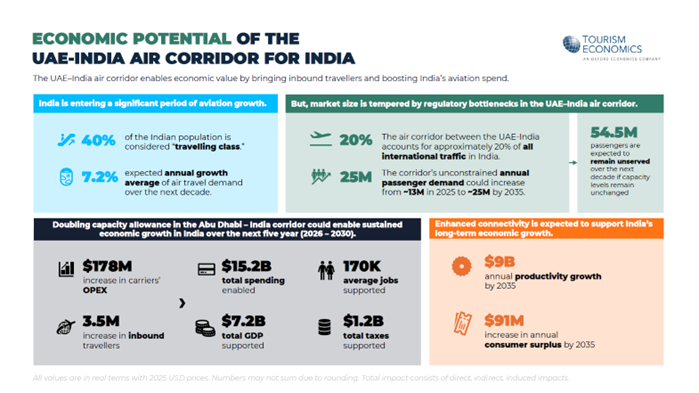
The analysis shows that 27% of forecast passenger demand between India and the UAE could remain unserved by 2035 if capacity remains at current levels. This equates to a cumulative shortfall of approximately 54.5 million passenger journeys between 2026 and 2035, with 13.2 million unserved passengers on the Abu Dhabi–India corridor alone. This indicates particularly acute capacity constraints on the Abu Dhabi–India corridor.

The report highlights strong structural growth in India’s aviation market. India’s travelling class—households with sufficient income to travel by air—has grown from 24%of the population in 2010 to 40% in 2024, representing an increase of nearly 300 million people. As a result, air travel demand is projected to grow by 7.2% per year through 2035, adding nearly 22 million additional passenger journeys per year over the next decade.

Matthew Dass, Director of Consulting, from Tourism Economics, said, “India–UAE air travel demand is growing rapidly, underpinned by rising incomes, expanding international trade, and increasing outbound and inbound tourism. Load factors exceed 80% on major routes in the study period, indicating limited spare capacity under current schedules. In our baseline outlook, the gap between forecast demand and available seats widens over time and available capacity is expected to be exhausted by 2026.”

The study also quantifies the economic activity enabled by the UAE–India air corridor, focusing on inbound travellers’tourism spending and airlines’ operational expenditure along the corridor. Under continued capacity constraints, the corridor’s GDP contribution is projected to grow at a 3% CAGR over the next five years; easing constraints under alternative scenarios could lift growth to 5.5%–7%. For example, doubling Abu Dhabi–India seat capacity is expected to enable an additional of $7.2 billion in GDP(including direct, indirect, induced impacts) over the next five years and support more than 170,000 jobs per year on average.

Beyond immediate impacts, the study suggests that improved connectivity could contribute to productivity gains (up to $9 billion per year by 2035) and may support investment and trade outcomes over time. The report also notes that increased capacity and competition can place downward pressure on fares, benefiting passengers.

The report concludes that aviation policy choices will play a critical role in determining whether India is able to fully capture the economic and consumer benefits of growth in international air travel.

FOREWORD

Dear Reader’s,


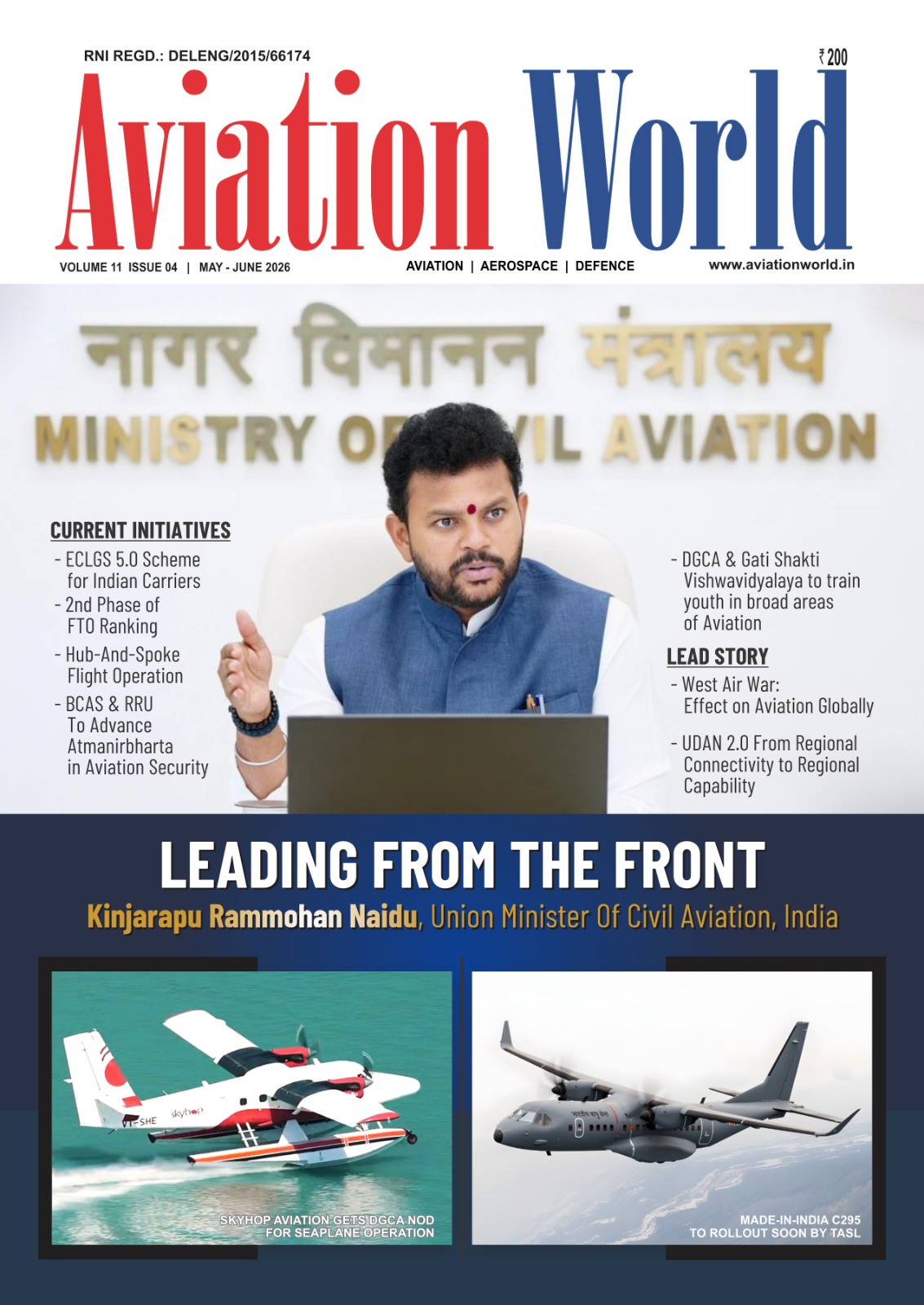
The current edition of Aviation World has covered many areas of Aerospace & Defence based on the latest development in the sector. The front cover highlights three different images, first for the Union Civil Aviation Minister ….. who is leading from the front to steer Indian Civil Aviation sector to witness one of the most interesting phases. He is also facing most tumultuous timing due to the ongoing financial stress in the Aviation sector due to ATF rising cost and long airspace restrictions resulting in mounting losses for Indian carriers. Despite of all the ground level challenges,the minister is addressing new things on regular basis which keeps the sector motivated. We have featured many such developmental works in this edition done under his guidance which will be interesting to read.

Our lead story on “ The West War” is another important feature which covers the ground level reality of the challenges faced by the Aviation sector. Its though time ahead and we believe it will pass soon .

There are features on Regional connectivity and MoCA revised rules on the UDAN 2.0 and how its going to transform the flying experience within India.

In this edition, we have covered topics on MRO,Various Policy changes,Sea Plane Operations by SkyHop Aviation, TATA-Airbus joint project on C295 military aircraft under Make In India which is expected to roll out soon and many other interesting contents which will be good to read.

We are covering Farnborough International Airshow 2026 from 20-24July 2026 in London and our next edition will be based on the same event.For features, you may contact our team on priority basis.


Happy Reading!

NEWSLETTER

Aviation World Magazine is India’s premier aviation magazine and has been actively supporting the development of the Indian and global civil aviation sector. We started our journey in year 2015 and its been 12 years now and the response and acceptance is really encouraging. Thanks to all our associates and writers who remained with us in our progressive journey.

We have started 2026 on a very positive note and we look forward to increase our footprints to more locations and induct many more new companies in our campaign.. Do write to us at : editor@aviationworld.in

Disclaimer

The contents published in this website are news covering Aviation, Aerospace and Defence sector. The objective is to provide news in informative form to keep our readers updated of the latest development. We also publish content featured in our print publication Aviation World.We try our best to avoid any factual errors or image displayed here but we ensure immediate corrections to any such thing brought to our notice that might have been published inadvertently. All images and contents are sourced from the relevant organisations media team.

Copyright ©2014 – 2026. AVIATION WORLD. All rights reserved.

Scroll to Top