

The Next Chapter in the Aerospace & Defense Transformation Journey

By Sam Swaro, Senior Vice President & Head –North America, Transportation,Cyient
The Inflection Point: What Engineering Partnerships 3.0 Didn’t Solve
The Aerospace and Defense (A&D) industry has undergone multiple waves of transformation—from labor arbitrage to globally distributed engineering ecosystems and the rise of Global Capability Centers (GCCs). These models enabled scale, efficiency, and access to global talent.
However, while Engineering Partnerships 3.0 optimized for cost and distribution, it left critical gaps unaddressed—particularly around resilience, sovereignty, and accountability in increasingly complex and regulated environments.
Engineering Partnerships 4.0 emerges at this inflection point, shaped by a world defined by shifting geopolitical realities, evolving risk boundaries, and the rise of intelligence-driven engineering.
What Changed in the Last Five Years
The world shifted beneath our feet. The pandemic stress-tested supply chains. Geopolitics redrew risk maps. A new tariff alignment moment on April 2, 2025, which many in the industry shorthand as ‘Liberation Day’, accelerated a pivot from pure offshoring to pragmatic friendshoring.
Meanwhile, advanced tools and AI evolved from experimentation into practical accelerators, led by deep domain knowledge and human engineering authority.
Together, these forces rewired the questions Aerospace and Defense leaders ask.
No longer, “Where is the cheapest talent?” but “Where is the most resilient, sovereign, technically deep, compliance-first ecosystem I can trust?”
Since then, India’s Global Capability Centers have scaled rapidly, growing from Rs. 1,580 in FY23 to Rs. 1,700 in FY24, and projected to reach Rs. 2,200–2,400 by 2030, underscoring their move from cost centers to strategic innovation hubs.
Across the product lifecycle, AI adoption has moved fast, from systems engineering and requirements mining to design exploration, development, verification and validation, manufacturing quality, supply chain optimization, and aftermarket support.
Two examples illustrate the momentum:
- Predictive maintenance at scale:For a global aerospace OEM, we delivered Predictive Maintenance+ and Fleet Performance solutions that help airlines avoid hundreds of delays annually and reduce operational interruptions, using cross-fleet machine-learning models on aircraft and engine systems.
- Engine health intelligence:For a leading engine manufacturer, we implemented data-driven monitoring and digital-thread analytics that detect and prevent hundreds of unplanned maintenance events per year, accelerating fault resolution from days to near real-time.
Together, these advances shift the operating model from scheduled checks to condition-based and predictive interventions, with measurable gains in safety, availability, and cost.
In parallel, recent high-profile safety incidents involving major commercial and cargo airlines have catalyzed unprecedented regulatory scrutiny and a renewed first-time-right focus across the aerospace supply chain.
In safety-critical industries, intelligence earns acceptance only when it strengthens trust before it accelerates change.
Top Trends Defining Engineering Partnerships 4.0
Engineering Partnerships 4.0 is not incremental. It is architectural.
Five structural trends now define how Aerospace and Defense designs, certifies, manufactures, and sustains products across trusted geographies.
- Friend shoring Becomes the Backbone: Engineering and build-to-print networks are being realigned around allied, tariff-aligned geographies. Resilience, dual sourcing, and locality of compliance matter as much as cost.
- Sovereignty Driven Delivery Models:Geo-distributed, compliance-first execution (ITAR/EAR, export controls, data residency) is the new default. Onshore, nearshore, and offshore nodes operate under one quality and security system.
- Intelligence First Engineering (AI as Amplifier):AI accelerates concept to certification when fused with domain depth.MBSE, model-based certification aids, verification automation, knowledge graphs, and safety evidence generation are where intelligence earns permission in aerospace.
- Integrated Engineering and Manufacturing: OEMs and Tier 1s increasingly prefer fewer, deeper partners who can take accountability from specification through qualification and design led manufacturing through aftermarket.
- Outcome Economics:Outcome-based contract, and productivity commitments replace time and materials thinking.
- Five Initiatives for Offshore Service Companies
To stay relevant and grow, service providers must redesign their operating model for sovereignty, intelligence, and accountability.
- Build Sovereign, Multi Geo Delivery Fabrics: Stand up onshore and nearshore trusted cells across the US, EU, UK, Canada, Australia, Japan, and India, with unified AS9100 governance, export control compliance, and secure enclaves for restricted programs.
- Make Intelligence First Real:Embed AI across the V model: requirements mining, design space exploration, verification automation, anomaly detection, and certification evidence packaging, with human engineering authority firmly in the loop.
In aerospace, intelligence is valued when it augments expert judgement, reduces workflow friction, and brings accumulated knowledge back into active use.
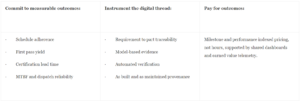
- Shift From Labor to Outcomes: Offer build-to-spec and turnkey work packages with shared risk, using MBSE and the digital thread to commit to schedule, quality, and cost metrics rather than hours.
Price for predictability, not just effort, and establish joint KPI baselines that both OEMs and partners can govern transparently:
- FPY (First Pass Yield)
- NFF (No Fault Found) reduction
- MRB burndown (Material Review Board non-conformance closure)
- Certification evidence velocity
Supported by shared, real-time dashboards and outcome telemetry.As Marty Cagan emphasizes, high-performing product organizations succeed when teams are empowered, deeply connected to the customer problem, and accountable for value, usability, feasibility, and outcomes, not activity.
Translating this into Aerospace and Defense, Engineering Partnerships 4.0 demands partners who own results end-to-end:
- Improving manufacturability
- Accelerating certification
- Reducing sustainment burden
- Strengthening supply chain resilience
- Enhancing fleet availability
This is the shift from “providing engineering capacity” to solving mission-critical problems and delivering measurable operational and business value, the product mindset that the industry increasingly expects.
- Co-create With Captives and Primes: Treat captive centers as force multipliers. Establish joint roadmaps, shared competency academies, and friendshored supplier development programs. Go to market together, where it helps the OEM win.
- Fuse Engineering with Design-Led Manufacturing:Integrate design, NPI, and certified manufacturing. Collapse handoffs and design for manufacturability and sustainment from day one.
- Positioning for Engineering Partnerships 4.0Organizations that succeed in this new paradigm will demonstrate four core capabilities:
- Deep domain expertise
- Sovereign, compliant delivery models
- Intelligence-driven execution
- Integrated engineering and manufacturing
An integrated approach—combining engineering, digital capabilities, and design-led manufacturing—enables end-to-end ownership from requirements through certification, production, and sustainment, with accountability for outcomes across schedule, quality, cost, and reliability.
In Aerospace and Defense, that idea has a very practical meaning. Companies that apply AI, data, and automation with discipline, inside the realities of safety, regulation, and long programme lifecycles. The goal is simple: help experienced engineers make better decisions faster, cut avoidable effort, and bring hard-won programme knowledge back into day-to-day work, while keeping human accountability firmly in the loop.
That is how we Embrace Intelligence at Cyient: not as hype, but as a steady way to improve engineering outcomes that customers and regulators can see, measure, and trust.
Conclusion
The next decade in Aerospace and Defense will be shaped by how confidently the industry can combine human engineering authority with intelligence embedded into everyday workflows.
Engineering Partnerships 4.0 is a shift in what customers reward: resilience over cost, outcomes over effort, and delivery ecosystems built for sovereignty, certification, and long-life programmes.
Success will depend on building delivery models that are not only intelligent and efficient, but also compliant, accountable, and trusted at scale.