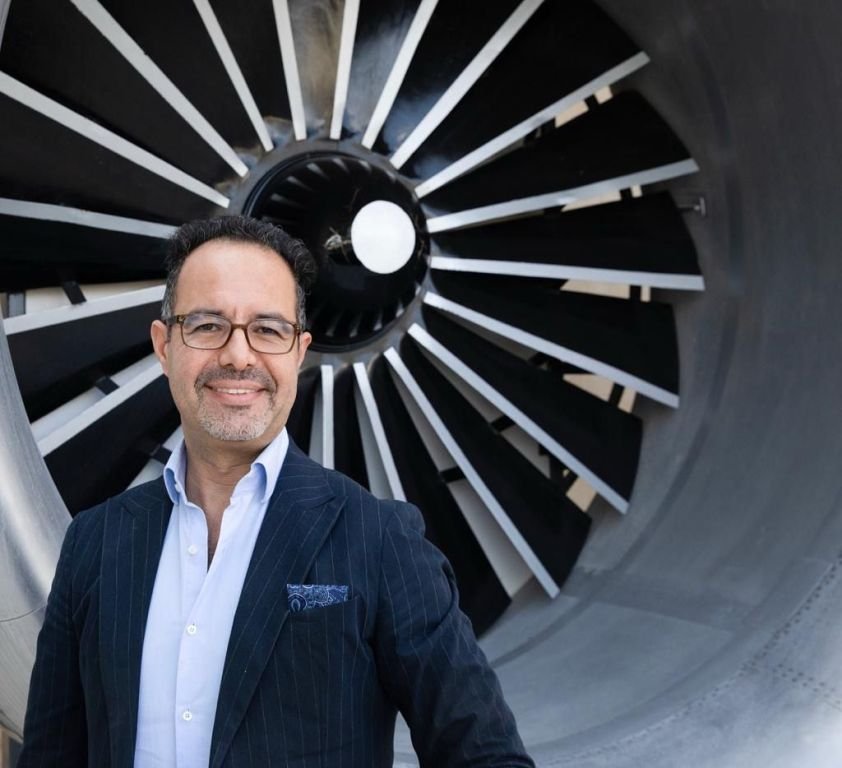


In Conversation with Dr. Satya Chakravarthy & Divya Manchanda of The ePlane Company
At the Farnborough International Airshow, Indian Advanced Air Mobility (AAM) pioneer The ePlane Company (Ubifly Technologies) highlighted its technology vision and announced key global and domestic strategic partnerships. These strategic agreements spanning advanced avionics, aerospace-grade fasteners, composite materials, electrical wiring, modular cabin interiors, and emergency healthcare operations are designed to solidify the e200X ecosystem as it advances through airworthiness certification and industrial production. During the event, Vishal Kashyap, Managing Editor of Aviation World, sat down with Dr. Satya Chakravarthy(Founder & CEO) and Divya Manchanda (EVP of Business Partnerships & AAM Strategy) to discuss how ePlane is positioning itself to lead the urban air mobility revolution in India and across emerging markets. Excerpts from the conversation: Dr. Satya Chakravarthy, Founder & CEO Q: Could you elaborate on the MOUs signed at the Farnborough International Airshow? At the Farnborough International Airshow, we announced a major strategic partnership with Apollo Hospitals to create an integrated emergency response model combining both our e200X electric air ambulances for critical patient transport and medical delivery drones (via our subsidiary, Amber Wings) for rapid movement of blood products, organs, vaccines, and diagnostic samples. We also announced formalized agreements with several strategic supply chain partners: Azista Composites for composite materials supply. Hensoldt for advanced avionics systems. Ankit Fasteners for aviation-grade fasteners. SASMOS for wiring harnesses, including high-voltage design, application, and on-aircraft installation. AMS Heli for modular interiors and seating, which will support our initial air ambulance variant and allow seamless conversion to future air taxi and cargo configurations. Q: Regarding technology, what system configuration and technical architecture does ePlane employ? Our aircraft uses a lift-plus-cruise configuration, which means it has separate propulsion systems for vertical take-off and landing, and for forward flight. For vertical flight, the aircraft uses dedicated lift rotors that operate similarly to a helicopter but are controlled using distributed electric propulsion, much like a drone. Once airborne, the aircraft transitions to forward flight using dedicated cruise propellers, allowing it to fly like a conventional fixed-wing aircraft. This architecture eliminates the need for complex tilting mechanisms found in tilt-rotor designs, resulting in a simpler, lighter, and more reliable system. From a safety perspective, the aircraft features a hex-rotor configuration for vertical lift. This provides redundancy, enabling the aircraft to continue safe flight even if one lift rotor or its associated motor or battery were to fail. Similarly, the aircraft is equipped with four forward propellers, allowing it to safely handle a one-engine-inoperative scenario during cruise flight. Another key differentiator is our proprietary Synergistic Lift technology. We have developed an in-house method of utilizing the vertical lift rotors during forward flight to improve the aerodynamic performance of the wings. This enables us to achieve a highly compact aircraft without compromising efficiency or performance. The result is an aircraft that can fly both slowly for safe urban operations and efficiently at higher speeds, maximizing the number of short trips that can be completed on a single battery charge. This innovation is protected by patents granted in approximately 15 jurisdictions worldwide, including the United States, underscoring the uniqueness and strength of our technology. Q: When can we expect the ePlane prototype to be operational? Our full-scale PT-01 prototype is built and currently undergoing ground testing. We expect to initiate flight testing shortly before transitioning to our second prototype, PT-02. PT-01 serves as an unmanned experimental scale technology demonstrator. PT-02 will be our conforming aircraft, built specifically for the air ambulance configuration and to demonstrate compliance to certification requirements. We plan to build PT-03 as an identical sister ship to PT-02, allowing both aircraft to jointly accumulate certification flight hours through 2027. Toward the end of that period, we will introduce the air taxi variant, pursuing additional certification above the air ambulance baseline. Our target timeline is to obtain Type Certification by mid-2028. Q: What services will be offered during the first phase of operations? Our initial go-to-market focus is the air ambulance variant. Urgent medical transport addresses a critical societal need in India, where traffic congestion frequently delays emergency responses, trauma care, cardiac treatment, and organ transit. By partnering with hospital networks like Apollo Hospitals integrating both electric air ambulances for patient transfer and delivery drones for urgent supplies, we aim to drastically lower operational costs and bring medical logistics down from hours to minutes, making air transport eligible for health insurance coverage. The second one is the air taxi variant which could cater to a lot of other use cases like for example not just doing the air taxi within urban areas but also airport shuttles which is again a time critical need, remote area access like hilly terrain and so on plus tourist attractions, pilgrim centers. Q: This sector is still at a very nascent stage and requires lots of planning and infrastructure. How do you assess such situations? One of the key differentiators of our aircraft is its exceptionally compact design, which sets it apart from many other eVTOLs being developed globally. Our proprietary Synergistic Lift technology enables the vertical lift rotors to work in conjunction with the wings during forward flight. This allows us to achieve a much smaller wingspan and overall footprint without compromising performance or efficiency. The compact form factor offers a significant operational advantage. It enables our aircraft to use many existing helipads, allowing us to leverage current infrastructure during the initial phase of deployment rather than waiting for an entirely new network of vertiports to be built. As the ecosystem evolves, we will develop dedicated vertiports optimized for our aircraft. Because of the aircraft’s compact footprint, these vertiports can be even smaller than conventional helipads, making them easier and more cost-effective to deploy in dense urban environments. By combining compatibility with existing helipad infrastructure and the ability to build smaller, purpose-designed vertiports in the future, we believe we can accelerate the adoption of Advanced Air Mobility Q: Is there any global affiliation required as well for operations? There are two aspects to this. First, the