Space

Space

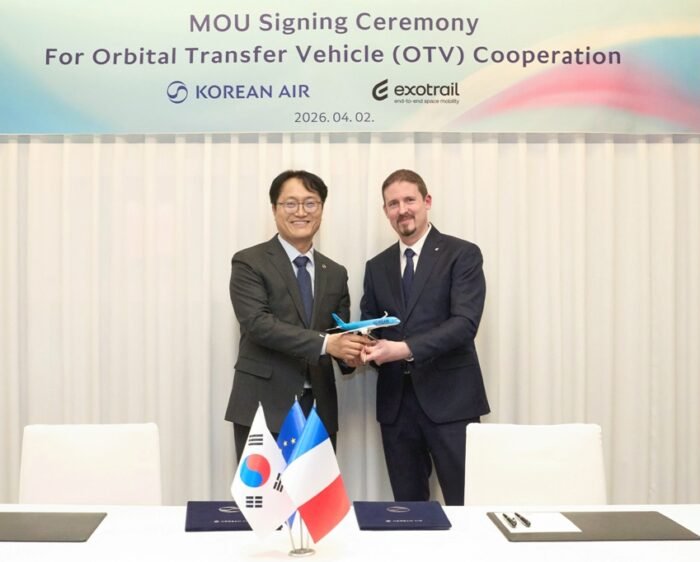
Korean Air and Exotrail partner to develop Orbital Transfer Vehicle (OTV) solutions

Seoul, April 7, 2026: Korean Air and French space company Exotrail signed a Memorandum of Understanding on April 2 in Seoul to develop Orbital Transfer Vehicle (OTV) solutions.Under the agreement, the two companies will collaborate on high-value space services, including: • Low Earth Orbit (LEO) satellite transport and payload hosting • Multi-orbit satellite deployment • Satellite life extension and in-orbit refueling The partners will establish a joint working group to coordinate launch schedules and optimize orbital transport cost structures. OTV: The last-mile delivery of space transport An Orbital Transfer Vehicle is a propulsion-based solution that transports small satellites from large launch vehicles to their final target orbits. Functioning as the last-mile delivery for space, OTVs provide critical in-orbit services after deployment, including orbital correction, refueling and life extension. As demand for small satellite constellations grows, OTV technology is essential for maximizing deployment efficiency. The capability to deploy multiple satellites into distinct orbits from a single launch vehicle is a key priority for the global “New Space” industry. Strategic cooperation and technical integration Korean Air will utilize its expertise in launch vehicle and satellite systems, including mission control and structural/control system design. Exotrail, a specialist in electric space propulsion and orbital solutions, will establish this partnership as a strategic bridgehead for its expansion into the Asian market. Through this collaboration, Korean Air aims to address growing demand for ultra-small satellite constellations in the defense and commercial sectors. “By combining Exotrail’s proven space heritage with Korean Air’s aerospace manufacturing capabilities, we aim to secure a competitive advantage in the New Space market,” said a Korean Air representative. The OTV partnership follows the launch of Korean Air’s 35-ton reusable methane engine development program with Hyundai Rotem in 2025. These combined initiatives expand the company’s aerospace operations to include both launch vehicle manufacturing and specialized orbital transport services.

Recent News, Space

SITA new satellite connectivity service keeps airports online

Geneva, 28th May 2025: In an industry where every second of downtime can disrupt passengers and delay operations, a new satellite service is helping airports and airlines stay connected, no matter what. With the launch of SITA Managed Satellites, airports around the world can now maintain vital communication at all times, even during blackouts, natural disasters, or in the most remote or infrastructure-limited locations. The fully managed service is now available in over 130 countries, offering primary, secondary, and emergency connectivity options tailored specifically for the air transport industry. It takes advantage of low earth orbit (LEO) satellites to deliver secure, high-bandwidth, low-latency communications that keep airport systems running continuously. This is also the case when other networks are struggling or completely offline. SITA Managed Satellites doesn’t only support regular networks that are in high demand. Recent global events have shown just how vulnerable traditional fiber and terrestrial networks can be. From earthquakes to extreme weather and fiber cuts, many airports, large and small, have experienced partial or complete outages. Even in major hubs, network congestion during peak periods can strain bandwidth and disrupt key services. SITA’s new satellite solution addresses these risks directly, giving airport and airline teams a way to keep operations running when it matters most. SITA Managed Satellites provides a fast, cost-effective way to deploy connectivity wherever it’s needed, including off-airport locations, aircraft maintenance hangars, cargo hubs, and even remote sites without existing digital infrastructure. It also unlocks temporary service for new route openings, seasonal operations, or rapid emergency deployments. This makes sure that ground crews and systems are never out of touch. “The quality and availability of the latest satellite technology means that it’s becoming a vital component within high availability networks. Airports, in particular, need new ways to ensure they can maintain critical operations in whatever circumstances they face – even when adverse incidents strike,” said Martin Smillie, Senior Vice President, Communications and Data Exchange at SITA. “Delivering high-speed internet connectivity via established satellite providers, SITA Managed Satellites allows customers to optimize operational performance. SITA Managed Satellites is an innovative solution to keep all parts of the aviation industry connected to vital platforms – even in the most challenging of times – and can be adapted for other transport sectors and markets also. It delivers a blend of availability and cost-effectiveness to optimize investments in any cloud, on-premises or hybrid computing environment.” SITA’s global team provides 24/7 monitoring, installation, maintenance, and support. The solution also integrates with other SITA connectivity services, offering customers a flexible, bundled approach to network resilience. Key features include: • A secure, aviation-specific satellite service that meets industry regulations • Full lifecycle management and support in over 130 countries • Proactive infrastructure monitoring to resolve issues before they impact operations • Optional bundling with other SITA airport connectivity solutions • Expert on-site support for surveys, setup, ongoing maintenance, and hardware replacement With aviation more reliant than ever on uninterrupted digital operations, SITA Managed Satellites gives customers the confidence and tools they need to keep critical systems live, even in the most unpredictable conditions. ( This news is published unedited on as shared basis by SITA.)

Space

First Civil Indian Astronaut, Capt. Gopichand Thotakura is part of New Shepard’s 25th Space Mission

Blue Origin revealed the six-person crew flying on its NS-25 mission (New Shepard) which also includes the first civil Indian Astronaut, Capt. Gopichand Thotakura. The other crew includes, Mason Angel, Sylvain Chiron, Kenneth L. Hess, Carol Schaller and former Air Force Captain Ed Dwight. This mission will be the seventh human flight for the New Shepard program and the 25th in its history. As on date, the program has flown 31 humans above the Kármán line. Ever since, Rakesh Sharma, the only Indian astronaut who could travel to the space on Soyuz T-11 in 1984, we have not witnessed any such expedition till date by an Indian. After four decades of wait, another Indian, Capt. Gopichand Thotakura, is going to achieve this milestone soon. He is an Indian civil astronaut selected by Blue Origin for its New Shepard’s 25th Mission alongwith five other Astronaut from across the world. The Blue Origin has been flight testing the New Shepard rocket and its redundant safety systems since 2012, its been always the talk for the world. Blue Origin was founded in 2000 by Jeff Bezos, the founder of Amazon and its New Shepard Space program it has completed 22 successful consecutive missions including three successful escape tests, showing the crew escape system can activate safely in any phase of flight. Blue Origin’s efforts include flying astronauts to space on New Shepard, producing reusable liquid rocket engines, developing an orbital launch vehicle with New Glenn, building next-generation space habitats, and returning to the surface of the Moon. These endeavors will add new chapters to the history of spaceflight and move all of humanity closer to that founding vision. #NewShepard #NS25 crew will include Mason Angel, Sylvain Chiron, Ed Dwight, Ken Hess, Carol Schaller, and Gopi Thotakura. Read more 🚀: https://t.co/KbAJkbRTvj pic.twitter.com/8QBFYPJkYj — Blue Origin (@blueorigin) April 4, 2024 Capt. Gopichand Thotakura and His Passion Capt. Gopichand Thotakura is a pilot and aviator who learned how to fly before he could drive. He is the co-founder of Preserve Life Corp, a global center for holistic wellness and applied health located near Hartsfield-Jackson Atlanta International Airport. In addition to flying jets commercially, Capt. Gopi pilots bush, aerobatic, and seaplanes, as well as gliders and hot air balloons, and has served as an international medical jet pilot. A lifelong traveler, his most recent adventure took him to the summit of Mt. Kilimanjaro. As part of the New Shepard’s 25th Mission program, each astronaut will carry a postcard to space on behalf of Blue Origin’s foundation, Club for the Future. This program gives students access to space on Blue Origin’s rockets, including an all-digital method to create and send postcards, which can be found here. The Club’s mission is to inspire and mobilize future generations to pursue careers in STEAM for the benefit of Earth. In India, Capt. Gopichand Thotakura founded Charlie Foxtrot in 2019 to cater to the requirements of individuals and companies looking for professional private aviation services. The company provides private jet charters to help people save time and get their desired comfort while traveling for business or leisure. You can get everything from private jets to business jets, from air ambulances to other private aviation support. Capt. Gopichand Thotakura Professional Journey Born into a humble background in Vijaywada, India, Capt. Gopichand Thotakura always knew he wanted to be up in the skies and explore space someday. Being an aviation enthusiast, Gopichand followed his passion and became a pilot before he could drive. He graduated as the senior class president at Embry-Riddle Aeronautical University, where he pursued a Bachelor of Science in Aeronautical Science. He delivered his graduation commencement speech with astronaut Nicole Stot, a proud moment for Gopichand Thotakura as a commercial pilot. During his training from Jan. 2012 to Aug. 2015, he performed exceptional tasks and participated in multiple activities to stand out from the rest. He also achieved multiple awards and recognitions at Embry-Riddle Aeronautical University, like the Outstanding Leadership Award, Good Samaritan Award, and Outstanding Safety and Dedication Award. His quest to explore more than just commercial flying enabled him to pursue advanced trainings like Normobaric Chamber Hypoxia High Altitude Lab training, Airline Flight Crew Techniques and Procedures, and he emphasized the importance of Crew Resource Management (CRM). Apart from the advanced training, he became a professional bush pilot, aerobatic pilot, seaplane pilot, glider pilot, international medical pilot, and even a hot air balloon instructor. A great aspect of Capt. Gopichand Thotakura’s aviation career is that he has also flown experimental aircraft; he owns an Aircam by Lockwood Aviation, a one-of-its-kind three-seater tandem experimental ultralight airplane that he assembled himself. Another major highlight of his aviation career is his tenure as a pioneer in India’s medical air ambulance missions, where he piloted a Learjet 45XR aircraft in India to uncontrolled and tier 3 city airfields, rescuing trapped wounded citizens who needed immediate medical evacuations. Having flown over 2000 medical medivac missions, carrying a 3-day-old newborn to a 103-year-old man, transporting organs for critical human transplants, and pushing the boundaries of Bombardier’s engine parameters, he has immense experience as an international medical jet pilot. With his vast experience and executing such daring missions in the medical air ambulance, today, Capt. Gopichand Thotakura has trained his successors in opening the Indian subcontinent to jet air ambulance operators. His vision has helped grow the medical air sector to allow anyone to call an emergency evacuation within hours. Apart from his dedication to improving the medical air sector of India, Capt. Gopichand Thotakura co-founded Preserve Life Crop (www.preserve.life), a world center for holistic wellness and applied health, a 1200-acre campus close to the Hartsfield-Jackson Atlanta International Airport. The approach to delivering the best results and helping others is the reason behind Capt. Gopichand Thotakura’s success in achieving great heights in his career. https://www.instagram.com/p/C5WI_kzuUzq/?igsh=c2MwMWI2aHZkMGhr  

Space

LVM3 M4 vehicle successfully launched Chandrayaan-3 into orbit

Chandrayaan-3, in its precise orbit, has begun its journey to the Moon. Health of the Spacecraft is normal- ISRO India, 15th July 2023: Chandrayaan-3 is a follow-on mission to Chandrayaan-2 to demonstrate end-to-end capability in safe landing and roving on the lunar surface. It consists of Lander and Rover configuration. It will be launched by LVM3 from SDSC SHAR, Sriharikota. The propulsion module will carry the lander and rover configuration till 100 km lunar orbit. The propulsion module has Spectro-polarimetry of Habitable Planet Earth (SHAPE) payload to study the spectral and Polari metric measurements of Earth from the lunar orbit. Lander payloads: Chandra’s Surface Thermophysical Experiment (ChaSTE) to measure the thermal conductivity and temperature; Instrument for Lunar Seismic Activity (ILSA) for measuring the seismicity around the landing site; Langmuir Probe (LP) to estimate the plasma density and its variations. A passive Laser Retroreflector Array from NASA is accommodated for lunar laser ranging studies. Rover payloads: Alpha Particle X-ray Spectrometer (APXS) and Laser Induced Breakdown Spectroscope (LIBS) for deriving the elemental composition in the vicinity of landing site. Chandrayaan-3 consists of an indigenous Lander module (LM), Propulsion module (PM) and a Rover with an objective of developing and demonstrating new technologies required for Inter planetary missions. The Lander will have the capability to soft land at a specified lunar site and deploy the Rover which will carry out in-situ chemical analysis of the lunar surface during the course of its mobility. The Lander and the Rover have scientific payloads to carry out experiments on the lunar surface. The main function of PM is to carry the LM from launch vehicle injection till final lunar 100 km circular polar orbit and separate the LM from PM. Apart from this, the Propulsion Module also has one scientific payload as a value addition which will be operated post separation of Lander Module. The launcher identified for Chandrayaan-3 is LVM3 M4 which will place the integrated module in an Elliptic Parking Orbit (EPO) of size ~170 x 36500 km. The mission objectives of Chandrayaan-3 are: 1. To demonstrate Safe and Soft Landing on Lunar Surface 2. To demonstrate Rover roving on the moon and 3. To conduct in-situ scientific experiments. To achieve the mission objectives, several advanced technologies are present in Lander such as, 1. Altimeters: Laser & RF based Altimeters 2. Velocimeters: Laser Doppler Velocimeter & Lander Horizontal Velocity Camera 3. Inertial Measurement: Laser Gyro based Inertial referencing and Accelerometer package 4. Propulsion System: 800N Throttleable Liquid Engines, 58N attitude thrusters & Throttleable Engine Control Electronics 5. Navigation, Guidance & Control (NGC): Powered Descent Trajectory design and associate software elements 6. Hazard Detection and Avoidance: Lander Hazard Detection & Avoidance Camera and Processing Algorithm 7. Landing Leg Mechanism. To demonstrate the above said advanced technologies in earth condition, several Lander special tests have been planned and carried out successfully viz. 1. Integrated Cold Test – For the demonstration of Integrated Sensors & Navigation performance test using helicopter as test platform 2. Integrated Hot test – For the demonstration of closed loop performance test with sensors, actuators and NGC using Tower crane as test platform 3. Lander Leg mechanism performance test on a lunar simulant test bed simulating different touch down conditions.

Space

Supernal and GKN Aerospace ties up for eVTOL Vehicle Aerostructures, Electrical Wiring Systems and Manufacturing Innovation

Paris Air Show, 20.06.2023: Supernal LLC and GKN Aerospace announced a partnership on the design and build of major aerostructures and Electrical Wiring Interconnection System (EWIS) for Supernal’s electric vertical takeoff and landing (eVTOL) vehicle. The companies will also mature high-rate manufacturing technologies to produce these parts and assembly methods. This marks the second established aerospace manufacturer agreement Supernal has announced at the Paris Air Show, as the Company works to develop a novel high-rate manufacturing process that will enable the Advanced Air Mobility (AAM) industry to meet expected demand in the coming decades. GKN will work with Supernal to apply its broad portfolio of design capabilities and manufacturing technologies to the development of the Company’s eVTOL vehicle. GKN will supply lightweight aerostructures and high-voltage, high-power electrical wiring systems for Supernal’s full-scale technology demonstrator, which the Company will begin flying in 2024. The partnership aims to improve the business case—and process—for introducing advanced materials and rate-enabling assembly processes to the AAM industry. In working with GKN to mature these innovative processes from the outset, Supernal will develop volume ramp-up capabilities that enable the Company to rapidly scale production as aircraft order demand grows. “Manufacturing is crucial to the success of Advanced Air Mobility and Supernal is pleased to partner with leading suppliers, such as GKN Aerospace, to industrialize existing processes,” said Jaiwon Shin, president of Hyundai Motor Group and CEO of Supernal. “Instead of focusing on ‘time to market,’ Supernal is prioritizing ‘time to scale.’ Our work with GKN Aerospace will lay the foundation for producing eVTOL vehicles at scale and will be bolstered by Hyundai Motor Group’s high-tech manufacturing processes.” As part of Hyundai Motor Group (HMG), Supernal is working to integrate the automotive leader’s expertise—including supply chain management, logistics and distribution, and manufacturing—throughout the AAM ecosystem. In the manufacturing realm, HMG is helping Supernal to develop a scalable digital factory model that will industrialize aerospace material and assembly advancements. Supernal’s work with leading aerospace manufacturers, such as GKN Aerospace, is an important first step toward the Company’s ability to reduce the cost and time of aircraft production. GKN Aerospace is a global leader in the design and manufacturing of lightweight aerostructures and EWIS, across global original equipment manufacturers (OEMs) and the growing AAM market. Supernal and GKN Aerospace’s design and manufacturing activities have begun at GKN Aerospace’s Global Technology Centre in Bristol and across sites in Europe. “We are excited to collaborate with Supernal and to support the development of this all-new eVTOL,” said John Pritchard, president, civil airframes, GKN Aerospace. “Supernal’s eVTOL can play a key role in the transition to zero-emissions flight, and we are delighted to be collaborating on the platform, in line with our mission to be the most trusted and sustainable partner in the sky. GKN Aerospace is proud to bring to this project its wealth of experience in design and high-rate manufacturing, in conjunction with key technological innovations and expertise.” Supernal’s partnership with GKN Aerospace is part of the Company’s “open ecosystem” approach to address the niche technology needs of AAM. The Company plans to grow its portfolio of manufacturing partners across other vehicle components and assemblies, in addition to airframe. Supernal and GKN Aerospace held a signing ceremony for the partnership at the Paris Air Show.

Space

THE ROAD TO ZERO CARBON AVIATION

Green Aviation The road to net-zero carbon is now clear in most sectors of the world economy – bar one relatively small, but crucial and fast-growing area. Air travel attracts heavy criticism for its planet-heating emissions. With game-changing technologies still on the far horizon, aviation needs ways to cut its carbon footprint now. By Robin M. Mills Aeroplanes release about 2.1 per cent of humankind’s carbon dioxide. But their injection of water vapour and other indirect greenhouse gases into the stratosphere, and the formation of condensation trails, worsen climate impact to 4.9 per cent of additional heating. The airline industry aims to have no net growth in emissions from 2020 onwards, and to reach net-zero by 2050. Without action, pre-pandemic emissions were forecast to rise as much as 4.3 per cent per year over the next two decades. The International Civil Aviation Organization believes better operations and more fuel-efficient planes could deliver 1.37 per cent savings per year – still leaving a large gap to aspirations, and to the acceptable levels implied by the Paris Agreement of 2015. Other transport modes such as rail certainly can and should be used more. But they are impractical over oceans or intercontinental distances, remote communities or for time-sensitive cargo. Batteries may be suitable to power short flights but their weight is prohibitive for long-haul. So for now, the industry is betting on sustainable aviation fuel (SAF). This is chemically similar to traditional jet fuel (kerosene), and so is compatible with current engines and fuel delivery systems. Today, it is made from biological materials such as waste cooking oil, food scraps, paper, and potentially in future wood, specially-grown plants and algae. It reduces carbon emissions by up to 80% compared to petroleum-based jet fuel. On Ground Challenges At present, there are two significant challenges with SAF. First, it is available today in only small and expensive quantities: 0.1% of current fuel demand, and costing several times more than conventional jet kerosene. It may reach 2% of demand by 2030, and, with regulatory support, 10% in specific markets such as Europe. Second, the future potential of biomass-based SAF is constrained. Other users, notably ground and maritime transport, also compete for biofuels. They might be squeezed out by aviation’s greater need, but likely only by higher prices. Once all suitable waste is allocated to make bio-based SAF, further volumes need specially-grown crops – competing with food production and natural ecosystems, and requiring water and fertiliser. It appears technically possible to meet all 2050 air travel demand with bio-SAF, but likely not desirable from environmental, social and economic viewpoints. Going beyond this will require hydrogen, liquid ammonia, or synthetic fuels made using atmospheric carbon dioxide. These promise long-term solutions but need cost reductions and much technological development in fuel production, logistics and engines. So one complement is low-carbon aviation fuel (LCAF). These are derived from petroleum, are identical to traditional fuel, and create the same emissions when used. But they are produced and processed to minimise life-cycle emissions. Not all crude oils are equal. Those that are high in sulphur, heavy (high-density), come from mature fields, or whose associated (by-product) natural gas is burnt off rather than being used productively, are more carbon-intensive to extract and refine. Carbon footprints of crude oil production vary widely between countries: As found by researchers from Stanford University published in Science, from 20-180 kilograms of carbon dioxide equivalent per barrel between the best and worst cases worldwide (a barrel of oil weighs about 380 kg). Differences between individual companies and fields can be even larger. The best performers are some Middle East countries with giant, highly-productive fields, and environmentally-minded nations such as Denmark and Norway. Oil companies have a wide variety of tools to reduce their carbon footprint: being selective about which fields they develop; stopping flaring and leaking of unwanted gas; improving energy efficiency; powering operations with renewable energy; using low-carbon hydrogen in their refineries; and employing carbon capture and storage (CCS) to prevent carbon dioxide escaping into the atmosphere. Eventually, companies such as Occidental Petroleum hope to produce “carbon-neutral oil”, where they capture an equivalent quantity of carbon dioxide directly from the atmosphere to inject into their oil-fields to enhance production. Globally, traditional jet fuel has an average life-cycle carbon intensity of 89 grams of CO2 per megajoule whereas LCAF certified under the Carbon Offsetting and Reduction Scheme for Aviation (CORSIA) must have a carbon intensity of below 80.1 gCO2 per MJ, i.e. at least 10% lower. Current best-in-class operations in both production and refining would deliver about a 12% reduction over the average. So LCAF can realistically be available in significant volumes and at only moderate added cost over the next decade. Along with efficiency gains, it can therefore play a major role in meeting the aviation industry’s medium-term targets, while truly near-zero carbon options scale up. To achieve this, airlines should recognise the potential of LCAF to meet their compliance obligations and interim corporate emissions targets. They should work with their fuel suppliers to demand and certify LCAF. In turn, the oil industry will respond by valuing its lower-carbon operations more highly and bringing in low-emissions technologies such as renewables and CCS. By solving the chicken-and-egg problem of matching low-carbon fuel demand and supply, the industry can buy crucial time – and escape some political heat. (The writer is CEO of Qamar Energy, and author of ‘The Myth of the Oil Crisis’.) Image: Honeywell Aerospace 

Space

Rolls-Royce’s all-electric aircraft ‘Spirit of Innovation’ takes to the skies

15th Sept,2021: The first all-electric flight ‘Spirit of Innovation’ developed by Rolls Royce took of the skies recently from the UK Ministry of Defence’s Boscombe Down site, which is managed by QinetiQ and flew for approximately 15 minutes. The plane was propelled by its powerful 400kW (500+hp) electric powertrain with the most power-dense battery pack ever assembled for an aircraft. This is another step towards the plane’s world-record attempt and another milestone on the aviation industry’s journey towards decarbonisation. Warren East, CEO, Rolls-Royce, said, “The first flight of the ‘Spirit of Innovation’ is a great achievement for the ACCEL team and Rolls-Royce. We are focused on producing the technology breakthroughs society needs to decarbonise transport across air, land and sea, and capture the economic opportunity of the transition to net zero. This is not only about breaking a world record; the advanced battery and propulsion technology developed for this programme has exciting applications for the Urban Air Mobility market and can help make ‘jet zero’ a reality.”

FOREWORD

Dear Reader’s,


The current edition of Aviation World has covered many areas of Aerospace & Defence based on the latest development in the sector. The front cover highlights three different images, first for the Union Civil Aviation Minister ….. who is leading from the front to steer Indian Civil Aviation sector to witness one of the most interesting phases. He is also facing most tumultuous timing due to the ongoing financial stress in the Aviation sector due to ATF rising cost and long airspace restrictions resulting in mounting losses for Indian carriers. Despite of all the ground level challenges,the minister is addressing new things on regular basis which keeps the sector motivated. We have featured many such developmental works in this edition done under his guidance which will be interesting to read.

Our lead story on “ The West War” is another important feature which covers the ground level reality of the challenges faced by the Aviation sector. Its though time ahead and we believe it will pass soon .

There are features on Regional connectivity and MoCA revised rules on the UDAN 2.0 and how its going to transform the flying experience within India.

In this edition, we have covered topics on MRO,Various Policy changes,Sea Plane Operations by SkyHop Aviation, TATA-Airbus joint project on C295 military aircraft under Make In India which is expected to roll out soon and many other interesting contents which will be good to read.

We are covering Farnborough International Airshow 2026 from 20-24July 2026 in London and our next edition will be based on the same event.For features, you may contact our team on priority basis.


Happy Reading!

NEWSLETTER

Aviation World Magazine is India’s premier aviation magazine and has been actively supporting the development of the Indian and global civil aviation sector. We started our journey in year 2015 and its been 12 years now and the response and acceptance is really encouraging. Thanks to all our associates and writers who remained with us in our progressive journey.

We have started 2026 on a very positive note and we look forward to increase our footprints to more locations and induct many more new companies in our campaign.. Do write to us at : editor@aviationworld.in

Disclaimer

The contents published in this website are news covering Aviation, Aerospace and Defence sector. The objective is to provide news in informative form to keep our readers updated of the latest development. We also publish content featured in our print publication Aviation World.We try our best to avoid any factual errors or image displayed here but we ensure immediate corrections to any such thing brought to our notice that might have been published inadvertently. All images and contents are sourced from the relevant organisations media team.

Copyright ©2014 – 2026. AVIATION WORLD. All rights reserved.

Scroll to Top