

At the Farnborough International Airshow, Indian Advanced Air Mobility (AAM) pioneer The ePlane Company (Ubifly Technologies) highlighted its technology vision and announced key global and domestic strategic partnerships. These strategic agreements spanning advanced avionics, aerospace-grade fasteners, composite materials, electrical wiring, modular cabin interiors, and emergency healthcare operations are designed to solidify the e200X ecosystem as it advances through airworthiness certification and industrial production.
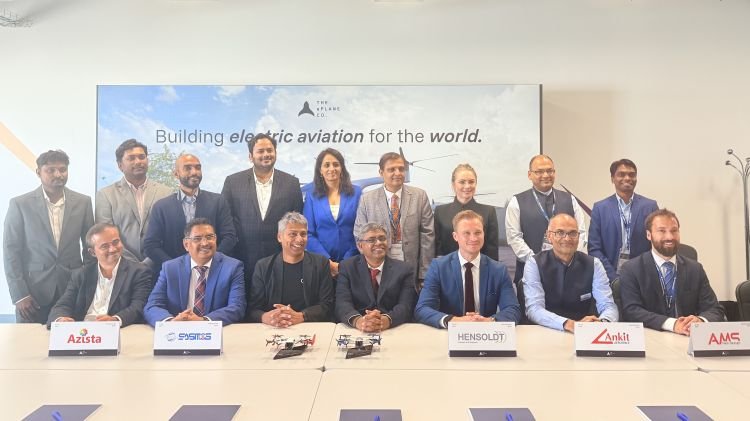
During the event, Vishal Kashyap, Managing Editor of Aviation World, sat down with Dr. Satya Chakravarthy(Founder & CEO) and Divya Manchanda (EVP of Business Partnerships & AAM Strategy) to discuss how ePlane is positioning itself to lead the urban air mobility revolution in India and across emerging markets.
Excerpts from the conversation:
Dr. Satya Chakravarthy, Founder & CEO
Q: Could you elaborate on the MOUs signed at the Farnborough International Airshow?
At the Farnborough International Airshow, we announced a major strategic partnership with Apollo Hospitals to create an integrated emergency response model combining both our e200X electric air ambulances for critical patient transport and medical delivery drones (via our subsidiary, Amber Wings) for rapid movement of blood products, organs, vaccines, and diagnostic samples.
We also announced formalized agreements with several strategic supply chain partners:
- Azista Composites for composite materials supply.
- Hensoldt for advanced avionics systems.
- Ankit Fasteners for aviation-grade fasteners.
- SASMOS for wiring harnesses, including high-voltage design, application, and on-aircraft installation.
- AMS Heli for modular interiors and seating, which will support our initial air ambulance variant and allow seamless conversion to future air taxi and cargo configurations.
Q: Regarding technology, what system configuration and technical architecture does ePlane employ?
Our aircraft uses a lift-plus-cruise configuration, which means it has separate propulsion systems for vertical take-off and landing, and for forward flight.
For vertical flight, the aircraft uses dedicated lift rotors that operate similarly to a helicopter but are controlled using distributed electric propulsion, much like a drone. Once airborne, the aircraft transitions to forward flight using dedicated cruise propellers, allowing it to fly like a conventional fixed-wing aircraft. This architecture eliminates the need for complex tilting mechanisms found in tilt-rotor designs, resulting in a simpler, lighter, and more reliable system.
From a safety perspective, the aircraft features a hex-rotor configuration for vertical lift. This provides redundancy, enabling the aircraft to continue safe flight even if one lift rotor or its associated motor or battery were to fail. Similarly, the aircraft is equipped with four forward propellers, allowing it to safely handle a one-engine-inoperative scenario during cruise flight.
Another key differentiator is our proprietary Synergistic Lift technology. We have developed an in-house method of utilizing the vertical lift rotors during forward flight to improve the aerodynamic performance of the wings. This enables us to achieve a highly compact aircraft without compromising efficiency or performance. The result is an aircraft that can fly both slowly for safe urban operations and efficiently at higher speeds, maximizing the number of short trips that can be completed on a single battery charge.
This innovation is protected by patents granted in approximately 15 jurisdictions worldwide, including the United States, underscoring the uniqueness and strength of our technology.
Q: When can we expect the ePlane prototype to be operational?
Our full-scale PT-01 prototype is built and currently undergoing ground testing. We expect to initiate flight testing shortly before transitioning to our second prototype, PT-02.
PT-01 serves as an unmanned experimental scale technology demonstrator. PT-02 will be our conforming aircraft, built specifically for the air ambulance configuration and to demonstrate compliance to certification requirements. We plan to build PT-03 as an identical sister ship to PT-02, allowing both aircraft to jointly accumulate certification flight hours through 2027.
Toward the end of that period, we will introduce the air taxi variant, pursuing additional certification above the air ambulance baseline. Our target timeline is to obtain Type Certification by mid-2028.
Q: What services will be offered during the first phase of operations?
Our initial go-to-market focus is the air ambulance variant. Urgent medical transport addresses a critical societal need in India, where traffic congestion frequently delays emergency responses, trauma care, cardiac treatment, and organ transit. By partnering with hospital networks like Apollo Hospitals integrating both electric air ambulances for patient transfer and delivery drones for urgent supplies, we aim to drastically lower operational costs and bring medical logistics down from hours to minutes, making air transport eligible for health insurance coverage.
The second one is the air taxi variant which could cater to a lot of other use cases like for example not just doing the air taxi within urban areas but also airport shuttles which is again a time critical need, remote area access like hilly terrain and so on plus tourist attractions, pilgrim centers.
Q: This sector is still at a very nascent stage and requires lots of planning and infrastructure. How do you assess such situations?
One of the key differentiators of our aircraft is its exceptionally compact design, which sets it apart from many other eVTOLs being developed globally.
Our proprietary Synergistic Lift technology enables the vertical lift rotors to work in conjunction with the wings during forward flight. This allows us to achieve a much smaller wingspan and overall footprint without compromising performance or efficiency.
The compact form factor offers a significant operational advantage. It enables our aircraft to use many existing helipads, allowing us to leverage current infrastructure during the initial phase of deployment rather than waiting for an entirely new network of vertiports to be built.
As the ecosystem evolves, we will develop dedicated vertiports optimized for our aircraft. Because of the aircraft’s compact footprint, these vertiports can be even smaller than conventional helipads, making them easier and more cost-effective to deploy in dense urban environments.
By combining compatibility with existing helipad infrastructure and the ability to build smaller, purpose-designed vertiports in the future, we believe we can accelerate the adoption of Advanced Air Mobility
Q: Is there any global affiliation required as well for operations?
There are two aspects to this.
First, the regulatory framework we are targeting through the DGCA is designed to be globally comparable with the certification standards of the FAA and EASA. Over time, we expect to evaluate how the certification obtained in India can be validated or accepted in other geographies. In fact, several countries have already shown interest in the Indian regulatory framework because its standards are aligned with those of Europe and the United States. This could provide us with a pathway to enter multiple international markets.
Second, we are actively building global supply chain partnerships. Aviation operates on globally accepted standards, and the same network of certified suppliers supports aircraft manufacturers around the world. We are no different in this regard. Our aircraft require certified components sourced from globally qualified suppliers, and we are already well integrated into this international supply chain ecosystem.
Q: What about the payload capacity and also as it will be electric mode, what will be the charging pattern and the durability?
The payload capacity depends on the mission profile.
For the air ambulance variant, the aircraft is designed to carry one patient, one paramedic, and one pilot. For the air taxi variant, the standard configuration is one pilot and two passengers.
Our market research shows that the vast majority of urban taxi trips involve a single passenger, so a two-passenger configuration effectively addresses most use cases while keeping the aircraft lightweight and efficient. As the tech, market, and demand evolve, we have the flexibility to reconfigure the cabin to accommodate more passengers. . Achieving this will be through an additional certification program once the initial market assumptions have been validated.
The aircraft is fully electric because electric propulsion offers significantly lower operating and maintenance costs compared to conventional aircraft. These cost advantages are essential to making air ambulance services affordable- potentially even eligible for health insurance coverage and enabling air taxi fares that are only marginally higher than today’s premium ride-hailing services.
In terms of charging, the aircraft is designed for rapid turnaround between flights, with fast-charging capabilities and battery management systems that maximize operational availability while maintaining battery health and safety. This allows the aircraft to perform multiple missions throughout the day with minimal downtime.
For longer-range missions or higher passenger capacities, hybrid-electric configurations could be considered in the future. However, our current focus is on the urban and regional mobility market, where fully electric aircraft provide the best combination of efficiency, economics, and sustainability.
Q: How much time does its takes to build an aircraft from scratch?
At the moment, we are in the prototype development phase, where we build one aircraft at a time. Developing a new prototype from scratch typically takes around three to four months.
However, once the design is validated, building subsequent aircraft becomes much faster. For example, a prototype such as PT3, which is largely a replication of PT2 with incremental improvements, can be completed in approximately two months.
Once we transition to full-scale production, our target is to manufacture one aircraft every 15 days on a single production line. As demand grows, we will scale capacity by operating multiple production lines in parallel, significantly increasing overall production output.
Q: What’s the actual timeline of start of operations and where will be main base?
Operational timelines are directly dependent on securing airworthiness certification. We plan to conduct for certification flight test campaigns with our conforming prototypes through 2027. If those campaigns proceed as planned, we anticipate securing Type Certification by mid-2028, setting the stage for initial commercial deployment in 2028/ 2029.
Q: Initially, how many numbers of ePlanes you will be manufacturing as well as operating? What will be selection procedure of the operators?
The first aircraft to enter commercial service will be our air ambulance variant. These aircraft will not be operated directly by us. Instead, they will be operated by established air ambulance service providers and other licensed operators.
The regulatory framework for eVTOL operations is currently being developed by the DGCA, including requirements for both Scheduled Operator Permit with Non-Scheduled Operator Permit operations already released. We will work closely with operators to ensure they meet all regulatory and operational requirements before commencing service.
From a manufacturing perspective, we expect to produce approximately 80 aircraft in the first year of commercial production. As production capacity expands and market demand grows, we plan to scale manufacturing to around 800-900 aircraft annually within four to five years, representing nearly a tenfold increase from our initial production levels.
Q: How about the DGCA regulatory compliances and approvals? What is the status as of now?
The DGCA has made significant progress in establishing the regulatory framework for eVTOL operations in India.
The first and most important milestone has been the introduction of aircraft certification regulations, which are designed to be comparable and readily harmonizable with the certification standards of EASA and the FAA. This provides a strong foundation for both domestic certification and future international acceptance.
Beyond aircraft certification, the DGCA has also introduced regulations covering vertiports, pilot training, air operator permits, and maintenance, repair, and overhaul (MRO) requirements. More recently, the regulator has been working on frameworks for air traffic management specific to eVTOL operations, as well as flight test pilot regulations, reflecting the fact that the industry is now entering the flight testing and certification phase.
Overall, the regulatory ecosystem is evolving rapidly, and India is among the few countries developing a comprehensive framework to support the safe certification, operation, and scaling of advanced air mobility.
Q: How you see the support from the government in terms of policy and providing green channel to make the project possible?
The government’s support has been extremely encouraging, and it has come at multiple levels.
At the regulatory level, the DGCA has made remarkable progress by putting in place the key regulations needed to enable eVTOL operations. These cover not only aircraft certification, but also the broader ecosystem, including vertiports, pilot training, air operator permits, MRO, and other operational requirements.
At the policy level, the Ministry of Civil Aviation has played a critical role in bringing together all the stakeholders required to build the Advanced Air Mobility ecosystem. It has organized several roundtable discussions involving aircraft developers, infrastructure providers, real estate developers, state governments, local authorities, charging infrastructure providers, MRO organizations, and air operators. This collaborative approach is helping create a strong and coordinated ecosystem for the industry.
The Ministry has also identified locations for sandbox trials, where eVTOL developers will be able to conduct demonstration flights and validate interoperability across different vertiports and operational environments before commercial deployment.
In addition to regulatory and policy support, the Government of India has also increased its focus on funding deep-tech innovation. We are pleased to be one of the beneficiaries of this initiative, having received one of the largest soft loans extended to a deep-tech startup. This kind of financial support is instrumental in accelerating technology development and commercialization.
Overall, the government’s proactive approach through regulation, policy coordination, infrastructure planning, and financial support has created a strong foundation for India’s Advanced Air Mobility ecosystem.

Divya Manchanda, EVP of Business Partnerships & AAM Strategy, The ePlane Company
Q: How do you see the ePlane project growing with the signing of MoUS with multiple companies?
These companies are pioneers in the aerospace industry having seen helicopters and aeroplanes being built and certified. Their products sit on certified machines and some of them have worked with other eVTOL companies. All of this brings with them advanced learning, know-how, experience which helps accelerate our path to certification.
They are also equally invested in the vision and our journey which helps in bringing this to life together.
Q: What factors that you believe will be of importance while eplane is on way to its launch?
The good thing is India is at the forefront of eVTOL regulations. Having already released regulations for eVTOL certification, vertiport standards, pilot training, air operator certificate, us having our first prototype out with key partners on board, the ecosystem is being built along the way. What is important is to have a common framework across different stakeholders and doing quick proof of concepts that will better the play book for commercialization and then scaled operations. It’s important to get there on the field, use what exists, see what works what doesn’t, make the SOPs, get all the stakeholders involved, establish what’s required for the first phase of eVTOL operations much before the aircraft gets commercialised.
( Exclusive content and Image for Aviation World only. Strictly not to be republished or used without permission.)