


Director, Sheetala Infrastructure Consultancy Pvt. Ltd.
The recent Foreign Object Damage (FOD) incident involving an Air India A350 at Delhi Airport—where a baggage container was ingested by a flagship engine—offers a sobering reminder of the fragile equilibrium that defines modern airfield operations. While early narratives understandably focus on ground-handling lapses and low-visibility conditions, from an engineering perspective, the incident points to a deeper structural vulnerability. In a high-energy international hub, a ₹100 wheel failure should never cascade into a ₹150-crore grounded asset. Preventing such escalation requires a fundamental shift—from managing incidents to engineering the operating environment itself.
The Unseen Storm: Why Jet Blast Truly Matters
A baggage trolley or container does not drift into an engine’s path by coincidence. In most cases, the silent catalyst is jet blast.
The high-velocity exhaust plume generated by taxiing or departing wide-body aircraft produces intense turbulence across aprons and taxiways. Under these conditions, unsecured or marginally stable ground equipment can be displaced, tipped, or accelerated—transforming static tools into mobile hazards.
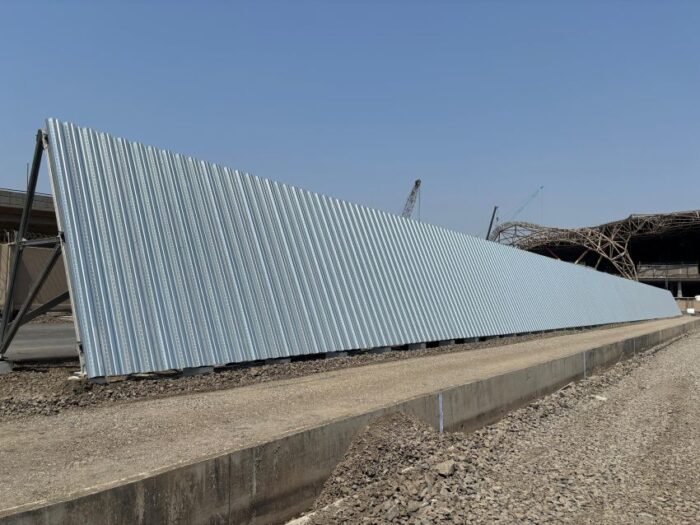
At Sheetala Infrastructure, we address this phenomenon using Computational Fluid Dynamics (CFD). By modelling the precise aerodynamic behaviour of an airfield, we design Jet Blast Deflectors (JBDs) that intentionally create aerodynamic “dead zones”—regions where exhaust energy is dissipated and ground equipment remains stable, even as aircraft such as a Boeing 777 or Sukhoi‑30 MKI operate nearby. This is not passive fencing. It is controlled energy management.
Bridging the Military–Civil Divide
Our experience as an Indian Air Force (IAF)–approved subcontractor has reinforced one fundamental lesson: safety is not a sliding scale.
Military airfields demand infrastructure capable of withstanding extreme thermal loads, blast pressures, and kinetic forces—particularly from afterburner operations. By transferring this rigor to civil aviation environments, including greenfield and brownfield airports, we deliver a level of structural resilience that conventional perimeter solutions simply cannot achieve.
Our 100% bolted, weld-free designs depart intentionally from legacy fabrication methods. Bolted systems offer superior fatigue resistance against continuous vibration, simplify inspection and replacement, and align with a faster, modular, and more environmentally responsible construction philosophy—an important consideration as Indian airports expand under tight timelines.
The ROI of Prevention
For airport operators, regulators, and investors, the economics are unambiguous.
The capital cost of a localized JBD installation is a fraction of a single wide-body engine’s insurance deductible—let alone the cumulative losses associated with aircraft downtime, schedule disruption, passenger recovery, and reputational impact.
In dense fog or low-visibility operations—when human observation and camera-based systems approach their functional limits—the physical infrastructure becomes the final, non-negotiable layer of defence.
By strategically deploying JBDs at critical taxiway intersections and apron boundaries, airports can be functionally zoned into protected operational segments. This approach goes beyond procedural compliance with DGCA CAR Section 4 or ICAO Annex 14—it safeguards operational continuity itself.
A Mission Aligned with Atmanirbhar Bharat
India is now the world’s third-largest aviation market, yet for decades we have relied on imported systems for some of the most critical elements of airside safety infrastructure.
As the only domestic manufacturer operating in this specialized domain, Sheetala Infrastructure’s mission is clear: to ensure Indian airports are protected by Indian engineering that meets—and exceeds—global benchmarks.
The AI101 incident should serve as a strategic inflection point. Reactive responses to ground accidents are no longer sufficient. The future lies in engineering risk out of the system altogether.
Our objective is simple but uncompromising: a future where Indian airports operate as near-zero-FOD environments, secured by indigenous, military-grade infrastructure designed for the realities of modern aviation.