
Having spent over two decades in Business Aviation, worked into multiple verticals and taking up various roles, the journey has been good enough for Mr. Abhishek Kumar. He happily accepts that he feel blessed in life to get all good opportunities which shaped his career. Within the time span, he has played a very key role in all his assignments which has achieved him an accolade from the industry peers. In this candid interview, Mr. Abhishek Kumar, Business Leader talks with Vishal Kashyap, Managing Editor, Aviation World about his Aviation journey and shares his perspective on the evolving sector. Excerpts…
Q: Tell us about your journey into Aviation? How you started and about your professional associations?
A: I started my career in 2004. My first assignment was with a company involved in trading of aircraft parts and consumables. I was there on a short term contract to prepare a software for that company to minimise the wastage of consumables.
I made a software using FIFO (First In First Out) method and it worked well and saved a lot for that company. Started working with OEMs like Honeywell, Recaro Seats for their projects in India (As their authorised service center). This helped me to setup Spare Parts Business Unit in one of the leading MROs in India from scratch and converting the same into profitable entity.
I learnt the nuances of maintenance which further helped me to shape up my career in another MRO in New Delhi. Having learnt trading and maintenance the next step was to see what happens on the other side. So I joined one of the leading charter management company who just took over a NSOP. Worked tirelessly to add 11 aircrafts on the AOP during the COVID period.
Q: You have played an instrumental role at senior management level. How has been the experience in terms of opportunities and responsibilities?
A: If you ask me, I have been lucky enough to get the opportunities which shaped my career. I always believed in upgrading my skills. I would have been a software developer till date working on the coding side if I would not have taken the opportunity offered to me to join the sales and operations.
I take the current opportunity and start working on my next level skill development. Starting from day one, I was responsible for complete P & L which helped me to take the risk and it really boosted my career. If you have to reach at top, you must have the appetite to take the risks. Being responsible for complete P & L gives the leverage to interact with various stake holders within the organization and it gives you overall BIGGER picture which normally one doesn’t see working in silo.
Secondly I am a firm believer of two things which really helped me to get these opportunities.
FIRST : It is important for you to know WHAT NOT TO DO even if you don’t know What to do next ? – It simply means I am very clear what all things I don’t have to do come what may. I have been a learner and keep learning new things and hence don’t know what will come next and what to do. But based on my learning and experiences, I have a list of what not to do and it really helps me.
SECOND : Focus on your own growth. There is a proverb in Hindi “ Tumhara kiya tumhare saath and mera kiya Mere saath). Again I am a firm believer of this and it has helped me a lot during my last 20+ years journey.

” It’s important for one to know WHAT NOT TO DO.
Several people will tell you what to do but no one tells you what’s not to do and actual success lies in knowing this fact.”
Q: There has been complete transition in Business Aviation in terms of number of aircrafts, business volume, type of pax, etc. How do you see the evolution and what next is projected?
A: The recent transformation in Business Aviation, marked by significant changes in aircraft numbers, business volume and passenger profiles – reflects broader shifts in the global economic landscape and evolving client preferences. More aircrafts are entering the market which are driven by rising demand from HNIs & corporates.
From large cabins jets to light jets, fleets are now catering to a wider range of needs, including short haul and regional. The pandemic initially suppressed business travel but has since rebounded strongly, with a shift towards more flexible, on-demand and private travel solutions. Increasing emphasis on greener, more efficient aircraft like those equipped with advanced engines affects operational volume and costs.
Business Aviation used to be dominated by corporates and HNIs but the client base now includes entrepreneurs, top executives and even government officials. High speed internet on board for remote work capabilities has become a new standard now. New airports and FBOs are being developed to cater to increased traffic.
WHAT NEXT :
Adoption of sustainable aviation fuels (SAFs), development of zero-emission aircraft and increased emphasis on carbon offsetting. Industry is looking forward to more flexible ownership models like fractional ownership, memberships and pay per use schemes. Client demands are increasing now to have highly personalized travel experience including bespoke interiors, tailored amenities and seamless digital interfaces.
The future of Business Aviation is poised for a combination of technological innovation, sustainability abd personalized service. While the core value of offering private, efficient and flexible travel remains unchanged, the ways in which this is achieved will continue to evolve and that’s going to bring new changes and dimension in this industry. Companies that embrace digital transformation, prioritize environmental responsibility and adapt to changing client expectations will be best positioned to achive bigger in this dynamic landscape.
Q: What’s your observation of Fractional ownership of Business jets in India?
A: Fractional ownership in aviation in India is a burgeoning concept and it still have to evolve. This allows an individual or a business unit to own a share of an aircraft rather than purchasing it completely. This model caters primarily to HNIs and corporates seeking the benefits of private flying without the full financial burden and operational responsibilities associated with the sole ownership. It does provide a compelling solution for those who require the flexibility and convenience of private air travel but may not fly frequently enough to justify the expense of outright ownership.
In India, leading companies have started to establish a presence, yet the market is still in its infancy compared to more mature markets like USA. Regulatory hurdles, limited infrastructure and lack of awareness among potential customers pose challenges that needs to be addressed timely. The Indian economy continues to grow and hence the demand of business air travel will increase and fractional ownership is poised to gain traction. Education around fractional ownership will attract more individuals and corporates to consider this innovative approach to private aviation.
Q: Your expertise into leasing of aircraft through GIFT city is phenomenal. How do you see the BA industry benefitted out of it?
A: Gift City is a wonderful project launched by Indian Govt. It’s a new project and hence the Govt is directly looking after the affairs. I have personally seen the officers working on to resolve the issues in mid-night to make it happening. It has emerged as a strategic hub that offers several benefits to the Business Aviation Industry in India. GIFT City offers several fiscal incentives, including tax breaks and simplified regulatory procedures. The Special Economic Zone status enhances ease of doing business thereby attracting global players and private owners. These benefits lowers the operational cost for business jet owners and operators, making India a more competitive and cost-effective market for Business Aviation.
Gift City hosts a vibrant ecosystem of financial institutions, multinational corporations and service providers. The incentives and infrastructure is attracting global private jet operators and OEMS to set up bases in India there by providing local support. This also increases investment in India’s business aviation sector and encourages the growth of related service industries. The major thing missing from India market is the ancillary industry and Gift City is ideally positioned to boost the ancillary industry which will make India self Dependent.
Q: The US tariff is still looming despite of the temporary halt till 9th July 2025 . If implemented, what impact is expected in the sector?
A: We all must hope for a positive outcome of this US Tariff war. If implemented, it could have several significant impacts on India’s business aviation sector :
Higher import prices : The increased tariff will directly affect the cost of acquiring or maintaining business jets which will further affect the fleet expansion plans.
Higher charter cost : Increased acquisition cost and operational cost will lead to higher charter rates thereby reducing the demand of charters among the corporate clients.
The increased tariffs will make the aircraft import costly which may lead to either delayed delivery or worst case cancellation of orders.
Leasing companies may revise their agreements to incorporate new changes leading to new pricing and ultimately non-availability of aircrafts.
There could be some positive impacts as well :
This may lead to increased demand for Domestic Maintenance and manufacturing. Indian Government must strategize to scale up manufacturing OR provide all possible support to the firms dealing with this to become a more self-reliant sector.
Alternatively the Indian Govt might think to provide some subsidy to cover up these increased costs.
Q: Many new NSOP are being issued and also under process in India. What’s the projected number of new aircrafts coming under these NSOPs?
A: As discussed earlier, this market is growing and lot of new NSOPs are coming to the market with specific requirement. We are hoping to see approx. 25-30 new aircrafts in this market in this year.
Q: What’s your view on the overall Business Aviation sector in India?
A: The overall business aviation sector in India has been experiencing steady growth, driven by increasing economic activity and the expanding needs to corporate India. India’s burgeoning corporate sector and expanding HNI’s population are fuelling demand for private and chartered aviation services. The need for efficient, time saving travel options has increased among corporate and government officials.
DGCA has also been working on streamlining regulations related to business aviation creating an industry friendly regulatory environment.
We still have the challenges of high operating cost due to high import duties on aircraft and spares parts which are a barrier to broader adoption.
The Indian aviation sector is poised for continued growth over the next decade. We are still smaller compared to mature markets like USA. Having said that if the key challenges related to cost and infrastructure are addressed, it is an attractive market for domestic and international players to capitalize on India’s economic rise.
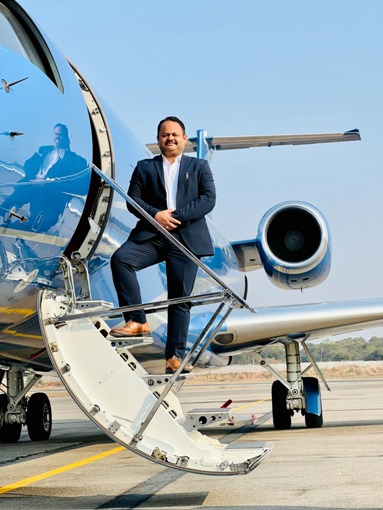
Abhishek Kumar
In the process of conducting the interview, Aviation World pointed out few of the top capabilities which is highlighted below:
* Abhishek Kumar is a seasoned aviation management professional with over 19 years of extensive experience spanning MRO (Maintenance, Repair, and Overhaul), FBO (Fixed Base Operations), aircraft sales, supply chain management, aircraft induction, and business development.
*His expertise lies in optimizing aviation operations, building high-performance teams, and expanding business footprints across India and neighboring markets.
*He possesses a strong track record in strategic project execution, including the induction of aircraft, establishing India’s first bonded warehouse for OEM parts, and creating multi-million dollar parts divisions from scratch.
*Abhishek excels in contract negotiation, supply chain logistics, regulatory compliance (CAR145, NSOP, ISO 9001), and implementing innovative service delivery models to enhance customer satisfaction and operational efficiency.
*His key skills include fleet management, ground handling, vendor management, revenue growth, cost optimization, and customer relationship development. Abhishek also demonstrates proficiency in ERP systems (RAMCO), Salesforce CRM, and inventory management systems, enabling streamlined operations and data-driven decision-making. With a proven history of leading complex projects, expanding business operations, and forging strategic partnerships with global OEMs like Honeywell and Textron.
*Abhishek is a dynamic leader capable of translating strategic vision into measurable results within the aviation sector.
( This interview is published in the July-August 2025 edition of Aviation World)