
Airports

Airports

Menzies Aviation gets 15‑year ground handling license at BLR Airport

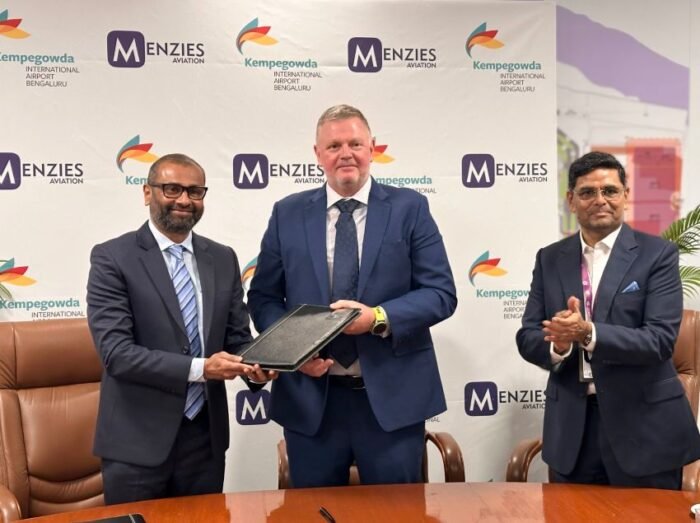
Bengaluru, 03 February 2026: Menzies Aviation has been awarded a 15-year license to provide ground handling services at Kempegowda International Airport Bengaluru (BLR Airport), one of India’s fastest‑growing airports for both domestic and international traffic. The license, awarded by Bangalore International Airport Limited (BIAL), is effective from 1 April 2026, with operations expected to commence immediately upon securing required regulatory approvals. Menzies Aviation is present at Blr Airport for more than 15-year where it has delivered air cargo services supporting global and domestic carriers. Under the new license, the company will provide a full suite of ground handling services across Terminals 1 and 2, including passenger, ramp, and baggage operations, enabling airline customers to benefit from integrated ground and cargo services at the airport. BLR Airport is a key aviation gateway for South Asia and one of India’s busiest airports, handling more than 43 million passengers annually and continuing to see strong growth in both domestic and international traffic. Charles Wyley, EVP Middle East, Africa & Asia, Menzies Aviation, said: “This long-term partnership reflects BIAL’s confidence in our global safety, compliance, and service standards, as well as our ability to support the airport’s sustainability and growth ambitions. Securing this 15-year license at one of India’s fastest-growing airports is an important step in strengthening our presence in a region experiencing exceptional aviation growth. We are proud to deepen our partnership with BIAL by delivering integrated ground handling and cargo solutions for our airline customers. Girish Nair, Chief Operating Officer, Bangalore International Airport Limited (BIAL), said: “We are pleased to onboard Menzies Aviation as our ground handling partner, bringing with them a proven global track record and deep operational expertise across some of the world’s largest international airports. Safety remains our foremost priority at BIAL, and Menzies’ strong safety culture, robust governance frameworks, and consistent adherence to global best practices align closely with our own standards. We are confident this partnership will further strengthen safe, efficient, and seamless ground handling operations at BLR Airport, support our long-term growth and sustainability ambitions, and deliver consistent value to our airline partners and passengers, reinforcing our vision of becoming a world-class aviation hub.”

Airports

Honeywell collaborates with SAF One and Tata Projects to enable SAF Production

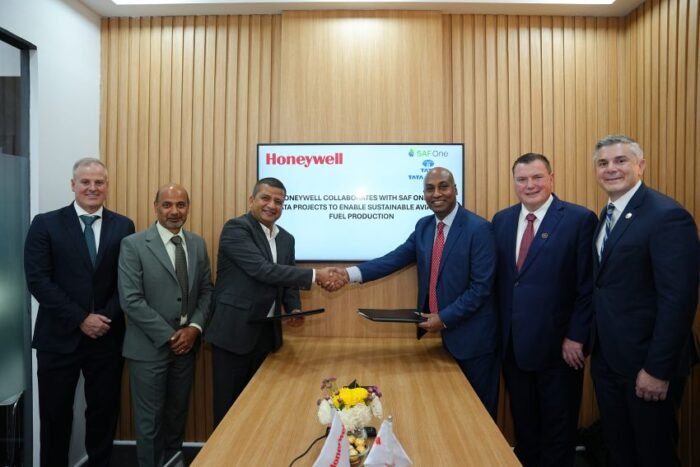
Delhi, January 27, 2026: Honeywell has announced that SAF One Energy Management Limited (SAF One) will use Honeywell UOP Ecofining™ process technology to produce sustainable aviation fuel (SAF). Tata Projects Limited (TPL), the Tata Group’s engineering and construction arm, has been appointed as the engineering, procurement, and construction (EPC) partner for the project. Together, Honeywell and TPL will deliver an integrated solution tailored to SAF One’s project requirements. Honeywell UOP’s Ecofining process technology, developed in collaboration with Eni S.p.A., offers a capital- and cost-effective solution for processing waste fats, oils and greases into renewable diesel and SAF. This collaboration marks a significant milestone in SAF One’s plans to develop multiple SAF production units globally, including one in India. Through the deployment of Honeywell UOP’s Ecofining process technology, SAF One will convert used cooking oil (UCO) and other waste oils and fats into SAF, helping the aviation industry reduce lifecycle emissions and advance its decarbonization goals. Rajesh Gattupalli, President, Honeywell UOP, said: “Our Ecofining process technology broadens the potential feedstock base for SAF and enables producers to adapt to shifting market conditions and resource availability. By leveraging our experience and continuous advancements in process engineering, we aim to make SAF production more economically feasible. The installation of our Ecofining process technology with SAF One and TPL demonstrates our leadership in SAF production and ability to help produce renewable fuels at scale.” Rajiv Menon, President & COO – Energy & Industrial Business, Tata Projects Limited, said: “Our collaboration with Honeywell and SAF One highlights the value of early engineering integration and disciplined execution in delivering scalable SAF projects. Together, we are enabling solutions that blend technology excellence with constructability and lifecycle efficiency.” Commenting on this significant milestone, Deepak Munganahalli, cofounder and CEO of SAF One, said: “We are delighted to work with Honeywell and Tata Projects Limited. Their techno-commercial expertise supports SAF One’s ‘design one build many’ approach across our pipeline of SAF projects. This collaboration strengthens our platform and enables us to work with our customers on scalable long-term decarbonization solutions.” Honeywell and TPL are jointly optimizing the technology configuration to maximize capital expenditure, enhance project timelines, and deliver a solution aligned with SAF One’s global deployment strategy. The companies’ collaboration supports the ambitions of both India and the larger world for climate change mitigation and reinforces Honeywell’s leadership in developing SAF technologies for global markets.

Airports

Munich Airport CEO Jost Lammers joins ACI World as its new Chair

Montreal, 12 January 2026: Airports Council International (ACI) World appoints Jost Lammers, CEO of Munich Airport, as Chair of the ACI World Governing Board (WGB) for the 2026–2027 term. Lammers succeeds Candace McGraw, retired CEO of Cincinnati/Northern Kentucky International Airport (CVG), who completes her tenure as ACI World’s first woman Chair, after guiding the organization through a period of strong global advocacy and strategic advancement. The ACI World Governing Board is composed of 28 airport CEOs nominated by ACI’s five regions. The Board provides strategic direction on airport policy, operational priorities, sustainability, and innovation on behalf of airports worldwide. A global aviation leader with extensive international experience Lammers has been an active member of the ACI World Governing Board since 2019—serving as Vice Chair from 2024–2025—and served on the Board of ACI EUROPE from 2017–2023. Elected President of ACI EUROPE in 2019, he led the ACI Region through the unprecedented challenges of the COVID-19 crisis, strengthening collaboration among airports across Europe and championing recovery. Industry leaders speak ACI World Director General Justin Erbacci said, “We are proud to welcome Jost Lammers as Chair of the ACI World Governing Board. His global experience, proven leadership, and deep understanding of airport operations and policy come at a pivotal moment for our industry. As airports accelerate innovation, strengthen operational resilience, and advance sustainability, Jost’s ability to build consensus and drive strategic progress will be instrumental. I would also like to extend our sincere appreciation to Candace McGraw for her exceptional leadership as ACI World’s first woman Chair. Her commitment to sustainability, advocacy, and workforce transformation has helped position airports for long-term success.” Munich Airport CEO Jost Lammers said, “It is an honor for me to serve as the Chair of the ACI World Governing Board. My dedication is focused on strengthening ACI’s leadership role on the global stage. By uniting strong advocacy, effective governance, and collaboration with global partners, we can ensure airports evolve as innovative, sustainable, and people-focused organizations, enhancing their role as vital hubs of mobility and economic growth.”

Airports

Airports Authority of India achieves excellent rating under MoU 2024-25

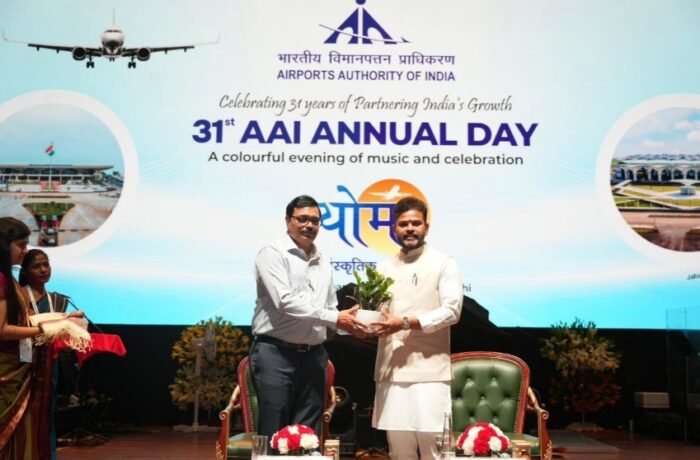
New Delhi, 9th January, 2026: Airports Authority of India (AAI)has achieved ‘Excellent’ rating with score of 93.21 under MoU 2024-25, signed with Ministry of Civil Aviation, highlighting its consistent achievements in operational efficiency. The Department of Public Enterprises has communicated AAI’s MoU score of 93.21 with final rating as ‘Excellent’. Memorandum of Understanding (MoU) between AAI and Ministry of Civil Aviation (MoCA) is signed as per DPE Guidelines wherein major emphasis is on financial targets in terms of growth in Revenue from Operations, Capex, Return on Capital Employed, Asset Turnover Ratio etc., and CPSE sector specific physical parameter(s). In addition, based on the priorities of Government of India, certain compliance parameters such as procurement from MSE’s including SC/ST & women, CSR etc., are also included in MoU. AAI has invested Rs. 5,075 Crore in capital expenditure under the MoU 2024-25 for development of state-of-the-art infrastructure and to enhance airport services, improvement in operational efficiency, resulting in a safer and seamless travel experience. Aligned with the Government of India’s vision, AAI’s performance reflects strong growth, efficient operations, MSME procurement and CSR initiatives.

Airports

CSMIA caters to record 55.5 mn pax in CY25

Mumbai, 8th January 2026: Closing calendar year 2025 on a strong note, Chhatrapati Shivaji Maharaj International Airport (CSMIA) recorded an overall passenger traffic of around 55.5 million in CY25, marking a steady year of growth alongside multiple operational milestones. The annual traffic included over 16.3 million international passengers and 39.2 million domestic passengers, reflecting a year-on-year growth of approximately 1.3% compared to CY24 with 54.8 million passengers, and an overall increase of 7.6% over CY 2023 passenger traffic numbers. Passenger movement at CSMIA during the year was driven by strong seasonal demand and peak travel periods. January 2025 emerged as the busiest month, with close to 5 million passengers, followed closely by November 2025 with approximately 4.9 million passengers. In November, the airport recorded its top three highest single-day passenger traffic figures, including its highest-ever single-day throughput of 1,75,925 passengers on 29 November 2025. The October–December quarter (Q4) also marked the highest quarterly passenger traffic, with 14.36 million passengers handled in Q4. Operational throughput at CSMIA also reached new highs during CY25. The airport handled a total of 3,31,011 Air Traffic Movements (ATMs), including 92,141 international and 2,38,870 domestic ATMs. A new record was also achieved on 21 November 2025, when CSMIA handled 1,036 ATMs, the highest number of ATMs recorded at CSMIA in a day. Overall, Air Traffic Movements at CSMIA have grown by approximately 25% from CY 2022. The airport also expended its connectivity adding several new routes to its network on both domestic and international sectors.

Airports

CSMIA commissions ‘Taxiway M’ to strengthen airside capacity and operational resilience

Mumbai, 30 December 2025: Chhatrapati Shivaji Maharaj International Airport (CSMIA), Mumbai has commissioned Taxiway M, a significant airside infrastructure upgrade designed to improve airside efficiency and operational resilience at one of the world’s busiest single-runway airports. CSMIA handles an average of 950+ aircraft traffic movements (ATMs) daily. This is primarily supported by the main runway 09/27 that handles high-intensity operations supported historically by a single Parallel Taxi Track (PTT) N–N1, which has remained in near-constant use due to the absence of an alternate full-length taxiway. Over time, sustained traffic levels and limited maintenance windows highlighted the need for an additional parallel taxiway to improve operational resilience and reduce dependency on a single taxi track. Taxiway M was conceived to address this critical requirement. However, the project involved substantial complexity, as the alignment was constrained by the presence of the Aerodrome Rescue and Fire Fighting (ARFF) building located along the taxiway corridor. To ensure full-length connectivity of the Taxiway, CSMIA relocated the ARFF facility and commissioned a temporary main fire station, ensuring uninterrupted CAT-10 emergency response capabilities, while concurrently commencing construction of the new permanent ARFF station. Executed during the Fourth Control Period (FCP), the project progressed in multiple phases. Phase 1 connected Runway 14–32, followed by Phase 2 where a continuous parallel taxiway network was established. Despite the challenges of working within a highly constrained airside environment—surrounded by active taxiways on three sides and a runway on the fourth—the project was delivered through meticulous planning, close coordination with stakeholders, and fast-track execution. Uncharted utilities encountered during execution were also addressed through swift design modifications, enabling the project to remain on schedule. Taxiway M was commissioned on 25 December 2025, aligned with the Aeronautical Information Regulation and Control (AIRAC) cycle, after approximately 240 days of construction, including the monsoon period. Despite the early monsoon onset and seasonal transitions, the timely delivery reflects the preparedness, foresight, and execution discipline of the CSMIA team, along with timely approvals from the Directorate General of Civil Aviation (DGCA). The new parallel Taxiway M delivers operational benefits by enabling more efficient departure sequencing, allowing aircrafts to move onto the runway and take-off promptly, and allow aircrafts to queue on the taxiway while awaiting take-off clearance. This significantly improves departure capacity during peak periods while offering greater flexibility to air traffic controllers in managing airside traffic flows. The parallel taxiway also provides an alternate routing option during planned maintenance or unforeseen disruptions, enhancing overall operational resilience. From an environmental standpoint, reduced taxi distances and shorter ground holding times contribute to lower fuel consumption and reduced carbon emissions, thus reinforcing CSMIA’s commitment to sustainable airport operations. With Taxiway M now operational, CSMIA is in a better positioned to manage current traffic volumes while creating headroom for future growth, ensuring smoother, safer and more reliable airport operations. (News published unedited on as shared basis )

Airports

NMIA records impressive passenger load on first day

Navi Mumbai, 26 December,2025: Passenger load at Navi Mumbai International Airport (NMIA) recorded a marked rise on December 25, the first day of passenger operations, fuelled by heightened traveller interest and start commercial operations.The overnight spurt in passenger load points to a positive response from travellers. A day earlier, on December 24, passenger load levels stood at 71 percent for arrivals and 83 percent for departures. With the start of scheduled operations on December 25, arrival load increased to 85 percent, while departure load climbed to 98 percent, reflecting a strong jump in booking levels as operations commenced on 25th December. On the first day of operations on 25 December, the airport recorded a total passenger throughput of 4,922, with 2,278 arriving passengers and 2,644 departing passengers, indicating strong demand from the Mumbai Metropolitan Region. On 26 December, passenger traffic increased further, with the airport handling a total of 5,028 passengers.

Airports

NMIA set to open tomorrow, expanding Mumbai’s aviation capacity

Mumbai, 24 December, 2025: Navi Mumbai International Airport (NMIA) will begin commercial flight operations tomorrow, December 25, marking a key milestone for India’s civil aviation sector and expanding capacity for the Mumbai Metropolitan Region (MMR). The opening adds a critical new gateway for a region that has faced sustained congestion for over a decade. Planned as part of a distributed aviation framework, NMIA supports Mumbai’s transition to a multi-airport system aimed at improving capacity, operational resilience and long-term scalability. On Day One, domestic services will be operated by IndiGo, Air India Express, Akasa Air and Star Air, connecting NMIA to nine destinations across India. The airport will handle 15 scheduled departures on the first day. During the initial phase, NMIA will operate between 08:00 hrs and 20:00 hrs, with up to 24 scheduled daily departures to 13 destinations and the capability to manage up to 10 aircraft movements per hour. From February 2026, operations are planned to progressively scale up to round-the-clock services. NMIA was inaugurated by the Prime Minister Narendra Modi on October 8. Since 2021, Adani Airports Holdings Limited (AAHL), a subsidiary of Adani Enterprises Limited (AEL), has led the development, construction, and operational readiness of the greenfield airport, progressing it from accelerated construction to phased commercial operations within a compressed timeframe. Passenger services from day one will be supported by Digi Yatra–enabled contactless processing at designated touchpoints, along with trained terminal staff across kerbside, check-in, security and boarding areas. Retail and food and beverage offerings have been curated with a focus on affordability and local relevance. Inspired by the lotus, India’s national flower, the terminal architecture integrates cultural identity with contemporary design and sustainability features. In its initial phase, NMIA is designed to handle 20 million passengers per annum (MPPA), with future expansion planned to scale capacity up to 90 MPPA, supported by dedicated cargo terminals and multimodal connectivity. With operations set to begin tomorrow, NMIA is expected to strengthen Mumbai’s role as a global gateway and support long-term economic growth through expanded aviation capacity.

Airports

Guwahati gets new airport terminal, inaugurated by the PM

Guwahati, 20 December 2025: The Prime Minister of India Narendra Modi inaugurated the new terminal at Lokapriya Gopinath Bordoloi International Airport (LGBIA) at Guwahati during the Advantage Assam 2.0 celebrations. The airport operations will commence by the end of February while a comprehensive Operational Readiness and Airport Transfer (ORAT) programme—supported by an expert visiting team from Munich, Germany—has ensured that systems, processes, personnel and passenger flows are aligned for a safe and seamless opening from day one. Envisioned as a modern gateway rooted in regional identity, the terminal—aptly named “The Bamboo Orchids”—draws inspiration from Assam’s iconic kopou phool (foxtail orchid) and indigenous bamboo varieties such as Bholuka bamboo from Assam and Apatani bamboo from Arunachal Pradesh. Blending natural materials, abundant daylight and contemporary design, the architecture reflects the Northeast’s ecological and cultural richness. Around 140 metric tonnes of locally sourced bamboo from the region have been used across the terminal, positioning it among India’s most prominent examples of nature-inspired airport architecture where traditional craftsmanship is reimagined through modern engineering. The project has been developed by Guwahati International Airport Limited, with operations led by Adani Airport Holdings Limited (AAHL). While inaugurating, the PM described it as part of a wider Vikas ka Utsav unfolding in Assam across the Northeast. He noted that Assam is emerging as India’s eastern gateway under the Act East policy, with the bamboo-rich terminal symbolising strength, sustainability and the state’s growing role in powering Viksit Bharat, as India advances toward becoming the world’s third-largest economy. Commenting on the occasion, Gautam Adani, Chairman, Adani Group, said, “The Guwahati terminal demonstrates how world-class airport infrastructure can be delivered swiftly while remaining deeply rooted in local identity. It will strengthen connectivity, support economic growth across the Northeast, and offer passengers a seamless, modern travel experience.” Equipped with DigiYatra-enabled processing, smart check-in systems and expansive passenger areas, the terminal is designed to handle 13.1 million passengers annually by 2032. In FY 2024–25, Guwahati Airport handled 6.50 million passengers, underscoring the region’s accelerating aviation demand. Currently, Guwahati ranks as the 10th busiest airport in India, serving as a critical hub for all eight Northeastern states. The overall airport development represents an investment of Rs 5,000 crore, including Rs 1,000 crore earmarked for Maintenance, Repair and Overhaul (MRO) facilities. Planned integrated domestic and international cargo infrastructure will further strengthen trade, logistics and employment generation across the region. The Guwahati milestone forms part of a wider national aviation expansion led by AAHL, with execution momentum continuing through the scheduled operational launch of the Navi Mumbai International Airport (NMIA) on December 25—one of India’s largest greenfield airport projects.

Airports

CSMIA achieves Level 5 of Airport Carbon Accreditation

Mumbai, 11 December 2025: CSMIA operated by Mumbai International Airport Limited (MIAL), has been awarded Level 5 accreditation under Airport Carbon Accreditation programme – the highest recognition within the globally recognised framework. This achievement recognises that CSMIA has achieved operational net-zero emissions (Scope 1 & 2) and has a validated roadmap to achieve net-zero Scope 3 emissions by 2050. This reflects CSMIA’s sustained, data-driven approach to carbon management, rooted in the principle of ‘Measure, Manage, Reduce and Communicate’, supported by a strong ESG policy framework and a cross-functional carbon management committee. With this accreditation, CSMIA joins a select group of 30 airports worldwide, including seven in the Asia-Pacific region and four in India, that have demonstrated advanced decarbonisation maturity. The Airport Carbon Accreditation programme is the industry standard for the assessment of an airport’s efforts to manage and reduce carbon emissions, where Level 5 represents the highest standard. Among other accreditations, CSMIA also is the first airport in India – and only the third worldwide – to achieve Level 5 Accreditation for Airport Customer Experience from Airports Council International (ACI). Speaking on the achievement, MIAL Spokesperson said, “This accreditation places CSMIA among the world’s leading airports that is committed to ensuring sustainable aviation operations. CSMIA will continue its efforts to blend innovation with environmental responsibility, setting new benchmarks for the global aviation ecosystem. Sustainability is a long-term responsibility, and we are proud to be at the forefront of driving this shift within India’s aviation industry”. Stefano Baronci, Director General of ACI Asia-Pacific & Middle East said: “Chhatrapati Shivaji Maharaj International Airport has always demonstrated strong leadership in advancing environmental sustainability. Achieving Level 5 of the Airport Carbon Accreditation Programme reflects their sustained effort and collaboration with stakeholders to reduce emissions, and this accomplishment aligns perfectly with airport industry’s shared vision of achieving net zero goals by 2050. Airports in India continue to be at the forefront of environmental stewardship. With four Indian airports achieving ACA Level 5 accreditation, Asia-Pacific & Middle East region is the second in the world with a total of seven L5 accredited airports. We hope this milestone encourages other airports in the region to continue strengthening their environmental performance and contributing to a more sustainable aviation sector.” The accreditation reflects MIAL’s sustained climate initiatives at CSMIA, supported by cross-functional governance, long-term investment in green technologies, and collaboration with aviation stakeholders. A cross functional carbon management committee at MIAL drives year-on-year emission reduction planning and performance tracking. Reinforcing these efforts, MIAL introduced its ESG policy in June 2022 and revised it in May 2025, highlighting the effort to maintain over 90 percent reduction in Scope 1 and 2 emissions and attain Net Zero for Scope 3 through the adoption of green and efficient technologies. In FY 2025, the airport reported Scope 1 emissions of 566.3 tCO2e, Scope 2 emissions at zero, and Scope 3 at 5,158,197. Progress Towards Net Zero Mumbai International Airport Limited (MIAL) has already eliminated emissions from its own operations (Scope 1 & 2) and is now focused on reducing indirect Scope 3 emissions through structural, collaborative, and technology-driven interventions. These measures have collectively led to a >98% reduction in absolute emissions in scope1 & 2 since FY2022, marking a decisive shift towards low-carbon airport operations. MIAL has undertaken several transformative sustainability initiatives since FY2022, following its achievement of the prestigious ACA Level 4+ certification, including: • 100 percent renewable electricity since August 2022 • Over 40 percent improvement in energy intensity (FY2025 vs FY2022) – through extensive upgrades such as converting belt-driven AHU fans to EC fans, transitioning entirely to LED lighting, and deploying advanced automation and high-efficiency inverter air-conditioning systems. • Full transition to electric airport vehicle fleet • Replacement of high-GWP refrigerants and CO₂-based fire systems with eco-friendly alternatives and fully decarbonized its ground fleet by converting all internal combustion engine vehicles to electric vehicles. • Deployment of energy-efficient HVAC systems, LEDs, and automation tools • Strengthened carbon governance via updated ESG policy in May 2025 MIAL’s climate strategy aligns with global reporting frameworks (GRI, ISO 14064-1:2018) and the UN Sustainable Development Goals, while prioritising sector transitions such as Sustainable Aviation Fuel (SAF) and a decarbonised airport ecosystem. The airport publishes annual sustainability reports to ensure transparent disclosures and performance benchmarking. Sustainability remains central to MIAL’s vision, driving continuous innovation and responsible growth. By integrating global standards and aligning with the UN Sustainable Development Goals, CSMIA continues to shape a greener, more resilient future for the aviation industry. (Pix Courtesy: MIAL/CSMIA)

FOREWORD

Dear Reader’s,


The current edition of Aviation World has covered many areas of Aerospace & Defence based on the latest development in the sector. The front cover highlights three different images, first for the Union Civil Aviation Minister ….. who is leading from the front to steer Indian Civil Aviation sector to witness one of the most interesting phases. He is also facing most tumultuous timing due to the ongoing financial stress in the Aviation sector due to ATF rising cost and long airspace restrictions resulting in mounting losses for Indian carriers. Despite of all the ground level challenges,the minister is addressing new things on regular basis which keeps the sector motivated. We have featured many such developmental works in this edition done under his guidance which will be interesting to read.

Our lead story on “ The West War” is another important feature which covers the ground level reality of the challenges faced by the Aviation sector. Its though time ahead and we believe it will pass soon .

There are features on Regional connectivity and MoCA revised rules on the UDAN 2.0 and how its going to transform the flying experience within India.

In this edition, we have covered topics on MRO,Various Policy changes,Sea Plane Operations by SkyHop Aviation, TATA-Airbus joint project on C295 military aircraft under Make In India which is expected to roll out soon and many other interesting contents which will be good to read.

We are covering Farnborough International Airshow 2026 from 20-24July 2026 in London and our next edition will be based on the same event.For features, you may contact our team on priority basis.


Happy Reading!

NEWSLETTER

Aviation World Magazine is India’s premier aviation magazine and has been actively supporting the development of the Indian and global civil aviation sector. We started our journey in year 2015 and its been 12 years now and the response and acceptance is really encouraging. Thanks to all our associates and writers who remained with us in our progressive journey.

We have started 2026 on a very positive note and we look forward to increase our footprints to more locations and induct many more new companies in our campaign.. Do write to us at : editor@aviationworld.in

Disclaimer

The contents published in this website are news covering Aviation, Aerospace and Defence sector. The objective is to provide news in informative form to keep our readers updated of the latest development. We also publish content featured in our print publication Aviation World.We try our best to avoid any factual errors or image displayed here but we ensure immediate corrections to any such thing brought to our notice that might have been published inadvertently. All images and contents are sourced from the relevant organisations media team.

Copyright ©2014 – 2026. AVIATION WORLD. All rights reserved.

Scroll to Top