Business Aviation

Business Aviation

Gulfstream G700 sets multiple city-pair records en route to Paris Air Show

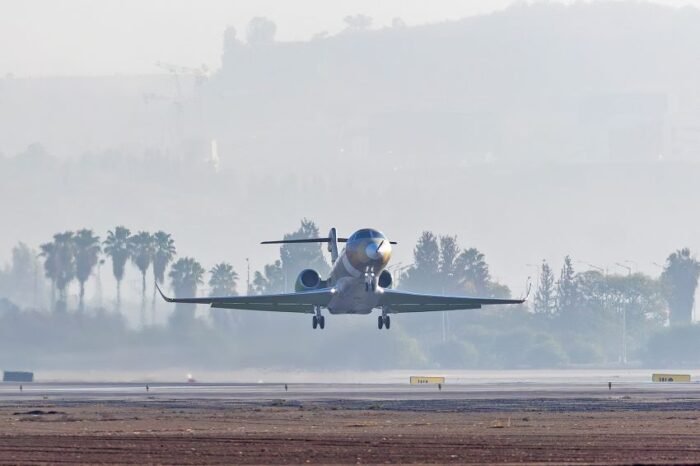
Paris Airshow, Le Bourget: Gulfstream Aerospace Corp. announced that the Gulfstream G700 has set two new city-pair speed records en route to the International Paris Air Show at Paris-Le Bourget airport. The G700 flew the record flights on sustainable aviation fuel (SAF) and will receive Sustainable Wings accreditation from the National Aeronautic Association (NAA) for each flight. The aircraft flew from Teterboro, New Jersey, to San Francisco, traveling 2,272 nautical miles/4,208 kilometers in 4 hours and 57 minutes at an average speed of Mach 0.91. It then flew from San Francisco to Paris, traveling 4,947 nm/9,162 km in 9 hours and 26 minutes at an average speed of Mach 0.91. “Recognition from our partners at the NAA and these latest record-breaking flights further demonstrate Gulfstream’s industry-leading commitment to sustainability,” said Mark Burns, president, Gulfstream. “We are excited for the G700 and our award-winning Gulfstream G600 to return to the International Paris Air Show this year and look forward to showcasing the compelling combination of advanced technology, performance and comfort as increased demand for our next-generation aircraft continues in Europe.” The G700 features the most spacious cabin in the industry and the Gulfstream Cabin Experience with 100% fresh air, natural light from 20 Gulfstream Panoramic Oval Windows and the industry’s lowest cabin altitude. With a maximum operating speed of Mach 0.935 and a high-speed cruise of Mach 0.90, the ultralong-range G700 has more than 80 city-pair speed records to date. The performance capabilities of the G700 can be attributed to the combination of Rolls-Royce Pearl 700 engines, Gulfstream-designed advanced aerodynamic wing and high-speed winglet introduced on the aircraft. The G700 is also outfitted with the award-winning Predictive Landing Performance System and dual head-up display featuring Gulfstream’s new Combined Vision System (CVS) that unites Enhanced Flight Vision System (EFVS) and Synthetic Vision System (SVS) in a single image, increasing pilot situational awareness and access to more airports.

Business Aviation

Megatron Aerospace becomes new dealer for INTEGRAL in India

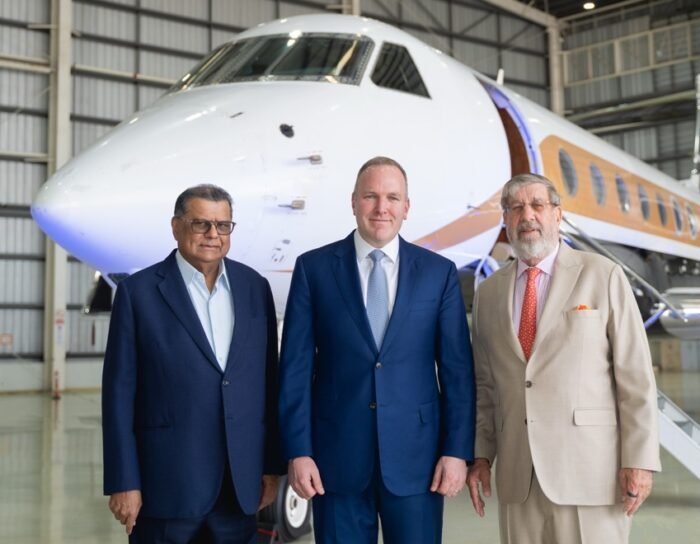
Paris Airshow: At the Paris Airshow 2025, AURA AERO signed an agreement with Megatron Aerospace Pvt Ltd, which becomes the manufacturer’s exclusive dealer in India for its INTEGRAL family of aircraft. Headquartered in New Delhi, Megatron Aerospace has sold over 100 aircraft across the country and has also introduced a wide range of aircraft to the Indian market — from reliable training aircraft to cutting-edge twin-engine jets. “MAPL is a renowned aviation market player boasting vast experience selling and supporting aircraft. Having them in our network will significantly strengthen our position and expand our reach in India. We will be able to access a wide range of new sales and service opportunities, while strengthening our order book for the INTEGRAL family, the future of sustainable aviation!” said Jérémy Caussade, Co-founder and CEO of AURA AERO. Drew McEwen, Chief Commercial Officer at AURA AERO, added: “We are thrilled to be partnering with MAPL, a respected aviation partner in India, to benefit from their extensive experience and their wide network to develop the sales of our INTEGRAL family of aircraft. This new partnership will considerably help develop our customer base and we are very excited about that”. INTEGRAL is a new-generation two-seater side-by-side training aircraft with aerobatic capabilities, suited for civil and military use and available in thermal or fully electric versions: ● INTEGRAL R: aerobatics, tailwheel, thermal engine (Lycoming), EASA certified, pending FAA certification in 2025, deliveries ongoing since April 2025; ● INTEGRAL S: training and leisure, nosewheel, thermal engine (Lycoming), pending EASA certification; ● INTEGRAL E: available in R or S version, electric motor (Safran ENGINeUS), ongoing flight test campaign since December 2024, EASA certification and first deliveries expected in Q4 2026. Sudeep Narula, Chairman and Managing Director of MAPL,said, “Driven by a passionate team of aviation enthusiasts, we pride ourselves on turning our clients’ aviation dreams into reality. At Megatron Aerospace, we don’t just fly — we elevate possibilities, and we think that AURA AERO’s aircraft are just the right planes for that”. He adds: “As a next-generation aviation company, we are committed to pushing the boundaries of technology, safety, and service. Our mission is to lead with innovation and integrity, pioneering sustainable flight solutions that shape the future of aviation.”

Business Aviation

Daher delivers 600th aircraft in the TBM 900-series at Paris Airshow

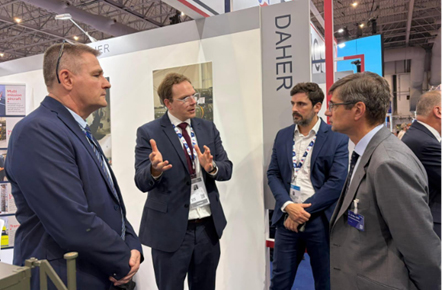
Paris Air Show, Le Bourget: Daher Aircraft’s turboprop-powered TBM airplane family marked a new milestone with the delivery of the 600th aircraft in the TBM 900-series, which was provided to its customer at the Paris Air Show. To date, more than 1,260 TBMs have been produced overall in six variants since the airplane’s 1990 service entry, beginning with the TBM 700 and TBM 850; and followed by the five versions in the TBM 900-series: the TBM 900, TBM 910, TBM 930, TBM 940 and TBM 960. The global TBM fleet has logged more than 2.6 million flight hours in service around the world. Daher’s milestone TBM 900-series aircraft is a TBM 960 version received by Jim Baum, a U.S.- based businessman who has been an operations executive in various technology firms for the past 30 years, and also manages the Minus 7 air-to-air visual communications company for aviation video and photography. As with more than half of the TBM customer base, Baum is a repeat buyer, having owned a TBM 940 and a TBM 930. Nicholas Chabbert, the CEO of Daher Aircraft’s division, said the TBM’s continued market demand reflects the aircraft’s combination of efficiency, sustainability and speed – backed by the global Daher Care support Network. “Attributes for the TBM’s success include its combination of jet-like speeds with turboprop performance, opening access to shorter runways, lowering fuel consumption and providing operational efficiency,” Chabbert stated. “We remain committed to the TBM product line’s competitiveness with an emphasis on listening to the customer and applying proven technology for further enhancements in sustainability, maintainability, flight safety and operability.” Daher’s introduction of the first TBM 900-series aircraft was in 2014 with the TBM 900 version, featuring such aerodynamic improvements as the addition of winglets, the use of new engine cowlings, and the integration of Hartzell’s five-blade scimitar propeller. In 2016, the TBM 900-series family was augmented by the TBM 930, equipped with Garmin’s touchscreen-controlled G3000 integrated flight deck. This variant incorporated the initial elements of TBM e-copilot® functionality, which lowers pilot workload and provides better situational awareness. Daher Aircraft further evolved the TBM 900 series in 2018 with the mid-category TBM 910, featuring Garmin’s G1000 NXi avionics. In 2019, production of the TBM 930 was succeeded by the TBM 940, which integrated the autothrottle function in its G3000 avionics suite. In 2020, the TBM 940 became one of the first aircraft equipped with the revolutionary HomeSafe™ emergency autoland system. The TBM 960 is the latest TBM 900-series version, unveiled by Daher Aircraft in 2022 and integrating the new PT6E-66XT turboprop engine – purpose-built by Pratt & Whitney Canada for this aircraft, as well as Hartzell Propeller’s five-blade composite propeller with the Raptor™ lightweight hub. Both the engine and propeller system are linked to the TBM 960’s dual- channel digital Engine and Propeller Electronic Control System (EPECS). The EPECS optimizes powerplant performance from the engine’s startup to landing, while reducing pilot workload by integrating all functions and protecting the engine’s life. It also enables the aircraft to be flown with more precise settings: at Daher’s recommended cruise setting of 308 kts., the fuel consumption is only 57 U.S. gallons per hour – a 10 percent fuel economy for more sustainability when compared to the maximum cruise setting. The TBM 960 benefits from a full range of TBM e-copilot® functions: an icing protection system; flight envelope monitoring through the Electronic Stability and Protection (ESP) and the Under- speed Protection (USP) systems; the Emergency Descent Mode (EDM) function; as well as the HomeSafe™ emergency autoland system. Daher’s use of digital power for the TBM 960 extends into the aircraft’s Prestige cabin, featuring an all-new environmental control system. Other enhancements include improved cabin style and comfort with ergonomically-enhanced seats, LED ambience strip lighting in the overhead ceiling panel, and electronically-dimmable windows – all controlled by a Passenger Comfort Display (PCD). Along with the TBM aircraft family’s continued popularity among individual owners and business operators, it continues to prove itself in multi-mission applications. Building on the TBM’s application in military command/VIP transportation, flight test support and the airlift of time-sensitive cargo, it has now entered service as a “birddog” aircraft in support of wildfire air attack missions.

Business Aviation

Fargo Jet Center purchase two Beechcraft King Air 360 aircraft for special missions at Paris Airshow

Paris Airshow, Le Bourget: Fargo Jet Center has announced the acquisition of two Beechcraft King Air 360 aircraft from Textron Aviation. The purchase was finalized at the Paris Air Show, with the agreement taking place at the Textron Aviation Special Missions booth. This milestone marks Fargo Jet Center’s first time exhibiting at the Paris Air Show, underscoring the company’s expanding global presence in the special missions aviation sector. The acquisition was a result of a collaborative agreement between key representatives from both organizations. “We are thrilled to secure these two King Air 360 aircraft, which are renowned for their reliability, versatility, and advanced avionics,” said Darren Hall, Vice President of Business Development, Fargo Jet Center. “These aircraft will enable us to provide mission-ready platforms to meet the needs of our global special missions customers.” The King Air 360 is celebrated for its enhanced cabin comfort, next-generation Collins Aerospace Pro Line Fusion avionics, and proven performance in demanding missions. Fargo Jet Center’s investment in these aircraft demonstrates its commitment to delivering industry-leading solutions and unparalleled customer support.

Business Aviation

Ascend Airways adds 5th aircraft to growing fleet, secures Canadian AOC

London, 8th June 2025: Ascend Airways, UK-based ACMI (Aircraft, Crew, Maintenance, and Insurance) and charter airline, has taken delivery of its 5th aircraft – Boeing 737-8 MAX. Part of Avia Solutions Group, the airline has also secured its Canadian Foreign Air Operator Certificate (FAOC), marking another significant milestone in its rapid expansion. The aircraft, registered as G-ULIT, received its Certificate of Airworthiness on June 3, 2025 and will be immediately deployed onto a long-term wet lease contract. This addition represents the fourth Boeing 737-8 MAX in Ascend Airways’ fleet. “I want to thank the entire team at Ascend Airways for their hard work and dedication in adding three aircraft over the past two months,” says Alastair Willson, CEO of Ascend Airways. “Our growing fleet positions us perfectly to meet the growing demand for reliable ACMI services in the UK and other markets with the newest generation of aircraft.” This has been a year of significant growth for Ascend Airways, which started 2025 with just two aircraft and now operates five. The airline plans to add further Boeing 737-8 MAX aircraft over the coming months, with the goal of operating a total of eight aircraft by year-end. The Boeing 737-8 MAX aligns with Ascend Airways’ strategy of offering the latest technology and most fuel-efficient aircraft to customers. The MAX 8 reduces CO2 emissions by 20% and has a 40% lower noise footprint compared to previous-generation aircraft, enabling customers to reduce their environmental impact when adding capacity. In addition to fleet expansion, Ascend Airways has received its Canadian FAOC, which allows the airline to commence ACMI operations in Canada. The approval comes in time for the peak season of travel in Canada during the IATA Winter season of which Ascend Airways currently has availability on B737-8 MAX aircraft. Ascend Airways is also in the final stages of gaining it’s FAA 129 approvals which will allow the Airline to operate ACMI and Charter flights to the US and also in the process of gaining it’s IOSA approvals.

Business Aviation

D328eco test aircraft rolls out: a defining milestone in sustainable regional aviation

Wessling, 28 May 2025: Deutsche Aircraft has unveiled the first D328eco test aircraft (TAC 1) at their headquarters in the Airtech Campus in Oberpfaffenhofen, a transformative moment for sustainable regional aviation. Following the announcement of the initial fuselage cut at the Farnborough International Airshow in July 2024, the programme has maintained steady momentum as it drives progress towards a more efficient and environmentally conscious future for regional air travel. Building upon the proven legacy of the Dornier 328, the D328eco is an advanced evolution, not a clean-sheet aircraft. It delivers enhanced performance, fuel efficiency, an elevated customer experience and lower emissions, while retaining the versatility and reliability that airlines, operators and passengers have trusted for over three decades. The roll out of the test aircraft underscores Deutsche Aircraft’s commitment to innovation, decarbonisation and regional connectivity. Engineering the Future of Regional Flight “The roll out of our first test aircraft marks a significant achievement in the D328eco programme and an important step towards our physical flight test activities,” announced Nico Neumann, Co-CEO of Deutsche Aircraft. “This milestone represents our transition from conceptual design to practical testing and industrialisation. At Deutsche Aircraft, we are proud to introduce an aircraft with the proven DNA of the Dornier 328, enhanced for better efficiency, reduced emissions and a superior customer experience, making it an optimal choice for regional operators worldwide.” “This milestone is a testament to our team’s dedication and technical expertise,” added Olaf Lawrenz, COO of Deutsche Aircraft. “Building upon the robust foundation of the Dornier 328, an aircraft ahead of its time, we have integrated modern technologies to enhance efficiency and sustainability. The roll out reflects our commitment to delivering a next-generation regional aircraft that combines proven reliability with cutting-edge advancements to meet the evolving demands of regional aviation.” Marie-Christine von Hahn, Chief Executive Officer of the German Aerospace Industries Association (BDLI), emphasised the significance of the roll out for the entire industry. “Innovations in the air improve our lives on the ground. Deutsche Aircraft is sending a strong signal on behalf of the entire industry: German aviation is a global leader.” A Next-Generation Regional Aircraft The D328eco is designed to set new standards in regional aviation, offering: Unmatched fuel efficiency with modernised aerodynamics and state-of-the-art propulsion systems. Optimised operational performance, capable of handling challenging runways, remote locations and extreme weather conditions. A future-ready platform, integrating next-generation avionics and cutting-edge manufacturing processes. A Clear Path to the Physical Test Campaign and Certification Following the roll out of the first test aircraft, Deutsche Aircraft is poised to start the test campaign, marking a significant step towards type certification and the aircraft’s subsequent entry into service in Q4 2027. The development of the D328eco is propelled by close collaboration with regulatory authorities, strategic industry partners and a highly skilled global supply chain. These partnerships ensure that the aircraft will adhere to the highest standards of performance, safety and sustainability. Redefining Regional Air Travel The D328eco is more than just an aircraft; it is a symbol of the aviation industry’s progress towards climate-conscious, fuel-efficient regional air travel. As Deutsche Aircraft continues to push the boundaries of sustainable aviation, the roll out cements its position as a leader in the next generation of regional flight. Celebrating with Key Stakeholders The roll out event was attended by over 500 guests, including key stakeholders from the Bavarian and Federal Government, industry partners, suppliers and representatives from regional, national and international media outlets. This significant turnout highlights the considerable support and interest in Deutsche Aircraft’s innovative approach to sustainable aviation.

Business Aviation

Gogo signs Falcon as first charter fleet customer for multiple Gogo Galileo HDX installations

Geneva,21st May 2025: Gogo has announced at EBACE 2025 that Falcon, part of Alex Group Investment, is the first charter fleet operator to commit to multiple installations of its Gogo Galileo HDX system. The mixed fleet operator has confirmed an initial purchase of five terminals for its Bombardier Global 5000 and Global Express aircraft as part of a strategic program to redefine the passengers’ onboard experience. Based in Dubai, the Falcon deal also represents the first Gogo Galileo customer signing in the Middle Eastern region. Falcon (operating under the Alex Jet AOC) selected the compact, advanced antenna system to bring fast, reliable connectivity to the cabin. Powered by the Eutelsat OneWeb constellation, it allows passengers to stay connected and productive throughout their flight to give an on-the-ground digital experience at altitude. “Our clients expect more than just connectivity; they want streaming-speed internet that travels with them. Galileo HDX lets us exceed expectations and offers a unique onboard experience that sets Falcon apart,” says Aziz Turan, Executive Director Alex Jet (part of Alex Group Investment). “This brings us a competitive advantage in a dynamic global charter market and adds valuable operational advantages to our crew.” Each aircraft will be upgraded with the Gogo Galileo half-duplex ESA and AVANCE SCS systems to deliver unlimited global access to calls, messaging, and high-speed internet. Passengers can enjoy in-flight entertainment and interactive moving maps through Gogo Vision, while crews benefit from real-time flight data, live weather updates, and automatic system updates. To support operations around the clock, Falcon crews will also have access to 24/7 multilingual technical support. “We are committed to meeting the needs of aircraft operators seeking genuine global coverage and are excited that we are working with Falcon to fulfill their customer demand for access to reliable enterprise-grade broadband globally,” says Dave Falberg, Senior Vice President EMEA APAC, Gogo. “The antenna design adapts to the evolving connectivity landscape and simplifies management, ensuring Falcon will always be providing the latest streamlined connectivity experience to its passengers.” Gogo is working with MROs to generate more than 40 STCs for the business jet market, with Bombardier Global family STCs expected to be completed by the end of 2025.

Business Aviation

Every OEM is important and wants the Indian market to grow: Jayant Nadkarni, MD, Flightshares Pvt.Ltd.

Business Aviation in India is growing but not at a pace that is being projected. There are many reasons to it but one pain-point which the industry has been voicing since long is implementation of policy on fractional ownership, which is inclined to enhance the growth of the sector in India. One such personality, who is very much vocal on this, is Mr. Jayant Nadkarni, a seasoned Business Aviation Professional & Managing Director – Flightshares Pvt.Ltd., who spoke with Vishal Kashyap, Managing Editor, Aviation World on various key issues and shared his candid views on the current status of the sector. Excerpts… What’s your take on the current status of Business Aviation in India?How do you see the growth projections? The whole world is changing ‘Old Ways’ of doing business on its head. How long can Business Aviation be left behind, in India? The biggest speed breaker hurdle for BA is clearly the dual tax regime for aircraft in India (not being elaborating here). Solve this tax system, and growth will explode. Do nothing, and growth will remain below India’s economic and geographic size. The other speed breaker hurdle is acceptance of separate owner-operator models (more on this below). This is an easier ask than the tax issue, and if it comes through, it will usher in formal Aircraft Management models as practiced in the western world. Whereas, solving the tax issue would allow the hugely popular fractional aircraft ownership model to take off in India. There is huge latent demand that we owe it to ourselves to set free. Industry insiders can feel this demand…. Just see how charter activity has gone through the roof across the board. But charters alone, do not serve the market fully, especially those who need to travel more often. India has a very small aircraft charter supply base. So change has to come at some point. Say it comes tomorrow when you wake up! Hypothetically speaking. It is still difficult to say how exactly BA will grow, but some pathways can surely be lit up and growth foretold. Let’s take the larger of the two hurdles highlighted above – the tax issue. If this is solved tomorrow morning, then give it 6 months for the fractional policy to come out from the Ministry of Civil Aviation (a draft is ready, but release held back due to the tax issue) which includes the time for DGCA to bring out necessary CAR rule changes (as the topic issue is not new and they have deliberating on it). So roughly it is safe to say that by the end of 2025, we would see the first operators to offer new aviation products like fractional aircraft ownership and aircraft management (and maybe there will be more models we don’t foresee now). But this is wishful thinking. We need to be realistic. So more realistically we may first see the owner-operator model (and fractional models, later on), especially as aircraft management does not really require a major tax tweak. India is a market that is highly parched for fresh new ideas and novel products in BA. So, any new offering (beyond charters) will 100% be tried out by the market. Operators/service providers who execute well, will see increased adoption and growth. How many of them will succeed? How many will flounder? Only time will tell. A lot depends on the seriousness and focus by Operators/service providers in execution. They should not treat these new aviation models as “quick sidekicks” to their existing and familiar charter businesses. Because, that can sully the market growth. You asked about Growth projections. For sure India’s installed base of BA aircraft is abysmally low compared to other countries that are far smaller in economic and geographic size (with exceptions of USA and EU as a whole). So the only way up is north. But I would avoid giving exact growth projections, as there are too many variables (in quality and scale of service) that will be offered. The market is there, and it is parched!. Growth projections can surely be gamed. But it is more technical with more nuances as highlighted above. You have been vocal towards Implementation of Fractional Ownership in Business Aviation in India. What is the government stand towards this demand? To their credit, most officials in the Ministry of Civil Aviation are positively inclined to fractional ownership in BA. But like it or not, India has always been, largely a political economy. Our reforms are not always based on pure economic rationales/logics. There are other compulsions that define reforms. A lot depends on the timing. The good news is that it certainly seems we are closer to the right time, today, than we have ever been in the past! We need to be patient and constantly keep trying to get more stakeholders in the Government to come on board. I knew this when we started Flightshares in 2021. For example, if you see our website itself you will see it is more educative and descriptive, than being a sales oriented site. It is more educational. The objective was to patiently apply “continuous advocacy” to the Government though different sources… be it media, BAOA, or direct meetings. Ask yourself, five years back, how many people knew about fractional aircraft ownership in India? But soon others joined in and many of them have championed the cause, some more than others. The more we have, the better it is. And, see today. Today we have this Buzz around fractional, more familiarity on the concept, more clarity on the mechanism, a draft policy has been drafted, the main speed breaker has been clearly identified: the dual of differential tax system on BA aircraft.   ” This is an easier ask than the tax issue, and if it comes through, it will usher in formal Aircraft Management models as practiced in the western world.  Whereas, solving the tax issue would allow the hugely popular fractional aircraft ownership model to take off in India.

Business Aviation

BGS and Wizz Air celebrate 14-year partnership by signing new agreement on fuel supply

Vilnius,2nd May 2025: Baltic Ground Services (BGS), ground handling service company and a subsidiary of Avia Solutions Group, has recently extended its 14-year partnership with European airline Wizz Air. The agreement, valid for another year, covers aviation fuel supply for the airline’s aircraft at Vilnius, Kaunas, Riga and Tallinn airports. Vitalis Dudys, Head of Commerce at BGS Group, commented: “We couldn’t be happier about this opportunity to further strengthen our partnership with Wizz Air, which has been going strong ever since 2011. On this occasion, I’d like to thank everyone at BGS who made this happen and am excited to see where our partnership goes next in the coming years”. According to Matteo Fregni, Head of Purchasing at Wizz Air: “The cornerstone of our cooperation with BGS has always been the exceptional quality of their services and unwavering commitment to safety, which are both paramount for success in the aviation industry. Given this history, we are confident that BGS will deliver yet again”. Partnership agreements for into-plane fuelling will be signed with all active Wizz Air divisions: Wizz Air Hungary, Wizz Air UK, Wizz Air Abu Dhabi, and Wizz Air Malta. Wizz Air is currently in the process of expanding its operations in Europe by introducing new travel destinations. Starting on June 30, 2025, the airline will begin operating flights from Vilnius to Budapest three times per week, namely – on Mondays, Wednesdays, and Fridays.

Business Aviation

flydocs announces strategic partnership with Sunclass Airlines

Birmingham,,24 April 2025: flydocs has signed a five-year agreement with Sunclass Airlines, the Nordic’s largest charter airline to provide market-leading Digital Records Management (DRM) and Lifecycle Asset Management (LAM) solutions, enhancing the airline’s operational efficiency and fleet management capabilities. By integrating both DRM and LAM, Sunclass will not only streamline and digitise its technical records processes but also gain real-time visibility of whether its assets meet lease return conditions. This consolidated view of fleet-wide lease return events can support Sunclass in aligning asset management strategies with engineering prioritiesand making smarter decisions on maintenance planning, cost avoidance and reducing risk during aircraft transitions, supported by predictive analytics and scenario modelling. This new partnership complements the airline’s existing partnerships with flydocs’ Digital Tech Ops Ecosystem partners AMOS, the leading maintenance and engineering (M&E) software. Together, the Digital TechOps Ecosystem provides a holistic approach to airline maintenance and technical operations, creating a powerful synergy that will empower Sunclass to streamline its operations across the tech ops value chain. Commenting on the partnership,Andy Smith, Chief Commercial Officer, flydocs said; “We are proud to partner with Sunclass Airlines to enhance the customer experience through digital transformation. DRM will seamlessly integrate with AMOS to ensure compliance-ready digital records, while our LAM software provides a single source of truth to reduce redelivery risk, improve transparency on component status vs lease return conditions, and enable smarter maintenance planning for revenue optimisation. This collaboration within our Digital Tech Ops Ecosystem reflects our commitment to quality, excellence and customer-centric solutions.” Martin Hodgkinson, Director of Fleet & Technical Strategy,Sunclass Airlines stated; “Propelled by a commitment to innovation, we are pleased to collaborate with flydocs,to enhance our digital capabilities.Their commitment to market-leading solutions will transition us from using non-specialised storage tools to a dedicated records management solution. We’re also excited to be one of the first users of flydocs LAM solution, helping us to transform our approach to asset management across the aircraft lifecycle. flydocs excellent track record and expertise align with our aviation roadmap marking a significant period in our transformation strategy.”

FOREWORD

Dear Reader’s,


The current edition of Aviation World has covered many areas of Aerospace & Defence based on the latest development in the sector. The front cover highlights three different images, first for the Union Civil Aviation Minister ….. who is leading from the front to steer Indian Civil Aviation sector to witness one of the most interesting phases. He is also facing most tumultuous timing due to the ongoing financial stress in the Aviation sector due to ATF rising cost and long airspace restrictions resulting in mounting losses for Indian carriers. Despite of all the ground level challenges,the minister is addressing new things on regular basis which keeps the sector motivated. We have featured many such developmental works in this edition done under his guidance which will be interesting to read.

Our lead story on “ The West War” is another important feature which covers the ground level reality of the challenges faced by the Aviation sector. Its though time ahead and we believe it will pass soon .

There are features on Regional connectivity and MoCA revised rules on the UDAN 2.0 and how its going to transform the flying experience within India.

In this edition, we have covered topics on MRO,Various Policy changes,Sea Plane Operations by SkyHop Aviation, TATA-Airbus joint project on C295 military aircraft under Make In India which is expected to roll out soon and many other interesting contents which will be good to read.

We are covering Farnborough International Airshow 2026 from 20-24July 2026 in London and our next edition will be based on the same event.For features, you may contact our team on priority basis.


Happy Reading!

NEWSLETTER

Aviation World Magazine is India’s premier aviation magazine and has been actively supporting the development of the Indian and global civil aviation sector. We started our journey in year 2015 and its been 12 years now and the response and acceptance is really encouraging. Thanks to all our associates and writers who remained with us in our progressive journey.

We have started 2026 on a very positive note and we look forward to increase our footprints to more locations and induct many more new companies in our campaign.. Do write to us at : editor@aviationworld.in

Disclaimer

The contents published in this website are news covering Aviation, Aerospace and Defence sector. The objective is to provide news in informative form to keep our readers updated of the latest development. We also publish content featured in our print publication Aviation World.We try our best to avoid any factual errors or image displayed here but we ensure immediate corrections to any such thing brought to our notice that might have been published inadvertently. All images and contents are sourced from the relevant organisations media team.

Copyright ©2014 – 2026. AVIATION WORLD. All rights reserved.

Scroll to Top