Civil Aviation

Civil Aviation

FLY91 starts flights between Vijayawada and Rajahmundry to Hyderabad

Panaji, April 2026: Indian regional airline FLY91 on Friday, 10th April commenced operations on its Hyderabad–Rajahmundry-Hyderabad and Hyderabad–Vijayawada-Hyderabad sectors. The service was virtually inaugurated by Kinjarapu Rammohan Naidu, Union Minister of Civil Aviation. Starting off with daily flights, the airline will ramp the frequency up to double daily services on 17 April on both routes. The inaugural flights marked the rollout of services connecting the key tier-2 cities with Hyderabad, strengthening regional air connectivity across Andhra Pradesh and Telangana, and southern India, aligned with the airline’s vision of ‘Connecting Bharat’. Ahead of the maiden departures, FLY91’s ATR 72-600 aircrafts received ceremonial water cannon salutes at the respective airports, signalling the start of operations on both sectors. The first set of passengers on the inaugural flights, were felicitated with commemorative boarding passes to mark the occasion. The Civil Aviation Minister said,”FLY91 is doing wonderfully, not only focusing on metro areas but also trying to connect the remote areas and the Tier-2 and Tier-3 cities of the country. And it is the confidence these airlines have shown in the Government of India that we have extended our Udan scheme for the next 10 years.” The central government’s mission is to increase the existing 165 airports in the country to 350 by 2047. Commenting on the launch of services, Manoj Chacko, Managing Director and CEO, FLY91, said, “The commencement of services on the Hyderabad–Rajahmundry and Hyderabad–Vijayawada sectors marks another step in strengthening regional connectivity. These routes are designed to offer reliable, trustworthy, safe and convenient travel options, while supporting the growing demand for air travel across emerging regional markets.”

Civil Aviation

Air India enters codeshare partnership with Uzbekistan Airways

New Delhi, 31st March 2026: Air India had entered into a new codeshare partnership with Uzbekistan Airways, strengthening its growing international network and enhancing connectivity between India and Central Asia. Effective 20 March 2026, Air India has begun placing its ‘AI’ designator code on Uzbekistan Airways’ flights operating on key India–Uzbekistan routes, including Delhi-Tashkent, Mumbai-Tashkent, Goa-Tashkent (seasonal route). The new codeshare partnership provides Air India guests seamless access to Tashkent from major Indian gateways, with convenient onward domestic and international connections on Air India’s extensive route network on a single ticket and baggage checked through to their final destination. Air India and Uzbekistan Airways also maintain an interline partnership which further provides onward connections from Tashkent to Bukhara, Qarshi, Nukus, Urgench, Termez, Samarkand, Fergana, and Namangan. Nipun Aggarwal, Chief Commercial Officer, Air India, said: “We are delighted to partner with Uzbekistan Airways as we continue to expand Air India’s global footprint. Tashkent is an increasingly important destination for leisure, business, and cultural travel, and this partnership allows us to offer our guests more choice and convenience while strengthening India’s air links with Central Asia.” Shukhrat Khudaykulov, Chairman of the Board of Uzbekistan Airways, JSC, noted: “The signing of the codeshare agreement between Uzbekistan Airways JSC and Air India opens a new chapter in the development of aviation cooperation between our countries. For us, this is a significant step in expanding our international route network and creating additional opportunities for our passengers. On behalf of Uzbekistan Airways JSC, I would like to express my gratitude to our partners at Air India for their trust and constructive cooperation. We anticipate that this agreement will serve as a solid foundation for the further development of our partnership and the implementation of new joint initiatives in the aviation industry.”

Civil Aviation, RCS

RCS – Modified UDAN with a total outlay of Rs.28,840 crore approved by the Govt.

New Delhi,26th March 2026: The Govt. of India approved the launch and implementation of the Regional Connectivity Scheme(RCS) – Modified UDAN for a period of ten years from FY 2026-27 to FY 2035-36 with a total outlay of Rs.28,840 crore with the budgetary support of the Government of India. Impact of RCS Modified version on Indian Aviation: Enhanced regional air connectivity to underserved and unserved areas. Boost to economic growth, trade and tourism in Tier-2 and Tier-3 cities. Support affordable air travel for common citizens. Improved emergency response and healthcare access in remote and hilly regions. Greater viability and sustainability for regional aerodromes and airline operators. Promotion of the indigenous aerospace sector under Atmanirbhar Bharat. Progress towards Viksit Bharat 2047 goal. The key components of the scheme are as under: (a) Development of Aerodromes (CAPEX) Under the Modified UDAN Scheme, it is proposed to develop 100 airports from existing unserved airstrips to enhance regional connectivity, in line with the Viksit Bharat 2047 vision of infrastructure expansion and transforming India into a globally competitive aviation ecosystem with a total outlay of Rs.12,159 crore over the next eight years. (b) Operation & Maintenance (O&M) of Aerodromes Given the high recurring O&M costs and limited revenue streams for Regional Connectivity Scheme (RCS)-only aerodromes, the Scheme proposes to provide O&M support for three years capped at Rs.3.06 crore per annum per airport and Rs.0.90 crore per annum per heliport/water aerodrome, estimated at Rs.2,577 crore for around 441 aerodromes. (c) Development of Modern Helipads To address connectivity challenges in hilly, remote, island and aspirational regions, the Scheme proposes developing 200 modern helipads at Rs.15 crore each, amounting to a total requirement of Rs.3,661 crore over the next eight years (inflation-adjusted), focused on priority and aspirational districts to improve last-mile connectivity and emergency response. (d) Viability Gap Funding (VGF) Under the Regional Connectivity Scheme, airline operators receive financial support in the form of VGF for operating awarded routes. Recognising the need for longer market development, VGF support to airline operators is proposed amounting to Rs.10,043 crore over 10 years. (e) Atmanirbhar Bharat Aircraft Acquisition To address the shortage of small fixed-wing aircraft and helicopters required for operations in remote and difficult terrains and to advance the Atmanirbhar Bharat vision, the scheme also proposes to procure two HAL Dhruv helicopters for Pawan Hans and two HAL Dornier aircraft for Alliance Air. RCS Background: The original UDAN Scheme was launched in October 2016 with the objective of making air travel affordable and strengthening connectivity to Tier-2 and Tier-3 cities. Over nine years of implementation: 663 routes have been operationalised across 95 airports, heliports and water aerodromes (as on 28 February 2026). More than 3.41 lakh flights have been operated, carrying 162.47 lakh passengers. Connectivity has been established in remote, hilly and island regions, boosting tourism, healthcare access and emergency services. The scheme has fostered growth in regional airlines and diverse fleet operations, laying a strong foundation for the Modified UDAN Scheme.

Civil Aviation

United to add 250+ planes by April 2028

Los Angeles, 24th March 2026: United Airlines has announced the next phase of its long-term plan with addition of 250+ Planes in next two years by April 2028. Most by any Airline includes New, Premium Customer Experiences, Aircraft Variants, Subfleet, Seats and Amenities. The airline expects to take delivery of more than 250 new aircraft by April 2028 – the most by any airline in a two-year period – to further modernize its fleet, add new aircraft variants, create a new experience for transcontinental travelers and introduce new onboard products for every customer, reinforcing United’s position as a leading premium airline. United is adding widebody experiences to its new, narrowbody aircraft: the new “Coastliner” Airbus A321 subfleet and A321XLR are United’s first narrowbodies with the Elevated interior and feature a new, all-aisle access lie-flat seat in United Polaris with a patented design that offers more elbow and shoulder room and lower suite walls that protect privacy while maintaining an open feel in the cabin. United has 100 of these new airplanes coming into its fleet, and they’ll replace 40 older, less efficient Boeing 757s. The Coastliner will have a specially designed livery and fly exclusively between United’s west coast hubs in San Francisco and Los Angeles and Newark/New York and will introduce the United Polaris cabin experience to domestic travelers. For the first time, customers traveling in United Polaris on these routes can also get access to the United Polaris lounge. United’s A321XLR gives travelers access to 32 premium seats – 16 more than the 757 it replaces – and will start flying later this year. The CRJ450 – a reimagined and redesigned version of the CRJ200 will be operated by SkyWest and will connect smaller cities to the airline’s Denver and Chicago hubs starting this fall. This will be one of United’s most premium regional jets, boasting a spacious United First cabin with a large luggage closet instead of overhead bins, creating an open, luxurious environment unlike any other commercial regional aircraft. United’s new 787-9 with the Elevated interior will fly internationally starting on April 22. These planes include the airline’s new United Polaris Studio: lie-flat, all-aisle-access seats that are 25% larger than standard United Polaris seats and include privacy doors*, an ottoman for companions on some seats, exclusive meal service with wine pairings and caviar, new amenity kits with retail-size offerings, wireless charging, Bluetooth connectivity and a huge 27-inch, 4K OLED seatback screen – the largest among U.S. carriers. Today’s announcement expands on the successful and ambitious ‘United Next’ growth strategy announced in 2021. Since that time, United has added 22 Boeing 787 Dreamliners, 237 Boeing 737 MAX and 67 Airbus A321neos, completed 70% of its plan to retrofit its mainline, narrow-body fleet, replaced more than 100 regional jets with larger mainline aircraft; increased premium seats per North American departure by 40% and hired more than 60,000 people. “For more than a decade, we’ve invested billions of dollars in our product, service, and technology as part of our plan to be the best brand loyal airline in the world, and the result is that more and more customers are choosing to fly us every day,” said United CEO Scott Kirby. “Today we accelerate our plans and elevate our offerings to the next level, creating an even more consistent, premium onboard experience for every customer and delivering value across every cabin of service.” “These new planes and products not only complement our fleet and network plans, but they also give our customers more premium amenity and seat choices – whether they bought a basic economy ticket to fly from Chicago to Ft. Wayne or are flying Polaris between San Francisco and Singapore,” said United Executive Vice President and Chief Commercial Officer Andrew Nocella. “United is setting the pace and innovating for our customers at a scope and scale unheard of in aviation history – and we’re not taking our foot off the gas.” New airplanes joining United’s fleet between now and April of 2028 include: 47 Boeing 787-9 Dreamliners with the Elevated interior 33 will be configured with additional premium seats 40 Airbus A321neo Coastliners out of 50 total on order 28 Airbus A321XLR out of 50 total on order 119 Boeing 737 MAX 18 Airbus A321neos


Civil Aviation

Star Alliance Opens Star Connection Centre At Los Angeles International Airport

Gurugram, 24th March 2026: To reinforce its commitment to delivering effortlessly connected multi-airline journeys across its global network, Star Alliance today opened a new Star Connection Centre (SCC) at LAX — its ninth centre worldwide. With more than 350,000 passengers connecting between Star Alliance member airlines at Los Angeles International Airport (LAX) each year, it is one of the Alliance’s most critical global transfer hubs. Designed to support passengers with tight connections between two Star Alliance member airline flights, SCC proactively identifies customers at risk of missing their onward journey due to their delayed incoming flight and expedites them to their next flight. “Every moment matters when connections are tight, and our goal is to make multi-airline journeys feel seamless,” said Ambar Franco, Vice President – Customer Experience at Star Alliance. “At Star Connection Centres, our member airlines come together as one to ensure that, regardless of which airline passengers are flying with, they are supported from an Alliance perspective. This is what Star Alliance stands for — delivering a smooth experience across our global network. Our latest Star Connection Centre at LAX will benefit our members and customers alike.” For Star Alliance passengers, the experience is simple: a smooth and seamless connection. Behind the scenes, however, teams across Star Alliance member airlines work together to make that possible. Dedicated agents monitor transfer windows using specialised software and step in to coordinate support — meeting passengers at the arrival gate and guiding them swiftly to their next flight. Star Alliance has been operating Connection Centres for more than a decade, supporting both passenger and baggage transfers across key hubs worldwide. In addition to Los Angeles, Star Connection Centres are located in Brussels (BRU), Chicago (ORD), Frankfurt (FRA) and Toronto (YYZ), while dedicated baggage-focused SCC operate in Houston (IAH), Newark (EWR), Washington Dulles (IAD) and San Francisco (SFO). At present, 16 Star Alliance member airlines serve Los Angeles: Air Canada, Air China, Air New Zealand, ANA, Asiana Airlines, Austrian, Avianca, Copa Airlines, EVA Air, LOT Polish Airlines, Lufthansa, Singapore Airlines, SWISS, TAP Air Portugal, Turkish Airlines and United. Together, they operate more than 2,000 weekly flights to over 80 destinations across more than 20 countries.

Civil Aviation

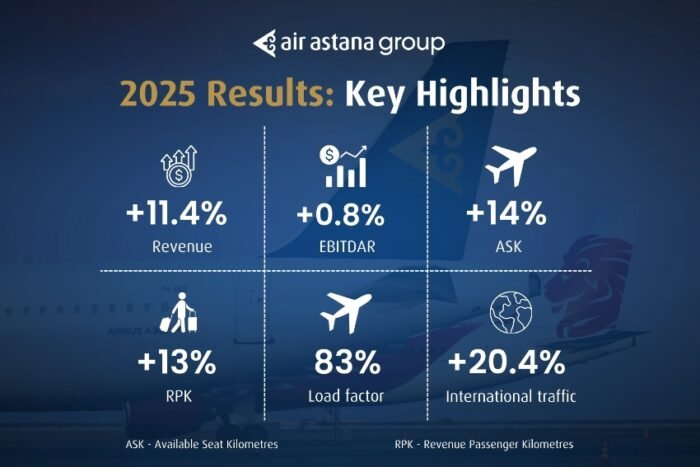
Air Astana announces results for the Q4 and full year ended 31 December 2025

Almaty,16th March 2026: Air Astana JSC, the airline group of Central Asia and the Caucasus regions had announced its results for the fourth quarter and full year ended 31 December 2025. On this occasion, the CEO of the Airline group Peter Foster shared his views on the various aspects of the airlines growth strategy: On 2025 Performance 2025 marks Air Astana Group’s second year as a public company and my 20th year as CEO. Amid industry-wide challenges, the Group has shown resilience with revenue growth of 11.4 per cent [1] to USD1,453.9 million and EBITDAR stability at USD321.2m (+0.8 per cent* increase). Through our continued commitment to dynamically managing capacity allocation, ASKs are up 14.0 per cent to 22.0bn, from 19.3bn in FY24. In Q4 specifically, the Group has seen strong demand with total revenue growth of 15.8 per cent.” Overall Journey More broadly, the Group has made significant progress in a number of areas, as we position both of our brands for long-term success. This includes investment in our fleet (including the largest aircraft order in our history), expansion of our route network (25 new routes), improvements in customer experience and enhanced operational efficiency – a central aspect being advancing our digital capabilities. Our Aviation Technical Centre serves as a primary asset in the resilience of the business, with the in-house MRO expertise being margin protective in the context of our ongoing management of the Pratt & Whitney issue.” Pratt & Whitney prompted Unscheduled Engine Removals are an industry-wide issue. UERs have impacted profitability by limiting our growth opportunities and thereby increasing unit costs, driven primarily by lost capacity, compressing the margin between RASK and CASK across the year. Our mitigation actions, however, have placed us in a strong position to minimise the forward-looking impact. We see the impact from UERs as diminishing over time. We have addressed the RASK challenge with improvements towards the end of Q3 and a particularly visible recovery in Q4 with an increase of 9.8 per cent. That gives us further confidence in our business with focus on CASK. As we start growing and spreading costs over a bigger capacity, we will achieve the margins we aspire to. While concluding his comment, Peter Foster said, ” With this being my final set of results, I would like to end by expressing the huge confidence I have in Air Astana and its leadership. We have a strong, diverse and motivated management team, many of whom I have worked with for my entire tenure. Others have joined very recently and will bring an external perspective to our strategy, such as Gonçalo Pires as our new CFO and Johan Eidhagen as the new FlyArystan President. From April, they will be led by Ibrahim Canliel who is uniquely positioned to drive Air Astana’s next phase of development. Ibrahim was a commercial leader within the group for 15 years before becoming CFO. In his roles he has been integral to much of the success we have enjoyed and as CFO also took responsibility for the entire IPO process. It has been my pleasure to work with him for over two decades and I leave the airline in very effective hands. We are due to take delivery of three new Boeing 787-9 aircraft in the next 15 months with other aircraft deliveries scheduled. We carried almost 10 million passengers, despite external challenges, with international network expansion a key factor in our success. I am enormously proud of what we have achieved together and I look forward to remaining involved in the company as a senior advisor to the Board.” FY 2025 Highlight: Solid revenue and capacity growth with stable EBITDAR performance despite margin pressure. • Total revenue and other income increased 11.4 per cent to USD 1,453.9 million (FY 2024: USD 1,304.9 million). • EBITDAR increased 0.8 per cent to USD 321.2 million (FY 2024: USD 318.7 million). EBITDAR margin 2.3 pp lower to 22.1 per cent (FY 2024: 24.4 per cent). • PAT decreased USD 35.9m to USD 13.6 million (FY 2024: USD 49.4 million). • ASK up 14.0 per cent to 22.0 billion (FY 2024: 19.3 billion). • RPK increased 13.0 per cent to 18.2 billion (FY 2024: 16.1 billion). • RASK-CASK differential reflected margin decrease in a challenging operating environment partially mitigated through dynamic capacity management, fares adjustment and operational efficiency. o RASK decreased 2.3 per cent to USD 6.60¢ (FY 2024: 6.75¢). o CASK increased 1.6 per cent to USD 6.20¢ (FY 2024: 6.10¢). • Group passengers carried increased 7.9 per cent to 9.7 million (FY 2024: 9.0 million) with a stable average load factor of 82.7 per cent (FY 2024: 83.5 per cent). • Group fleet expanded to 62 aircraft. Q4 Highlights Revenue and traffic growth, with earnings impacted by Pratt & Whitney Unscheduled Engine Removals (UER) but RASK growth turning positive in the fourth quarter. • Total revenue and other income increased 15.8 per cent to USD 357.0 million (Q4 2024: USD 308.4 million). • EBITDAR decreased 9.7 per cent  to USD 59.1 million (Q4 2024: USD 65.4 million). EBITDAR margin 4.7pp lower to 16.5 per cent (Q4 2024: 21.2 per cent). • PAT decreased USD 15.3m to USD -17.7 million (Q4 2024: USD -2.4 million). • ASK up 5.5 per cent to 5.0 billion (Q4 2024: 4.7 billion). • RPK increased 5.4 per cent to 4.1 billion (Q4 2024: 3.9 billion). • RASK-CASK differential impacted by Pratt & Whitney UERs, curtailing capacity growth and grounding more of the fleet than planned during Q4. o RASK increased 9.8 per cent to USD 7.18¢ (Q4 2024: 6.54¢) due to the allocation of capacity to higher margin international routes and fare adjustments initiated earlier this year with the full financial effect reflected in Q4. o CASK increased 17.3 per cent to USD 7.23¢ (Q4 2024: 6.16¢) due to lost capacity caused by UERs, with resources geared for peak season and higher engine maintenance costs. • Group passengers carried remain stable at 2.2 million (Q4 2024:

Civil Aviation

Gulf Air extends travel dates for flights via Dammam

Muharraq, Kingdom of Bahrain, 15 March 2026: Gulf Air has announced the extension of its temporary operations via King Fahad International Airport in Dammam (DMM), with flights for commercial booking now available to all passengers for travel until and including the 22nd of March 2026. Amid the temporary closure of Bahrain’s airspace, this initiative reaffirms Gulf Air’s commitment to maintaining connectivity to and from the Kingdom of Bahrain. • Dammam (DMM) – London Heathrow (LHR) – Dammam (DMM) • Dammam (DMM) – Mumbai (BOM) – Dammam (DMM) • Dammam (DMM) – Bangkok (BKK) – Dammam (DMM) To facilitate travel, Gulf Air will assist passengers travelling to and from the Kingdom of Bahrain with the issuance of Saudi transit visas. Alternatively, passengers traveling to Saudi Arabia should hold an eligible visa for entry into Saudi Arabia, arranged independently. Gulf Air will provide transportation between the Kingdom of Bahrain and King Fahad International Airport in Dammam for passengers holding confirmed bookings on these flights. Passengers are advised to ensure they hold a confirmed booking prior to proceeding to Dammam for departure. Flights to and from Bahrain International Airport remain temporarily suspended, and Gulf Air will resume regular scheduled services once the Bahrain Civil Aviation Affairs confirms the safe reopening of the Kingdom’s airspace.

Civil Aviation

SriLankan Airlines enhances Australia connectivity with 14 weekly flights

New Delhi,13th March 2026 SriLankan Airlines is set to increase its weekly service between Colombo and Melbourne to 10 flights, effective from 2 August 2026, with the addition of three more scheduled flights in response to growing demand and evolving market dynamics. The expansion reinforces the airline’s commitment to strengthening its footprint in Australia, recently identified as one of the fastest-growing inbound tourism markets to Sri Lanka, driven by leisure travel and a rising volume of visits by family and friends. The newly added flights will operate every Tuesday, Thursday and Sunday, departing Colombo as UL608 at 14:10 hrs and arriving in Melbourne at 04:30 hrs the following day. The return service, UL609, will depart Melbourne every Wednesday, Friday and Monday at 06:00 hrs, arriving in Colombo at 12:15 hrs the same day, offering convenient onward connections across the airline’s network. The schedule is designed to maximise time spent in Sri Lanka for leisure travellers while enhancing connectivity for passengers travelling onwards to India via Colombo. In addition to the new frequencies, the airline will continue operating its daily service, UL604, departing Colombo at 00:20 hrs and arriving in Melbourne at 14:40 hrs, with the return service UL605 departing Melbourne at 16:10 hrs and arriving in Colombo at 22:25 hrs. These services provide seamless connectivity to key destinations across India and beyond. This addition of flights will provide Sri Lankans with better options when choosing flights between the two countries and enable them to plan their travel more conveniently. The increased frequency will be especially beneficial for the Sri Lankan diaspora living in Australia, providing greater flexibility to visit family and friends while maintaining strong connections with their homeland. Additionally, Sri Lankan students studying in Australia will find these enhanced services advantageous, as the expanded schedule accommodates academic calendars and holiday breaks, making it easier to travel home and return to their studies. Overall, improved connectivity supports both the expatriate community and students by offering more convenient and accessible travel options tailored to their needs.

Civil Aviation

De Havilland Canada provides production update on the Canadair 515 Aircraft

Calgary, Alberta, 11th March 2026: De Havilland Aircraft of Canada Limited (De Havilland Canada) has shared an update on the De Havilland Canadair 515 (DHC-515) currently in production at the Canadian manufacturing facilities. De Havilland Canada is producing 22 aircraft for European customers, including Croatia, Spain, Italy, Greece, Portugal, and France and have recently signed contracts with the Canadian provinces of Manitoba, Ontario, and Alberta. These orders underscore the strong domestic and international demand for the world’s only purpose-built amphibious firefighting aircraft. Production is progressing on the first DHC-515 aircraft, with structures being assembled in our Canadian manufacturing facilities. The cockpit and the hull have been recently joined in our Calgary aerostructure assembly line to form the forward fuselage. In addition, we recently completed the assembly of the first DHC-515 wing box, an impressive 28.6-meter-long structure. De Havilland Canada has also released a new video spotlighting manufacturing and assembly activity across its Canadian facilities. The video offers a behind-the-scenes look at the progress, precision, and dedication driving production forward. From key assembly milestones to the skilled teams powering operations, the footage captures the continued momentum and commitment to excellence across DHC’s Canadian footprint. https://vimeo.com/1167448206

Civil Aviation

SriLankan Airlines Resumes Flights to Riyadh and Dubai

Colombo,09 March 2026: SriLankan Airlines has announced the resumption of daily services to Riyadh tonight and Dubai tomorrow, while continuing to closely monitor the situation in the Middle East and prioritising the safety and wellbeing of its passengers and crew. The following flights are scheduled to operate: Flight Route Scheduled time of departure (local time) UL265 Colombo–Riyadh 18:15 hrs UL266 Riyadh–Colombo 22:35hrs UL231 Colombo–Dubai 12:40 hrs UL232 Dubai–Colombo 17:00hrs

FOREWORD

Dear Readers,

The Asia-Pacific aviation sector is expanding rapidly, driving growth far beyond aircraft numbers into crucial verticals like MRO, training, logistics, and aerospace supply chains. In this edition of Aviation World, we bring you exclusive interviews and features from across these sectors, offering direct industry insights from top global leadership.

Our cover story highlights Shveta Gupta, CEO of Divyanshi Aviation. Under her dynamic leadership, the company has established itself as one of India’s premier aerospace supply chain providers, partnering with leading global manufacturers. Our corporate feature delves into Divyanshi Aviation’s core operations, paired with an exclusive interview where Ms. Gupta candidly shares her professional journey and vision for the company’s future.

This issue also features exclusive conversations with prominent industry leaders, including:

  • Ron Nye, President of Avionics, Acron Aviation
  • Bob Gibbs, Vice President, Defense & Special Missions Sales, Textron Aviation
  • Sudhir S. Rajeshirke, President – Aerospace, Jubilant Enpro
  • Emmanuel Simon, Program Manager and Aerospace Leader, PHINIA
  • Arved von zur Muehlen, Chief Commercial Officer, Saudia Group
  • Simon Azar, Vice President, Civil Aviation, Asia Pacific, CAE

Each leader offers key perspectives on their organization’s strategic initiatives and their growing contributions to the Indian aviation and aerospace ecosystem. Additionally, you will find expert-authored analytical features offering deep dives into current sector trends.

Aviation World continues to expand its global footprint as an official media partner for major domestic and international aviation events. Our editorial team will be participating in several upcoming global forums, and we look forward to connecting with industry peers and exploring new collaborations.

We extend our sincere gratitude to our advertisers and partners whose continued support fuels our endeavor.

Happy Reading!

The Editorial Team

Aviation World

NEWSLETTER

Aviation World Magazine is India’s premier aviation magazine and has been actively supporting the development of the Indian and global civil aviation sector. We started our journey in year 2015 and its been 12 years now and the response and acceptance is really encouraging. Thanks to all our associates and writers who remained with us in our progressive journey.

We have started 2026 on a very positive note and we look forward to increase our footprints to more locations and induct many more new companies in our campaign.. Do write to us at : editor@aviationworld.in

Disclaimer

The contents published in this website are news covering Aviation, Aerospace and Defence sector. The objective is to provide news in informative form to keep our readers updated of the latest development. We also publish content featured in our print publication Aviation World.We try our best to avoid any factual errors or image displayed here but we ensure immediate corrections to any such thing brought to our notice that might have been published inadvertently. All images and contents are sourced from the relevant organisations media team.

Copyright ©2014 – 2026. AVIATION WORLD. All rights reserved.

Scroll to Top